

167
4.7 Isentropic and Polytropic Efficiencies
flow ( M > M th ). The choking mass flow rate is ρ th v th A th . Note that the throat Mach
number is lower than 1 at choking.
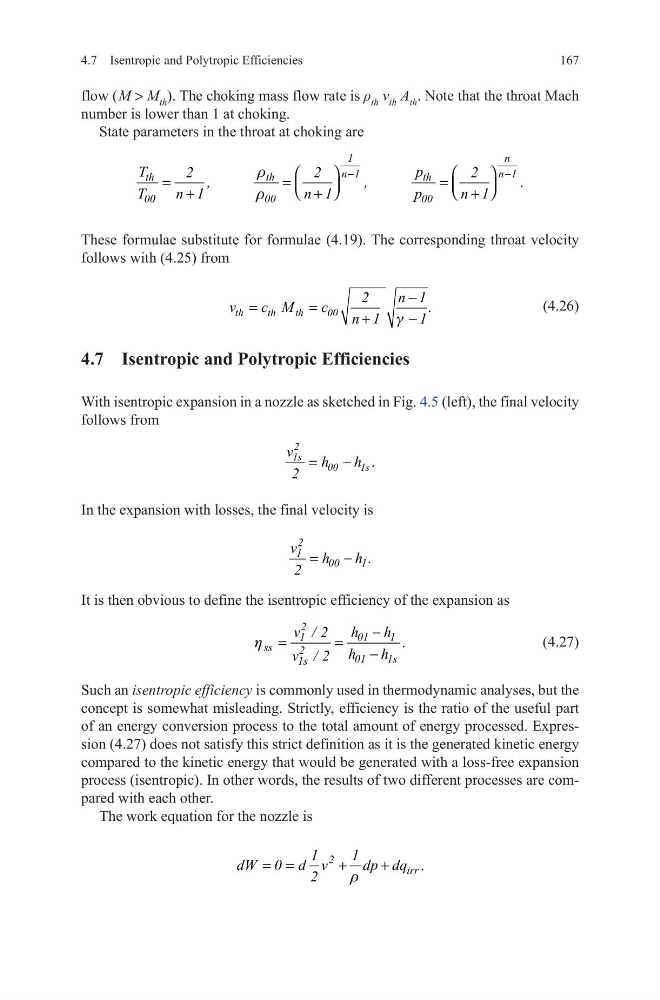
State parameters in the throat at choking are
These formulae substitute for formulae (4.19). The corresponding throat velocity
follows with (4.25) from
(4.26)
4.7 Isentropic and Polytropic Efficiencies
With isentropic expansion in a nozzle as sketched in Fig. 4.5 (left), the final velocity
follows from
In the expansion with losses, the final velocity is
It is then obvious to define the isentropic efficiency of the expansion as
(4.27)
Such an isentropic efficiency is commonly used in thermodynamic analyses, but the
concept is somewhat misleading. Strictly, efficiency is the ratio of the useful part
of an energy conversion process to the total amount of energy processed. Expression (4.27) does not satisfy this strict definition as it is the generated kinetic energy
compared to the kinetic energy that would be generated with a loss-free expansion
process (isentropic). In other words, the results of two different processes are compared with each other.
The work equation for the nozzle is
1
n
n 1
n 1
th
th
th
00
00
00
T
p
2
2
2
,
,
.
T
n 1
n 1
p
n 1
r
r
−
−
=
=
=
+
+
+
.
th
th
th
00
2
n 1
v
c M
c
n 1
1
g
−
=
=
+
−
.
2
1s
00
1s
v
h
h
2
=
−
2
1
00
1
v
h
h .
2
=
−
2
01
1
1
ss
2
01
1s
1s
h
h
v / 2
.
h
h
v / 2
h
−
=
=
−
2
irr
1
1
dW 0 d v
dp dq .
2
r
= =
+
+
4.7 Isentropic and Polytropic Efficiencies
flow ( M > M th ). The choking mass flow rate is ρ th v th A th . Note that the throat Mach
number is lower than 1 at choking.
State parameters in the throat at choking are
These formulae substitute for formulae (4.19). The corresponding throat velocity
follows with (4.25) from
(4.26)
4.7 Isentropic and Polytropic Efficiencies
With isentropic expansion in a nozzle as sketched in Fig. 4.5 (left), the final velocity
follows from
In the expansion with losses, the final velocity is
It is then obvious to define the isentropic efficiency of the expansion as
(4.27)
Such an isentropic efficiency is commonly used in thermodynamic analyses, but the
concept is somewhat misleading. Strictly, efficiency is the ratio of the useful part
of an energy conversion process to the total amount of energy processed. Expression (4.27) does not satisfy this strict definition as it is the generated kinetic energy
compared to the kinetic energy that would be generated with a loss-free expansion
process (isentropic). In other words, the results of two different processes are compared with each other.
The work equation for the nozzle is
1
n
n 1
n 1
th
th
th
00
00
00
T
p
2
2
2
,
,
.
T
n 1
n 1
p
n 1
r
r
−
−
=
=
=
+
+
+
.
th
th
th
00
2
n 1
v
c M
c
n 1
1
g
−
=
=
+
−
.
2
1s
00
1s
v
h
h
2
=
−
2
1
00
1
v
h
h .
2
=
−
2
01
1
1
ss
2
01
1s
1s
h
h
v / 2
.
h
h
v / 2
h
−
=
=
−
2
irr
1
1
dW 0 d v
dp dq .
2
r
= =
+
+