

163
4.6 Nozzle with Losses: Infinitesimal Efficiency
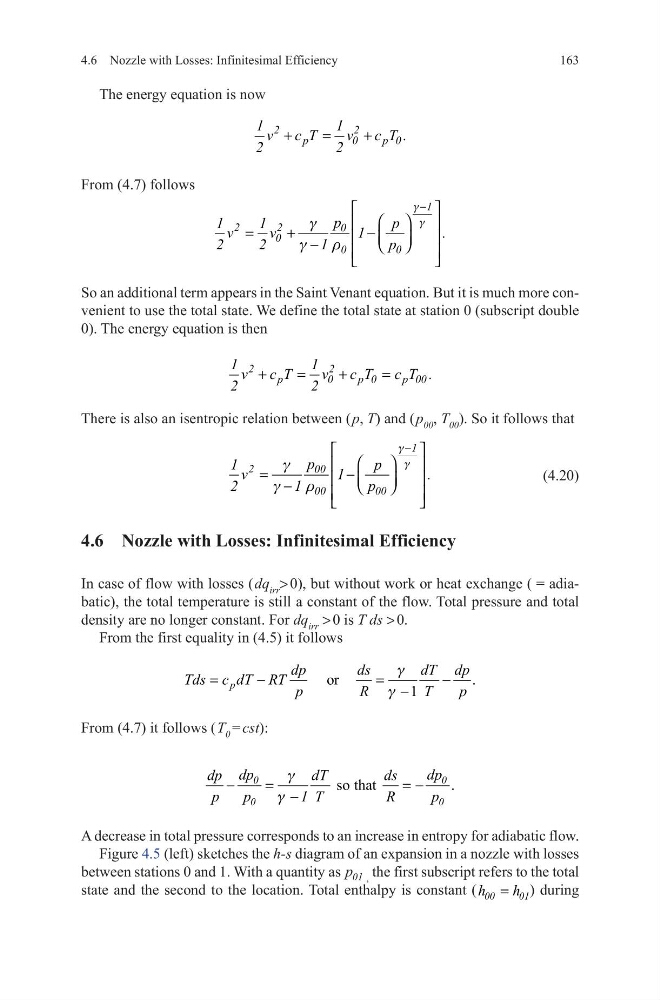
The energy equation is now
From (4.7) follows
So an additional term appears in the Saint Venant equation. But it is much more convenient to use the total state. We define the total state at station 0 (subscript double
0). The energy equation is then
There is also an isentropic relation between ( p, T) and ( p 00 , T 00 ). So it follows that
(4.20)
4.6 Nozzle with Losses: Infinitesimal Efficiency
In case of flow with losses ( dq irr > 0), but without work or heat exchange ( = adiabatic), the total temperature is still a constant of the flow. Total pressure and total
density are no longer constant. For dq irr > 0 is T ds > 0.
From the first equality in (4.5) it follows
From (4.7) it follows ( T 0 = cst):
A decrease in total pressure corresponds to an increase in entropy for adiabatic flow.
Figure 4.5 (left) sketches the h-s diagram of an expansion in a nozzle with losses
between stations 0 and 1. With a quantity as p 01 , the first subscript refers to the total
state and the second to the location. Total enthalpy is constant ( 00
01
h
h
= ) during
2
2
p
0
p 0
1
1
v c T
v c T .
2
2
+
=
+
1
2
2
0
0
0
0
p
1
1
p
v
v
1
.
2
2
1
p
g
g
g
g
r
−
=
+
−
−
2
2
p
0
p 0
p 00
1
1
v c T
v c T c T .
2
2
+
=
+
=
1
2
00
00
00
p
1
p
v
1
.
2
1
p
g
g
g
g
r
−
=
−
−
or
.
1
p
dp
ds
dT dp
Tds c dT RT p
R
T
p
g
g
=
−
=
−
−
so that
.
0
0
0
0
dp
dp
dp
dT
ds
p
p
1 T
R
p
g
g
−
=
= −
−
4.6 Nozzle with Losses: Infinitesimal Efficiency
The energy equation is now
From (4.7) follows
So an additional term appears in the Saint Venant equation. But it is much more convenient to use the total state. We define the total state at station 0 (subscript double
0). The energy equation is then
There is also an isentropic relation between ( p, T) and ( p 00 , T 00 ). So it follows that
(4.20)
4.6 Nozzle with Losses: Infinitesimal Efficiency
In case of flow with losses ( dq irr > 0), but without work or heat exchange ( = adiabatic), the total temperature is still a constant of the flow. Total pressure and total
density are no longer constant. For dq irr > 0 is T ds > 0.
From the first equality in (4.5) it follows
From (4.7) it follows ( T 0 = cst):
A decrease in total pressure corresponds to an increase in entropy for adiabatic flow.
Figure 4.5 (left) sketches the h-s diagram of an expansion in a nozzle with losses
between stations 0 and 1. With a quantity as p 01 , the first subscript refers to the total
state and the second to the location. Total enthalpy is constant ( 00
01
h
h
= ) during
2
2
p
0
p 0
1
1
v c T
v c T .
2
2
+
=
+
1
2
2
0
0
0
0
p
1
1
p
v
v
1
.
2
2
1
p
g
g
g
g
r
−
=
+
−
−
2
2
p
0
p 0
p 00
1
1
v c T
v c T c T .
2
2
+
=
+
=
1
2
00
00
00
p
1
p
v
1
.
2
1
p
g
g
g
g
r
−
=
−
−
or
.
1
p
dp
ds
dT dp
Tds c dT RT p
R
T
p
g
g
=
−
=
−
−
so that
.
0
0
0
0
dp
dp
dp
dT
ds
p
p
1 T
R
p
g
g
−
=
= −
−