

156
4 Compressible Fluids
The total state p 0 , ρ 0 , T 0 is constant within the nozzle and corresponds in Fig. 4.1 to
the state within the first space, with an assumed stagnant fluid there.
With formulae (4.6) and (4.7), it is assumed that the gas, apart from being ideal
( p = ρRT and h only dependent on T), is perfect as well, i.e. that specific heat capacities c p and c v are constant. In a real gas, these coefficients are somewhat temperature-dependent. For example, for a velocity change of v = 0 to v = 300 m/s, the
kinetic energy change is 45 kJ/kg. The corresponding temperature change is about
40 K. The change of c p over such a temperature difference is about 2–4 ‰. So, the
approximation with constant coefficients is very adequate.
For adiabatic reversible flow, the energy equation (4.6) may be written as
With (4.7) it follows that
(4.8)
This equation is termed the Barré de Saint Venant equation. Below (Sect. 4.6), we
derive a similar equation for a flow with losses. The Saint Venant equation is for a
compressible fluid the equivalent of the Bernoulli equation for an incompressible
(constant density) fluid.
4.2 Compressibility and Velocity of Sound
A small pressure perturbation in a compressible fluid propagates. A pressure wave is
generated. The wave velocity is a function of the compressibility and may characterise
it. Small pressure perturbations are called sound. The corresponding velocity is termed
the speed of sound. Pressure waves corresponding to large pressure changes are called
shock waves. Their propagation speed exceeds the speed of sound (see fluid mechanics).
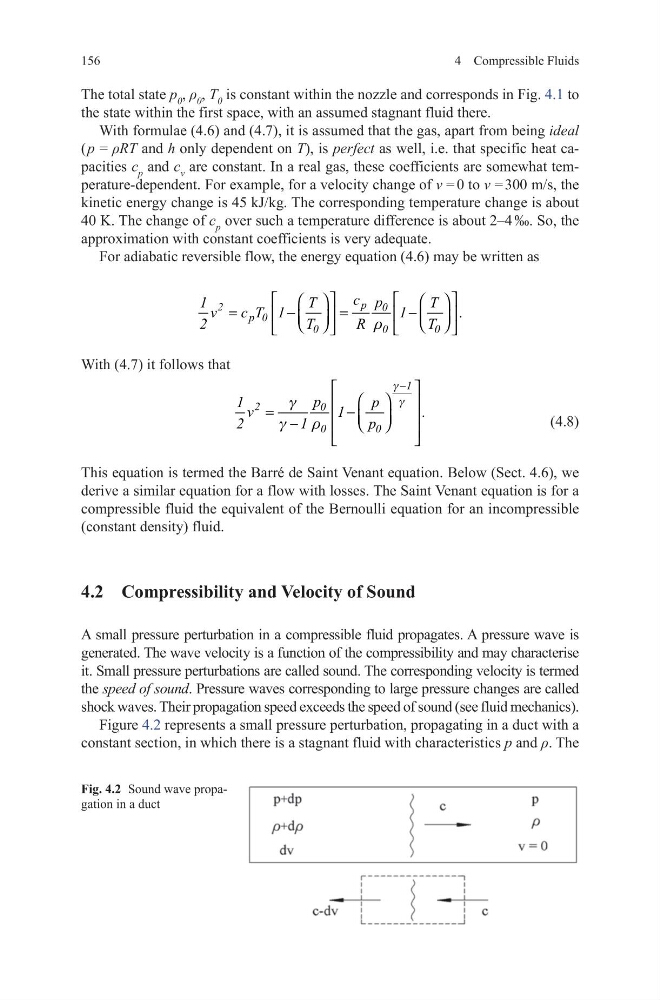
Figure 4.2 represents a small pressure perturbation, propagating in a duct with a
constant section, in which there is a stagnant fluid with characteristics p and ρ. The
p
2
0
p 0
0
0
0
c p
1
T
T
v
c T 1
1
.
2
T
R
T
r
=
−
=
−
1
2
0
0
0
p
1
p
v
1
.
2
1
p
g
g
g
g
r
−
=
−
−
Fig. 4.2 Sound wave propagation in a duct
4 Compressible Fluids
The total state p 0 , ρ 0 , T 0 is constant within the nozzle and corresponds in Fig. 4.1 to
the state within the first space, with an assumed stagnant fluid there.
With formulae (4.6) and (4.7), it is assumed that the gas, apart from being ideal
( p = ρRT and h only dependent on T), is perfect as well, i.e. that specific heat capacities c p and c v are constant. In a real gas, these coefficients are somewhat temperature-dependent. For example, for a velocity change of v = 0 to v = 300 m/s, the
kinetic energy change is 45 kJ/kg. The corresponding temperature change is about
40 K. The change of c p over such a temperature difference is about 2–4 ‰. So, the
approximation with constant coefficients is very adequate.
For adiabatic reversible flow, the energy equation (4.6) may be written as
With (4.7) it follows that
(4.8)
This equation is termed the Barré de Saint Venant equation. Below (Sect. 4.6), we
derive a similar equation for a flow with losses. The Saint Venant equation is for a
compressible fluid the equivalent of the Bernoulli equation for an incompressible
(constant density) fluid.
4.2 Compressibility and Velocity of Sound
A small pressure perturbation in a compressible fluid propagates. A pressure wave is
generated. The wave velocity is a function of the compressibility and may characterise
it. Small pressure perturbations are called sound. The corresponding velocity is termed
the speed of sound. Pressure waves corresponding to large pressure changes are called
shock waves. Their propagation speed exceeds the speed of sound (see fluid mechanics).
Figure 4.2 represents a small pressure perturbation, propagating in a duct with a
constant section, in which there is a stagnant fluid with characteristics p and ρ. The
p
2
0
p 0
0
0
0
c p
1
T
T
v
c T 1
1
.
2
T
R
T
r
=
−
=
−
1
2
0
0
0
p
1
p
v
1
.
2
1
p
g
g
g
g
r
−
=
−
−
Fig. 4.2 Sound wave propagation in a duct