

3.7 Axial and Mixed-Flow Fans
145
The average blade speed increases as well, which increases the rotor work. Such a
machine is, strictly spoken, a mixed-flow machine. As the blade shape remains the
same as that with a purely axial machine, the machine is commonly termed as axial.
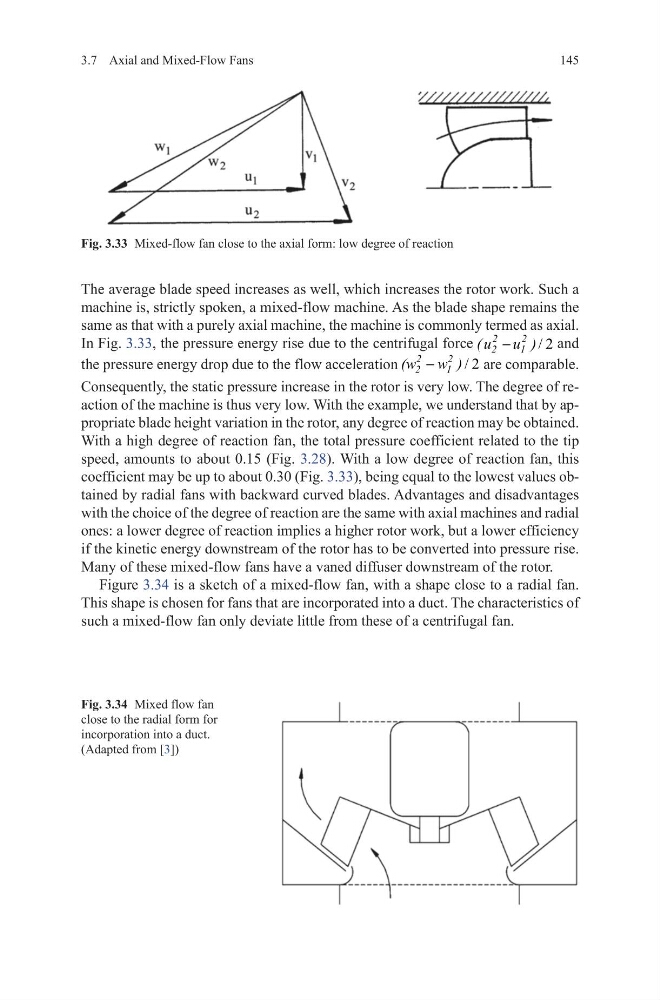
In Fig. 3.33, the pressure energy rise due to the centrifugal force
/ 2
2
2
2
1
( u u )
−
and
the pressure energy drop due to the flow acceleration
/ 2
2
2
2
1
(w w )
−
are comparable.
Consequently, the static pressure increase in the rotor is very low. The degree of reaction of the machine is thus very low. With the example, we understand that by appropriate blade height variation in the rotor, any degree of reaction may be obtained.
With a high degree of reaction fan, the total pressure coefficient related to the tip
speed, amounts to about 0.15 (Fig. 3.28). With a low degree of reaction fan, this
coefficient may be up to about 0.30 (Fig. 3.33), being equal to the lowest values obtained by radial fans with backward curved blades. Advantages and disadvantages
with the choice of the degree of reaction are the same with axial machines and radial
ones: a lower degree of reaction implies a higher rotor work, but a lower efficiency
if the kinetic energy downstream of the rotor has to be converted into pressure rise.
Many of these mixed-flow fans have a vaned diffuser downstream of the rotor.
Figure 3.34 is a sketch of a mixed-flow fan, with a shape close to a radial fan.
This shape is chosen for fans that are incorporated into a duct. The characteristics of
such a mixed-flow fan only deviate little from these of a centrifugal fan.
Fig. 3.33 Mixed-flow fan close to the axial form: low degree of reaction
Fig. 3.34 Mixed flow fan
close to the radial form for
incorporation into a duct.
(Adapted from [3])
145
The average blade speed increases as well, which increases the rotor work. Such a
machine is, strictly spoken, a mixed-flow machine. As the blade shape remains the
same as that with a purely axial machine, the machine is commonly termed as axial.
In Fig. 3.33, the pressure energy rise due to the centrifugal force
/ 2
2
2
2
1
( u u )
−
and
the pressure energy drop due to the flow acceleration
/ 2
2
2
2
1
(w w )
−
are comparable.
Consequently, the static pressure increase in the rotor is very low. The degree of reaction of the machine is thus very low. With the example, we understand that by appropriate blade height variation in the rotor, any degree of reaction may be obtained.
With a high degree of reaction fan, the total pressure coefficient related to the tip
speed, amounts to about 0.15 (Fig. 3.28). With a low degree of reaction fan, this
coefficient may be up to about 0.30 (Fig. 3.33), being equal to the lowest values obtained by radial fans with backward curved blades. Advantages and disadvantages
with the choice of the degree of reaction are the same with axial machines and radial
ones: a lower degree of reaction implies a higher rotor work, but a lower efficiency
if the kinetic energy downstream of the rotor has to be converted into pressure rise.
Many of these mixed-flow fans have a vaned diffuser downstream of the rotor.
Figure 3.34 is a sketch of a mixed-flow fan, with a shape close to a radial fan.
This shape is chosen for fans that are incorporated into a duct. The characteristics of
such a mixed-flow fan only deviate little from these of a centrifugal fan.
Fig. 3.33 Mixed-flow fan close to the axial form: low degree of reaction
Fig. 3.34 Mixed flow fan
close to the radial form for
incorporation into a duct.
(Adapted from [3])