

107
3.3 Radial Fan Analysis for Lossless Two-Dimensional Flow …
one with a lower velocity and a higher pressure ( pressure side). The generation
of suction and pressure sides has been explained in Chap. 1 as a consequence of
the Coriolis force (rotation effect), but influenced by the lift force. Herewith, we
understand that a rotational motion is superimposed onto the translational motion.
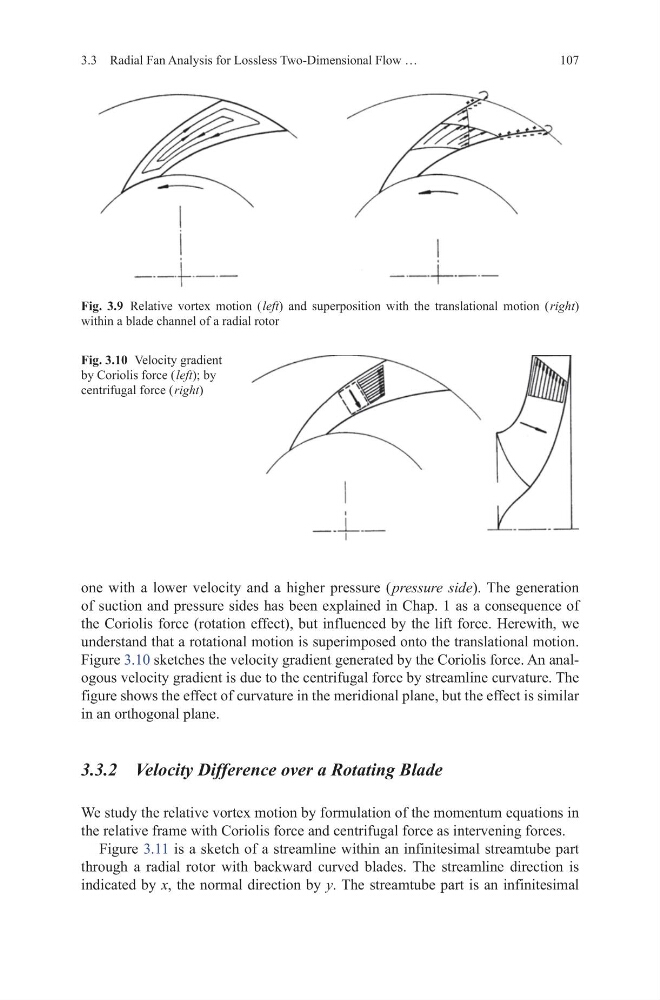
Figure 3.10 sketches the velocity gradient generated by the Coriolis force. An analogous velocity gradient is due to the centrifugal force by streamline curvature. The
figure shows the effect of curvature in the meridional plane, but the effect is similar
in an orthogonal plane.
3.3.2 Velocity Difference over a Rotating Blade
We study the relative vortex motion by formulation of the momentum equations in
the relative frame with Coriolis force and centrifugal force as intervening forces.
Figure 3.11 is a sketch of a streamline within an infinitesimal streamtube part
through a radial rotor with backward curved blades. The streamline direction is
indicated by x, the normal direction by y. The streamtube part is an infinitesimal
Fig. 3.9 Relative vortex motion ( left) and superposition with the translational motion ( right)
within a blade channel of a radial rotor
Fig. 3.10 Velocity gradient
by Coriolis force ( left); by
centrifugal force ( right)
3.3 Radial Fan Analysis for Lossless Two-Dimensional Flow …
one with a lower velocity and a higher pressure ( pressure side). The generation
of suction and pressure sides has been explained in Chap. 1 as a consequence of
the Coriolis force (rotation effect), but influenced by the lift force. Herewith, we
understand that a rotational motion is superimposed onto the translational motion.
Figure 3.10 sketches the velocity gradient generated by the Coriolis force. An analogous velocity gradient is due to the centrifugal force by streamline curvature. The
figure shows the effect of curvature in the meridional plane, but the effect is similar
in an orthogonal plane.
3.3.2 Velocity Difference over a Rotating Blade
We study the relative vortex motion by formulation of the momentum equations in
the relative frame with Coriolis force and centrifugal force as intervening forces.
Figure 3.11 is a sketch of a streamline within an infinitesimal streamtube part
through a radial rotor with backward curved blades. The streamline direction is
indicated by x, the normal direction by y. The streamtube part is an infinitesimal
Fig. 3.9 Relative vortex motion ( left) and superposition with the translational motion ( right)
within a blade channel of a radial rotor
Fig. 3.10 Velocity gradient
by Coriolis force ( left); by
centrifugal force ( right)