

3.2 Idealised Mean Line Analysis of a Radial Fan
101
the discharge sides. The diameter ratio (inner diameter to outer diameter) is very
high, analogous to the radial fan with forward curved blades. Velocity triangles are
sketched in Fig. 3.4. Blades are radial at the inner side. Rotor work is comparable
to that with a fan with forward curved blades. The degree of reaction is very low as
well. The dimensions in the axial direction are nearly unlimited with this fan type,
which makes it appropriate to generate a flow through a slot-shaped area. Applications are mostly generation of cooling air in electric appliances (overhead projector,
copier) or a heated air jet (electric convector, blow-dryer).
3.2 Idealised Mean Line Analysis of a Radial Fan
3.2.1 Idealised Flow Concept: Infinite Number of Blades
A mean line analysis is performed in a plane perpendicular to the rotor shaft, firstly
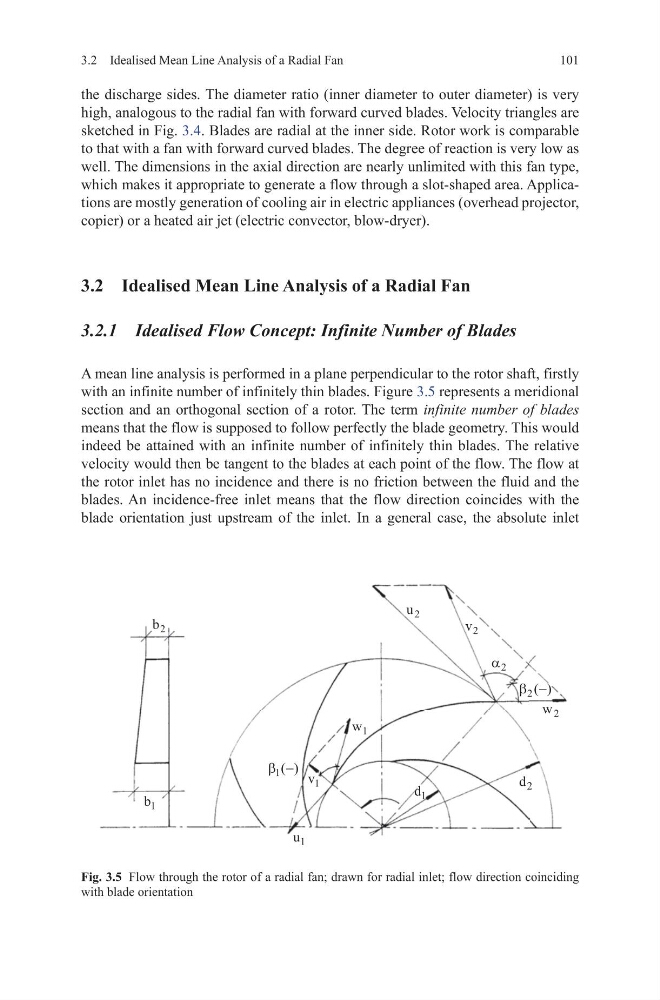
with an infinite number of infinitely thin blades. Figure 3.5 represents a meridional
section and an orthogonal section of a rotor. The term infinite number of blades
means that the flow is supposed to follow perfectly the blade geometry. This would
indeed be attained with an infinite number of infinitely thin blades. The relative
velocity would then be tangent to the blades at each point of the flow. The flow at
the rotor inlet has no incidence and there is no friction between the fluid and the
blades. An incidence-free inlet means that the flow direction coincides with the
blade orientation just upstream of the inlet. In a general case, the absolute inlet
Fig. 3.5 Flow through the rotor of a radial fan; drawn for radial inlet; flow direction coinciding
with blade orientation
101
the discharge sides. The diameter ratio (inner diameter to outer diameter) is very
high, analogous to the radial fan with forward curved blades. Velocity triangles are
sketched in Fig. 3.4. Blades are radial at the inner side. Rotor work is comparable
to that with a fan with forward curved blades. The degree of reaction is very low as
well. The dimensions in the axial direction are nearly unlimited with this fan type,
which makes it appropriate to generate a flow through a slot-shaped area. Applications are mostly generation of cooling air in electric appliances (overhead projector,
copier) or a heated air jet (electric convector, blow-dryer).
3.2 Idealised Mean Line Analysis of a Radial Fan
3.2.1 Idealised Flow Concept: Infinite Number of Blades
A mean line analysis is performed in a plane perpendicular to the rotor shaft, firstly
with an infinite number of infinitely thin blades. Figure 3.5 represents a meridional
section and an orthogonal section of a rotor. The term infinite number of blades
means that the flow is supposed to follow perfectly the blade geometry. This would
indeed be attained with an infinite number of infinitely thin blades. The relative
velocity would then be tangent to the blades at each point of the flow. The flow at
the rotor inlet has no incidence and there is no friction between the fluid and the
blades. An incidence-free inlet means that the flow direction coincides with the
blade orientation just upstream of the inlet. In a general case, the absolute inlet
Fig. 3.5 Flow through the rotor of a radial fan; drawn for radial inlet; flow direction coinciding
with blade orientation