

beads substantially increases the sorption capacity for Pt (II) and Pd (IV) (Wang et al.
2017). In addition to high capacity for metal biosorption, Lopez et al. (2017)
reported that algal cells encapsulated in alginate yielded more nucleic acid than the
free-living cells; hence higher concentration of nucleic acid indicates the more active
cells in alginate algal beads than the free-living cells. Limitations were also observed
in cell entrapment such as poor diffusion of carbon dioxide and oxygen, larger
volume-to-surface ratio of encapsulating materials, etc. However, to overcome these
challenges, researchers (Wang et al. 2017; Mujtaba and Lee 2017) have made
several attempts by introducing new entrapment matrices.
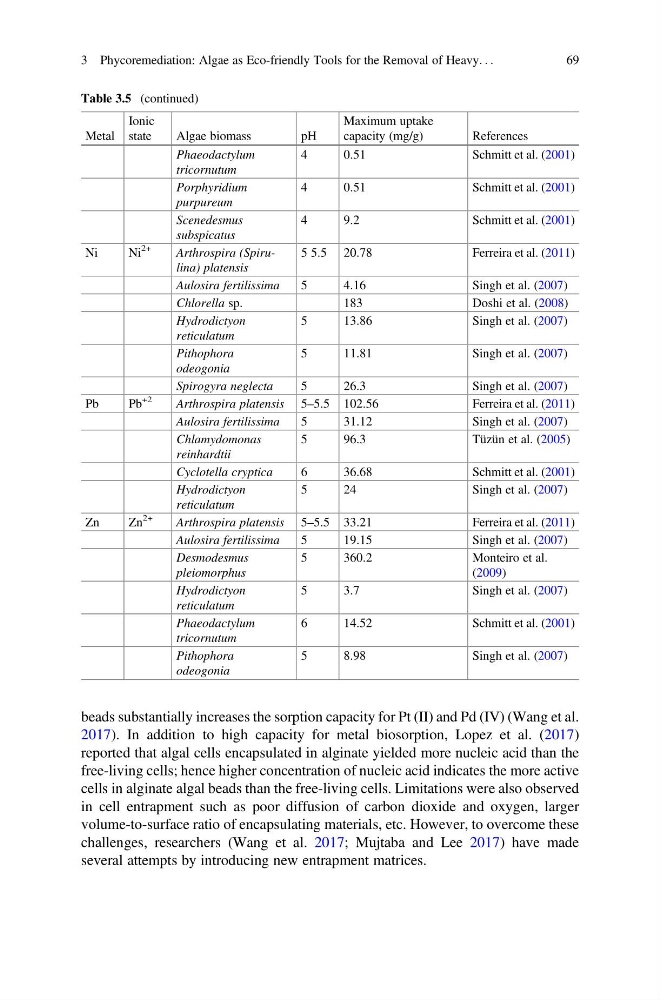
Table 3.5 (continued)
Metal
Ionic
state
Algae biomass
pH
Maximum uptake
capacity (mg/g)
References
Phaeodactylum
tricornutum
4
0.51
Schmitt et al. (2001)
Porphyridium
purpureum
4
0.51
Schmitt et al. (2001)
Scenedesmus
subspicatus
4
9.2
Schmitt et al. (2001)
Ni
Ni
2+
Arthrospira (Spirulina) platensis
5 5.5 20.78
Ferreira et al. (2011)
Aulosira fertilissima
5
4.16
Singh et al. (2007)
Chlorella sp.
183
Doshi et al. (2008)
Hydrodictyon
reticulatum
5
13.86
Singh et al. (2007)
Pithophora
odeogonia
5
11.81
Singh et al. (2007)
Spirogyra neglecta
5
26.3
Singh et al. (2007)
Pb
Pb
+2
Arthrospira platensis 5–5.5 102.56
Ferreira et al. (2011)
Aulosira fertilissima
5
31.12
Singh et al. (2007)
Chlamydomonas
reinhardtii
5
96.3
Tüzün et al. (2005)
Cyclotella cryptica
6
36.68
Schmitt et al. (2001)
Hydrodictyon
reticulatum
5
24
Singh et al. (2007)
Zn
Zn
2+
Arthrospira platensis 5–5.5 33.21
Ferreira et al. (2011)
Aulosira fertilissima
5
19.15
Singh et al. (2007)
Desmodesmus
pleiomorphus
5
360.2
Monteiro et al.
(2009)
Hydrodictyon
reticulatum
5
3.7
Singh et al. (2007)
Phaeodactylum
tricornutum
6
14.52
Schmitt et al. (2001)
Pithophora
odeogonia
5
8.98
Singh et al. (2007)
3 Phycoremediation: Algae as Eco-friendly Tools for the Removal of Heavy. . .
69
2017). In addition to high capacity for metal biosorption, Lopez et al. (2017)
reported that algal cells encapsulated in alginate yielded more nucleic acid than the
free-living cells; hence higher concentration of nucleic acid indicates the more active
cells in alginate algal beads than the free-living cells. Limitations were also observed
in cell entrapment such as poor diffusion of carbon dioxide and oxygen, larger
volume-to-surface ratio of encapsulating materials, etc. However, to overcome these
challenges, researchers (Wang et al. 2017; Mujtaba and Lee 2017) have made
several attempts by introducing new entrapment matrices.
Table 3.5 (continued)
Metal
Ionic
state
Algae biomass
pH
Maximum uptake
capacity (mg/g)
References
Phaeodactylum
tricornutum
4
0.51
Schmitt et al. (2001)
Porphyridium
purpureum
4
0.51
Schmitt et al. (2001)
Scenedesmus
subspicatus
4
9.2
Schmitt et al. (2001)
Ni
Ni
2+
Arthrospira (Spirulina) platensis
5 5.5 20.78
Ferreira et al. (2011)
Aulosira fertilissima
5
4.16
Singh et al. (2007)
Chlorella sp.
183
Doshi et al. (2008)
Hydrodictyon
reticulatum
5
13.86
Singh et al. (2007)
Pithophora
odeogonia
5
11.81
Singh et al. (2007)
Spirogyra neglecta
5
26.3
Singh et al. (2007)
Pb
Pb
+2
Arthrospira platensis 5–5.5 102.56
Ferreira et al. (2011)
Aulosira fertilissima
5
31.12
Singh et al. (2007)
Chlamydomonas
reinhardtii
5
96.3
Tüzün et al. (2005)
Cyclotella cryptica
6
36.68
Schmitt et al. (2001)
Hydrodictyon
reticulatum
5
24
Singh et al. (2007)
Zn
Zn
2+
Arthrospira platensis 5–5.5 33.21
Ferreira et al. (2011)
Aulosira fertilissima
5
19.15
Singh et al. (2007)
Desmodesmus
pleiomorphus
5
360.2
Monteiro et al.
(2009)
Hydrodictyon
reticulatum
5
3.7
Singh et al. (2007)
Phaeodactylum
tricornutum
6
14.52
Schmitt et al. (2001)
Pithophora
odeogonia
5
8.98
Singh et al. (2007)
3 Phycoremediation: Algae as Eco-friendly Tools for the Removal of Heavy. . .
69