

microalgae include rapid capacity of metal uptake, reduced time and energyefficient, eco-friendly, polynomial, recyclable, economical, highly efficient, large
surface/volume (S/V) ratio, high selectivity (which enhances their performance), no
synthesis required, and useful in all types of system (Cristina et al. 2012). Apart from
possessing greater HM ion removal efficiency, microalgae perform easy recovery of
HMs involving a few simple desorption physical and chemical methods. AAB
requires minimum nutrients (nitrogen and phosphorus) and climatic condition,
while PAB does not require nutrients. Moreover, they could also remove HM ion
from wastewater and aqueous solutions too. Microalgae can effectively remove
HMs, and use of transgenic approaches enhances the HM binding efficiency.
Microalgae have the ability to bind polyvalent metal ions; thus they can be effectively applied to treat the wastewater contaminated with polyvalent metallic ion.
With affinities for polyvalent metals helping to establish their potential application in
cleansing of wastewater containing dissolved metallic ions (De-Bashan and Bashan
2010), particularly, Chlorella and Scenedesmus are microalgae of choice for metal
removal. Passive algal biomass has been found to uptake a variety of heavy metals
such as Fe, Co, Cu, Mn, Ni, V, Zn, As, Cd, Mo, Pb, and Se. Brinza et al. (2007)
explored the potential use of PAB of Chlamydomonas reinhardtii, C. sorokiniana,
C. vulgaris, C. miniata, Chlorella salina, Chlorococcum spp., Phaeodactylum
tricornutum, Scenedesmus abundans, S. quadricauda, S. subspicatus, Spirulina
platensis, (Gokhale et al. 2008) and Spirogyra sp. for biosorption of heavy
metal ions.
Microalgal biomass specially produces peptide bond during the photosynthesis
which is capable of binding HM ion and forming organometallic complexes, which
are further reached inside the vacuoles to maintain the cytoplasmic concentration of
HM ion, which neutralizes the toxic effect of the HMs. Most studies of HMs focus
on Cu, followed by Cd, Ni, Pb, Zn, Hg, and Cr by microalgae. The efficiency to
absorb metal was found to be different in macro- and microalgae strains. Metal
uptake capacity in macroalgae is found to be directly related to the extent of alginate,
its availability to provide sorption site, and specific macromolecular conformations.
Despite having similar functional groups in Spirogyra and Cladophora sp., Lee and
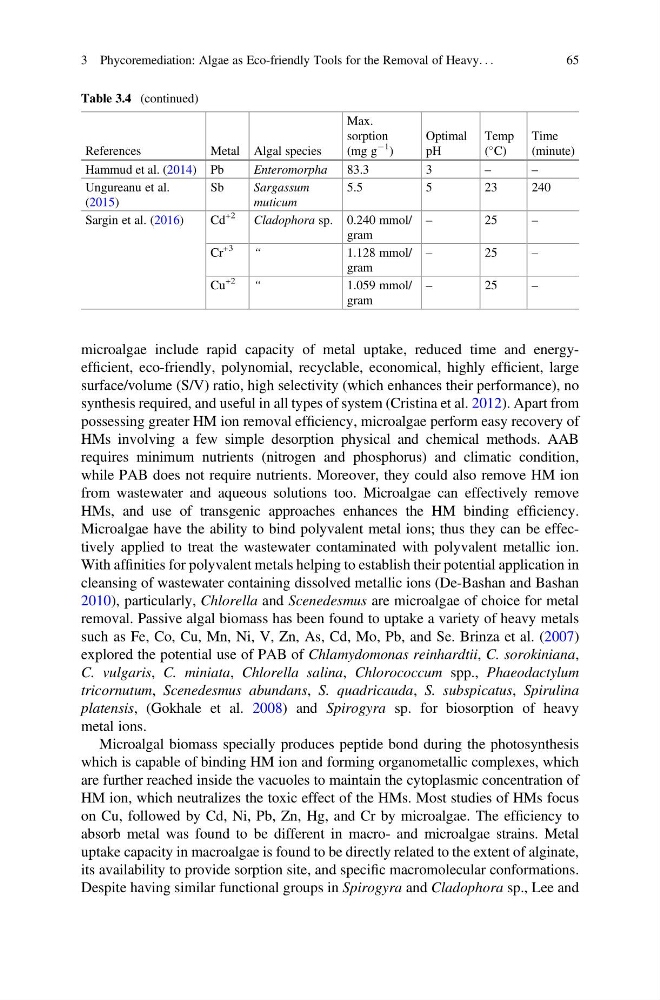
Table 3.4 (continued)
References
Metal Algal species
Max.
sorption
(mg g
À1
)
Optimal
pH
Temp
(
C)
Time
(minute)
Hammud et al. (2014) Pb
Enteromorpha
83.3
3
–
–
Ungureanu et al.
(2015)
Sb
Sargassum
muticum
5.5
5
23
240
Sargin et al. (2016)
Cd
+2
Cladophora sp. 0.240 mmol/
gram
–
25
–
Cr
+3
“
1.128 mmol/
gram
–
25
–
Cu
+2
“
1.059 mmol/
gram
–
25
–
3 Phycoremediation: Algae as Eco-friendly Tools for the Removal of Heavy. . .
65
surface/volume (S/V) ratio, high selectivity (which enhances their performance), no
synthesis required, and useful in all types of system (Cristina et al. 2012). Apart from
possessing greater HM ion removal efficiency, microalgae perform easy recovery of
HMs involving a few simple desorption physical and chemical methods. AAB
requires minimum nutrients (nitrogen and phosphorus) and climatic condition,
while PAB does not require nutrients. Moreover, they could also remove HM ion
from wastewater and aqueous solutions too. Microalgae can effectively remove
HMs, and use of transgenic approaches enhances the HM binding efficiency.
Microalgae have the ability to bind polyvalent metal ions; thus they can be effectively applied to treat the wastewater contaminated with polyvalent metallic ion.
With affinities for polyvalent metals helping to establish their potential application in
cleansing of wastewater containing dissolved metallic ions (De-Bashan and Bashan
2010), particularly, Chlorella and Scenedesmus are microalgae of choice for metal
removal. Passive algal biomass has been found to uptake a variety of heavy metals
such as Fe, Co, Cu, Mn, Ni, V, Zn, As, Cd, Mo, Pb, and Se. Brinza et al. (2007)
explored the potential use of PAB of Chlamydomonas reinhardtii, C. sorokiniana,
C. vulgaris, C. miniata, Chlorella salina, Chlorococcum spp., Phaeodactylum
tricornutum, Scenedesmus abundans, S. quadricauda, S. subspicatus, Spirulina
platensis, (Gokhale et al. 2008) and Spirogyra sp. for biosorption of heavy
metal ions.
Microalgal biomass specially produces peptide bond during the photosynthesis
which is capable of binding HM ion and forming organometallic complexes, which
are further reached inside the vacuoles to maintain the cytoplasmic concentration of
HM ion, which neutralizes the toxic effect of the HMs. Most studies of HMs focus
on Cu, followed by Cd, Ni, Pb, Zn, Hg, and Cr by microalgae. The efficiency to
absorb metal was found to be different in macro- and microalgae strains. Metal
uptake capacity in macroalgae is found to be directly related to the extent of alginate,
its availability to provide sorption site, and specific macromolecular conformations.
Despite having similar functional groups in Spirogyra and Cladophora sp., Lee and
Table 3.4 (continued)
References
Metal Algal species
Max.
sorption
(mg g
À1
)
Optimal
pH
Temp
(
C)
Time
(minute)
Hammud et al. (2014) Pb
Enteromorpha
83.3
3
–
–
Ungureanu et al.
(2015)
Sb
Sargassum
muticum
5.5
5
23
240
Sargin et al. (2016)
Cd
+2
Cladophora sp. 0.240 mmol/
gram
–
25
–
Cr
+3
“
1.128 mmol/
gram
–
25
–
Cu
+2
“
1.059 mmol/
gram
–
25
–
3 Phycoremediation: Algae as Eco-friendly Tools for the Removal of Heavy. . .
65