

algal cells. As a consequence, it decreases in metal uptake. Biosorption is mainly
based on adsorption reaction which is an exothermic process. The extent of adsorption of heavy metals through algae increases with decrease in temperature. It has
been reported that the temperature optimum for S. cerevisiae was 25
C for maximum heavy metal (Ni and Pb) biosorption. Ali et al. (2013) reported that metal
uptake by S. platensis (PAB) increased gradually with increasing temperature, and it
was found that metal (Cu) uptake was maximum (90.61%) at temperature 37
C.
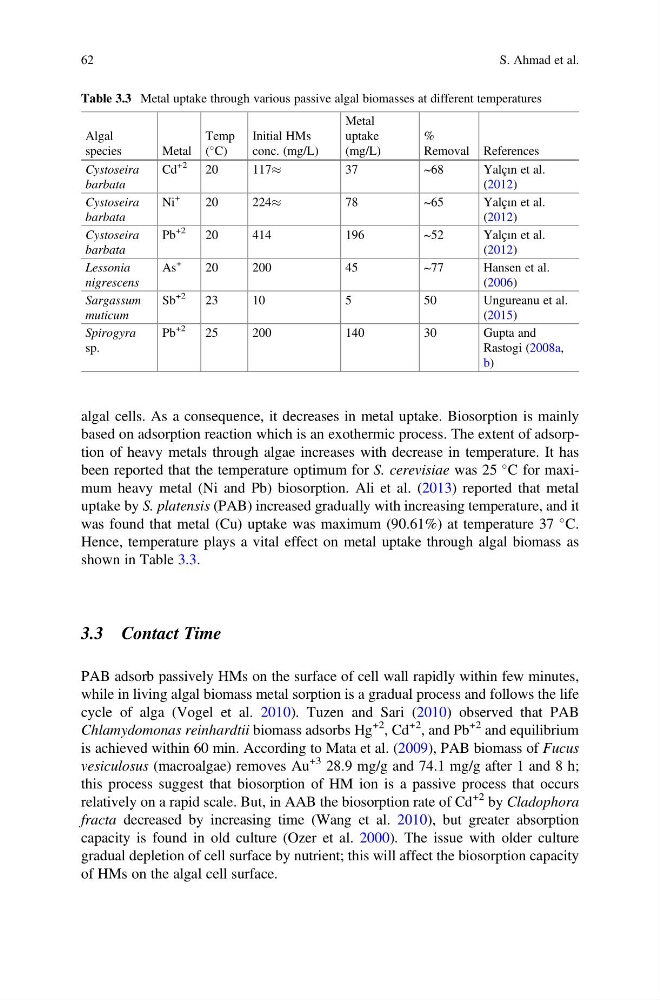
Hence, temperature plays a vital effect on metal uptake through algal biomass as
shown in Table 3.3.
3.3 Contact Time
PAB adsorb passively HMs on the surface of cell wall rapidly within few minutes,
while in living algal biomass metal sorption is a gradual process and follows the life
cycle of alga (Vogel et al. 2010). Tuzen and Sari (2010) observed that PAB
Chlamydomonas reinhardtii biomass adsorbs Hg
+2 , Cd
+2 , and Pb
+2 and equilibrium
is achieved within 60 min. According to Mata et al. (2009), PAB biomass of Fucus
vesiculosus (macroalgae) removes Au
+3 28.9 mg/g and 74.1 mg/g after 1 and 8 h;
this process suggest that biosorption of HM ion is a passive process that occurs
relatively on a rapid scale. But, in AAB the biosorption rate of Cd
+2 by Cladophora
fracta decreased by increasing time (Wang et al. 2010), but greater absorption
capacity is found in old culture (Ozer et al. 2000). The issue with older culture
gradual depletion of cell surface by nutrient; this will affect the biosorption capacity
of HMs on the algal cell surface.
Table 3.3 Metal uptake through various passive algal biomasses at different temperatures
Algal
species
Metal
Temp
(
C)
Initial HMs
conc. (mg/L)
Metal
uptake
(mg/L)
%
Removal References
Cystoseira
barbata
Cd
+2
20
117%
37
~68
Yalçın et al.
(2012)
Cystoseira
barbata
Ni
+
20
224%
78
~65
Yalçın et al.
(2012)
Cystoseira
barbata
Pb
+2
20
414
196
~52
Yalçın et al.
(2012)
Lessonia
nigrescens
As
+
20
200
45
~77
Hansen et al.
(2006)
Sargassum
muticum
Sb
+2
23
10
5
50
Ungureanu et al.
(2015)
Spirogyra
sp.
Pb
+2
25
200
140
30
Gupta and
Rastogi (2008a,
b)
62
S. Ahmad et al.
based on adsorption reaction which is an exothermic process. The extent of adsorption of heavy metals through algae increases with decrease in temperature. It has
been reported that the temperature optimum for S. cerevisiae was 25
C for maximum heavy metal (Ni and Pb) biosorption. Ali et al. (2013) reported that metal
uptake by S. platensis (PAB) increased gradually with increasing temperature, and it
was found that metal (Cu) uptake was maximum (90.61%) at temperature 37
C.
Hence, temperature plays a vital effect on metal uptake through algal biomass as
shown in Table 3.3.
3.3 Contact Time
PAB adsorb passively HMs on the surface of cell wall rapidly within few minutes,
while in living algal biomass metal sorption is a gradual process and follows the life
cycle of alga (Vogel et al. 2010). Tuzen and Sari (2010) observed that PAB
Chlamydomonas reinhardtii biomass adsorbs Hg
+2 , Cd
+2 , and Pb
+2 and equilibrium
is achieved within 60 min. According to Mata et al. (2009), PAB biomass of Fucus
vesiculosus (macroalgae) removes Au
+3 28.9 mg/g and 74.1 mg/g after 1 and 8 h;
this process suggest that biosorption of HM ion is a passive process that occurs
relatively on a rapid scale. But, in AAB the biosorption rate of Cd
+2 by Cladophora
fracta decreased by increasing time (Wang et al. 2010), but greater absorption
capacity is found in old culture (Ozer et al. 2000). The issue with older culture
gradual depletion of cell surface by nutrient; this will affect the biosorption capacity
of HMs on the algal cell surface.
Table 3.3 Metal uptake through various passive algal biomasses at different temperatures
Algal
species
Metal
Temp
(
C)
Initial HMs
conc. (mg/L)
Metal
uptake
(mg/L)
%
Removal References
Cystoseira
barbata
Cd
+2
20
117%
37
~68
Yalçın et al.
(2012)
Cystoseira
barbata
Ni
+
20
224%
78
~65
Yalçın et al.
(2012)
Cystoseira
barbata
Pb
+2
20
414
196
~52
Yalçın et al.
(2012)
Lessonia
nigrescens
As
+
20
200
45
~77
Hansen et al.
(2006)
Sargassum
muticum
Sb
+2
23
10
5
50
Ungureanu et al.
(2015)
Spirogyra
sp.
Pb
+2
25
200
140
30
Gupta and
Rastogi (2008a,
b)
62
S. Ahmad et al.