

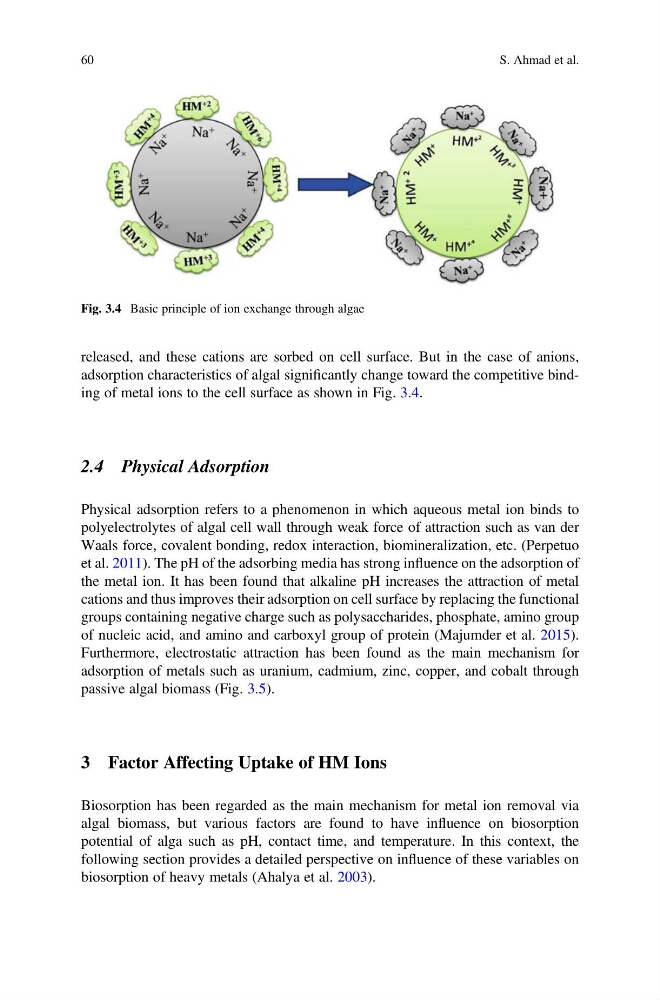
released, and these cations are sorbed on cell surface. But in the case of anions,
adsorption characteristics of algal significantly change toward the competitive binding of metal ions to the cell surface as shown in Fig. 3.4.
2.4 Physical Adsorption
Physical adsorption refers to a phenomenon in which aqueous metal ion binds to
polyelectrolytes of algal cell wall through weak force of attraction such as van der
Waals force, covalent bonding, redox interaction, biomineralization, etc. (Perpetuo
et al. 2011). The pH of the adsorbing media has strong influence on the adsorption of
the metal ion. It has been found that alkaline pH increases the attraction of metal
cations and thus improves their adsorption on cell surface by replacing the functional
groups containing negative charge such as polysaccharides, phosphate, amino group
of nucleic acid, and amino and carboxyl group of protein (Majumder et al. 2015).
Furthermore, electrostatic attraction has been found as the main mechanism for
adsorption of metals such as uranium, cadmium, zinc, copper, and cobalt through
passive algal biomass (Fig. 3.5).
3 Factor Affecting Uptake of HM Ions
Biosorption has been regarded as the main mechanism for metal ion removal via
algal biomass, but various factors are found to have influence on biosorption
potential of alga such as pH, contact time, and temperature. In this context, the
following section provides a detailed perspective on influence of these variables on
biosorption of heavy metals (Ahalya et al. 2003).
Fig. 3.4 Basic principle of ion exchange through algae
60
S. Ahmad et al.
adsorption characteristics of algal significantly change toward the competitive binding of metal ions to the cell surface as shown in Fig. 3.4.
2.4 Physical Adsorption
Physical adsorption refers to a phenomenon in which aqueous metal ion binds to
polyelectrolytes of algal cell wall through weak force of attraction such as van der
Waals force, covalent bonding, redox interaction, biomineralization, etc. (Perpetuo
et al. 2011). The pH of the adsorbing media has strong influence on the adsorption of
the metal ion. It has been found that alkaline pH increases the attraction of metal
cations and thus improves their adsorption on cell surface by replacing the functional
groups containing negative charge such as polysaccharides, phosphate, amino group
of nucleic acid, and amino and carboxyl group of protein (Majumder et al. 2015).
Furthermore, electrostatic attraction has been found as the main mechanism for
adsorption of metals such as uranium, cadmium, zinc, copper, and cobalt through
passive algal biomass (Fig. 3.5).
3 Factor Affecting Uptake of HM Ions
Biosorption has been regarded as the main mechanism for metal ion removal via
algal biomass, but various factors are found to have influence on biosorption
potential of alga such as pH, contact time, and temperature. In this context, the
following section provides a detailed perspective on influence of these variables on
biosorption of heavy metals (Ahalya et al. 2003).
Fig. 3.4 Basic principle of ion exchange through algae
60
S. Ahmad et al.