

7.1 In Situ Bioremediation
In situ biological permeable reactive barriers (BPRBs) have been used mainly for
removal of toxic organic compounds by introducing organisms or by enhancing the
activity of the portion of the indigenous community possessing inherent capability to
degrade recalcitrant organic compounds (Ramsburg et al. 2004; Steffan et al. 1999).
Specific application of BPRB systems for the removal of Cr(VI) in groundwater has
only been attempted lately at pilot level by Jeyasingh et al. (2011). The slow progress
toward full implementation of biological barriers for remediation of Cr(VI) and toxic
metals has been both due to the unavailability of microorganisms capable of growing
under nutrient-stressed conditions and lack of information on the speciation and
mobility of the reduced metal ion species in the soil.
During preliminary investigations in the laboratory at the University of Pretoria,
microorganisms capable of reducing and immobilizing Cr(VI) were isolated from
dried sludge and introduced in columns packed with aquifer media to remove Cr
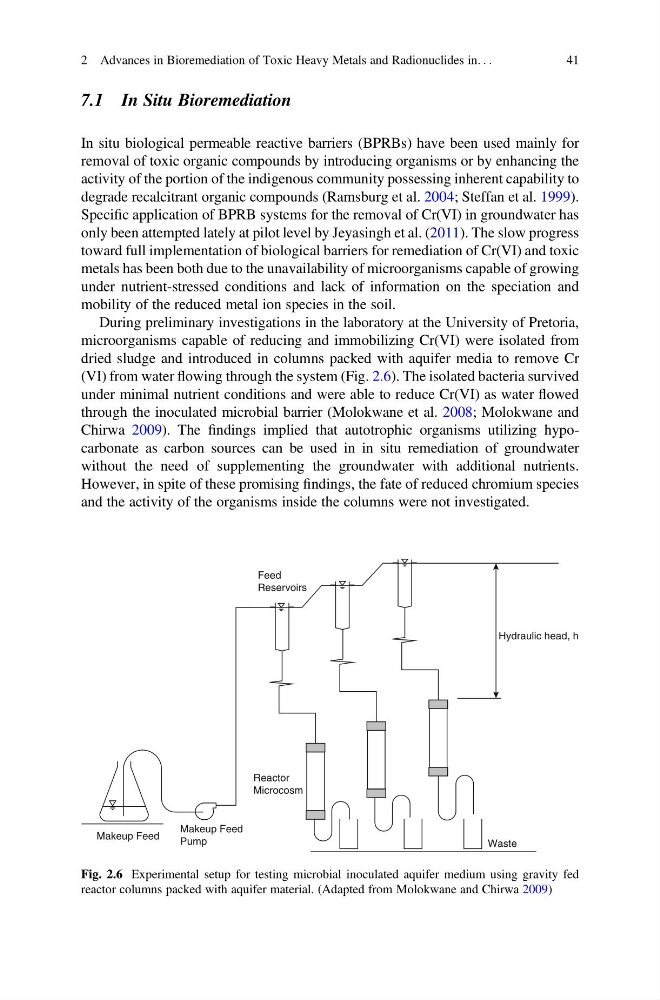
(VI) from water flowing through the system (Fig. 2.6). The isolated bacteria survived
under minimal nutrient conditions and were able to reduce Cr(VI) as water flowed
through the inoculated microbial barrier (Molokwane et al. 2008; Molokwane and
Chirwa 2009). The findings implied that autotrophic organisms utilizing hypocarbonate as carbon sources can be used in in situ remediation of groundwater
without the need of supplementing the groundwater with additional nutrients.
However, in spite of these promising findings, the fate of reduced chromium species
and the activity of the organisms inside the columns were not investigated.
Feed
Reservoirs
Hydraulic head, h
Waste
Reactor
Microcosm
Makeup Feed
Pump
Makeup Feed
Fig. 2.6 Experimental setup for testing microbial inoculated aquifer medium using gravity fed
reactor columns packed with aquifer material. (Adapted from Molokwane and Chirwa 2009)
2 Advances in Bioremediation of Toxic Heavy Metals and Radionuclides in. . .
41
In situ biological permeable reactive barriers (BPRBs) have been used mainly for
removal of toxic organic compounds by introducing organisms or by enhancing the
activity of the portion of the indigenous community possessing inherent capability to
degrade recalcitrant organic compounds (Ramsburg et al. 2004; Steffan et al. 1999).
Specific application of BPRB systems for the removal of Cr(VI) in groundwater has
only been attempted lately at pilot level by Jeyasingh et al. (2011). The slow progress
toward full implementation of biological barriers for remediation of Cr(VI) and toxic
metals has been both due to the unavailability of microorganisms capable of growing
under nutrient-stressed conditions and lack of information on the speciation and
mobility of the reduced metal ion species in the soil.
During preliminary investigations in the laboratory at the University of Pretoria,
microorganisms capable of reducing and immobilizing Cr(VI) were isolated from
dried sludge and introduced in columns packed with aquifer media to remove Cr
(VI) from water flowing through the system (Fig. 2.6). The isolated bacteria survived
under minimal nutrient conditions and were able to reduce Cr(VI) as water flowed
through the inoculated microbial barrier (Molokwane et al. 2008; Molokwane and
Chirwa 2009). The findings implied that autotrophic organisms utilizing hypocarbonate as carbon sources can be used in in situ remediation of groundwater
without the need of supplementing the groundwater with additional nutrients.
However, in spite of these promising findings, the fate of reduced chromium species
and the activity of the organisms inside the columns were not investigated.
Feed
Reservoirs
Hydraulic head, h
Waste
Reactor
Microcosm
Makeup Feed
Pump
Makeup Feed
Fig. 2.6 Experimental setup for testing microbial inoculated aquifer medium using gravity fed
reactor columns packed with aquifer material. (Adapted from Molokwane and Chirwa 2009)
2 Advances in Bioremediation of Toxic Heavy Metals and Radionuclides in. . .
41