

4 Inorganic Pollutants of Distillery Waste
Inorganic compounds may include HMs such as Pb, Zn, Cr, Ni, Cd, Cu, and
inorganic nutrients, viz., Na
+
, NO 3
À , N-NH 4
+
, S 2
À , and PO 4
3À . If the processing
of waste is a cost-prohibitive one, then the distilleries throw the waste into the
environment without any adequate treatment. The concentrations of these HMs in
distillery waste are for above than the permissible limit in the environment as per
USEPA (2002).
5 Bioremediation Approaches of Distillery Waste
Bioremediation is a natural, cost-effective, and sustainable approach to cleaning up
contaminated water, soil, and sediments through the use of naturally occurring
organisms such as fungi, bacteria, or their enzymes (USEPA 2006, 2012a). It is an
attractive waste management technique that offers partial decontamination, maintenance of biological activity, physical structure and microorganism of soils, and site
restoration. Bioremediation is an emerging technology where microorganisms are
grown in the presence of hazardous contaminants to enhance the decomposition
and/or removal of inorganic and organic pollutants. On the basis of transportation
and removal of pollutants from contaminated sites, bioremediation technology can
be grouped into two categories: (i) in situ bioremediation and (ii) ex situ
bioremediation.
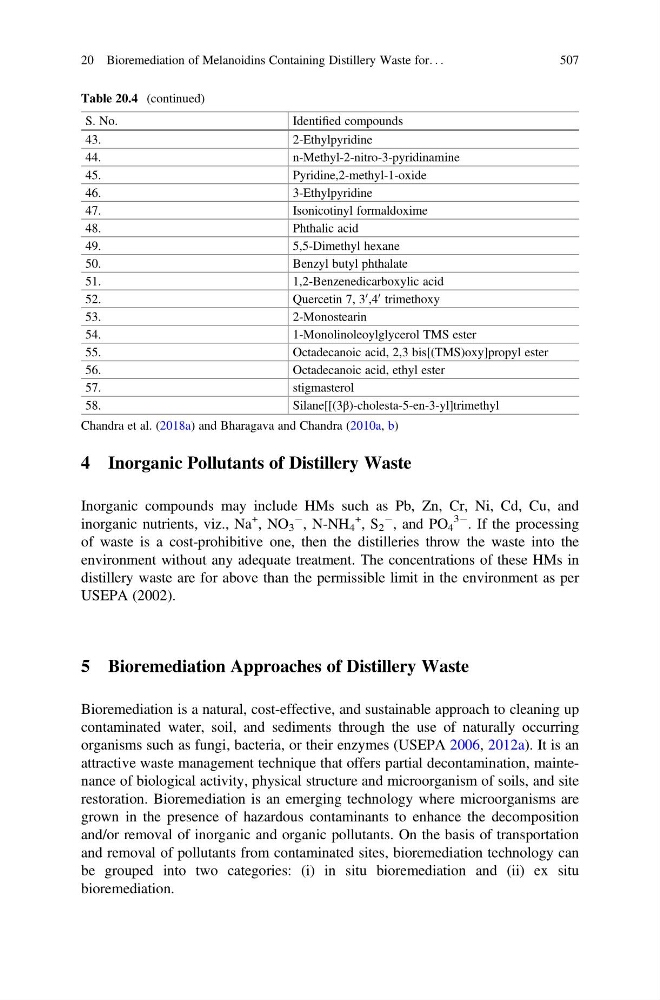
Table 20.4 (continued)
S. No.
Identified compounds
43.
2-Ethylpyridine
44.
n-Methyl-2-nitro-3-pyridinamine
45.
Pyridine,2-methyl-1-oxide
46.
3-Ethylpyridine
47.
Isonicotinyl formaldoxime
48.
Phthalic acid
49.
5,5-Dimethyl hexane
50.
Benzyl butyl phthalate
51.
1,2-Benzenedicarboxylic acid
52.
Quercetin 7, 3
0 ,4
0 trimethoxy
53.
2-Monostearin
54.
1-Monolinoleoylglycerol TMS ester
55.
Octadecanoic acid, 2,3 bis[(TMS)oxy]propyl ester
56.
Octadecanoic acid, ethyl ester
57.
stigmasterol
58.
Silane[[(3β)-cholesta-5-en-3-yl]trimethyl
Chandra et al. (2018a) and Bharagava and Chandra (2010a, b)
20 Bioremediation of Melanoidins Containing Distillery Waste for. . .
507