

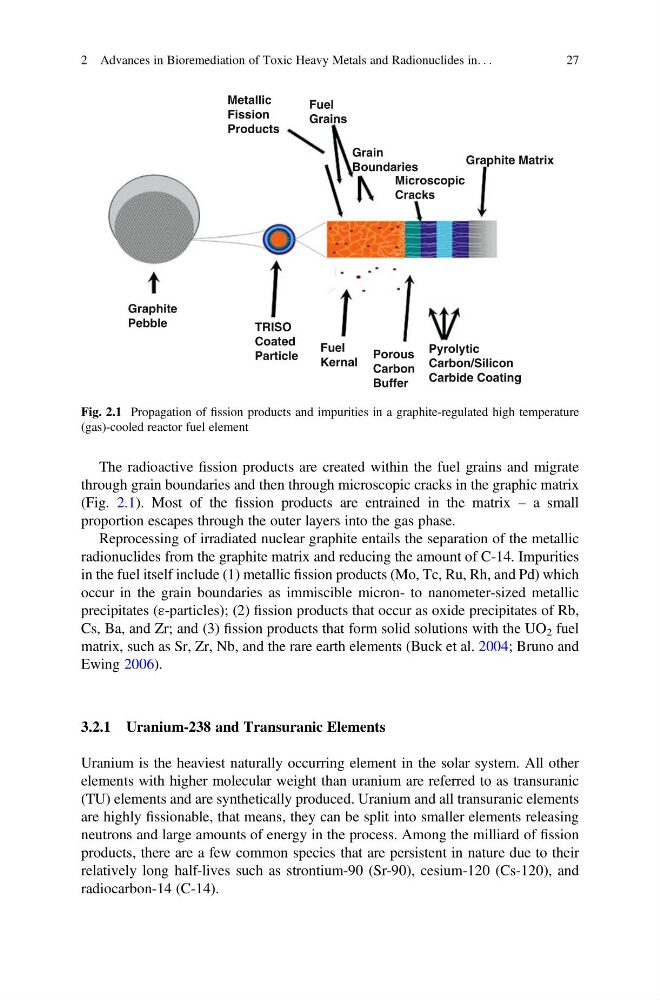
The radioactive fission products are created within the fuel grains and migrate
through grain boundaries and then through microscopic cracks in the graphic matrix
(Fig. 2.1). Most of the fission products are entrained in the matrix – a small
proportion escapes through the outer layers into the gas phase.
Reprocessing of irradiated nuclear graphite entails the separation of the metallic
radionuclides from the graphite matrix and reducing the amount of C-14. Impurities
in the fuel itself include (1) metallic fission products (Mo, Tc, Ru, Rh, and Pd) which
occur in the grain boundaries as immiscible micron- to nanometer-sized metallic
precipitates (ε-particles); (2) fission products that occur as oxide precipitates of Rb,
Cs, Ba, and Zr; and (3) fission products that form solid solutions with the UO 2 fuel
matrix, such as Sr, Zr, Nb, and the rare earth elements (Buck et al. 2004; Bruno and
Ewing 2006).
3.2.1 Uranium-238 and Transuranic Elements
Uranium is the heaviest naturally occurring element in the solar system. All other
elements with higher molecular weight than uranium are referred to as transuranic
(TU) elements and are synthetically produced. Uranium and all transuranic elements
are highly fissionable, that means, they can be split into smaller elements releasing
neutrons and large amounts of energy in the process. Among the milliard of fission
products, there are a few common species that are persistent in nature due to their
relatively long half-lives such as strontium-90 (Sr-90), cesium-120 (Cs-120), and
radiocarbon-14 (C-14).
Metallic
Fission
Products
Fuel
Grains
Grain
Boundaries
Microscopic
Cracks
Graphite Matrix
Graphite
Pebble
TRISO
Coated
Particle
Fuel
Kernal
Porous
Carbon
Buffer
Pyrolytic
Carbon/Silicon
Carbide Coating
Fig. 2.1 Propagation of fission products and impurities in a graphite-regulated high temperature
(gas)-cooled reactor fuel element
2 Advances in Bioremediation of Toxic Heavy Metals and Radionuclides in. . .
27
through grain boundaries and then through microscopic cracks in the graphic matrix
(Fig. 2.1). Most of the fission products are entrained in the matrix – a small
proportion escapes through the outer layers into the gas phase.
Reprocessing of irradiated nuclear graphite entails the separation of the metallic
radionuclides from the graphite matrix and reducing the amount of C-14. Impurities
in the fuel itself include (1) metallic fission products (Mo, Tc, Ru, Rh, and Pd) which
occur in the grain boundaries as immiscible micron- to nanometer-sized metallic
precipitates (ε-particles); (2) fission products that occur as oxide precipitates of Rb,
Cs, Ba, and Zr; and (3) fission products that form solid solutions with the UO 2 fuel
matrix, such as Sr, Zr, Nb, and the rare earth elements (Buck et al. 2004; Bruno and
Ewing 2006).
3.2.1 Uranium-238 and Transuranic Elements
Uranium is the heaviest naturally occurring element in the solar system. All other
elements with higher molecular weight than uranium are referred to as transuranic
(TU) elements and are synthetically produced. Uranium and all transuranic elements
are highly fissionable, that means, they can be split into smaller elements releasing
neutrons and large amounts of energy in the process. Among the milliard of fission
products, there are a few common species that are persistent in nature due to their
relatively long half-lives such as strontium-90 (Sr-90), cesium-120 (Cs-120), and
radiocarbon-14 (C-14).
Metallic
Fission
Products
Fuel
Grains
Grain
Boundaries
Microscopic
Cracks
Graphite Matrix
Graphite
Pebble
TRISO
Coated
Particle
Fuel
Kernal
Porous
Carbon
Buffer
Pyrolytic
Carbon/Silicon
Carbide Coating
Fig. 2.1 Propagation of fission products and impurities in a graphite-regulated high temperature
(gas)-cooled reactor fuel element
2 Advances in Bioremediation of Toxic Heavy Metals and Radionuclides in. . .
27