

dissolved concentration of PAH was measured by using polyoxymethylene (POM)
strips and observed lower concentration in activated carbon-amended contaminated
soils. However, Yu et al. (2009) reported that the sorbing nature of biochar could
reduce the bioavailability of various organic pollutants (pesticides) to plants. Though
this reduction could be only in the bioavailable fraction, organic contaminants
(pesticide) cannot persist for longer time in the presence of biochar or activated
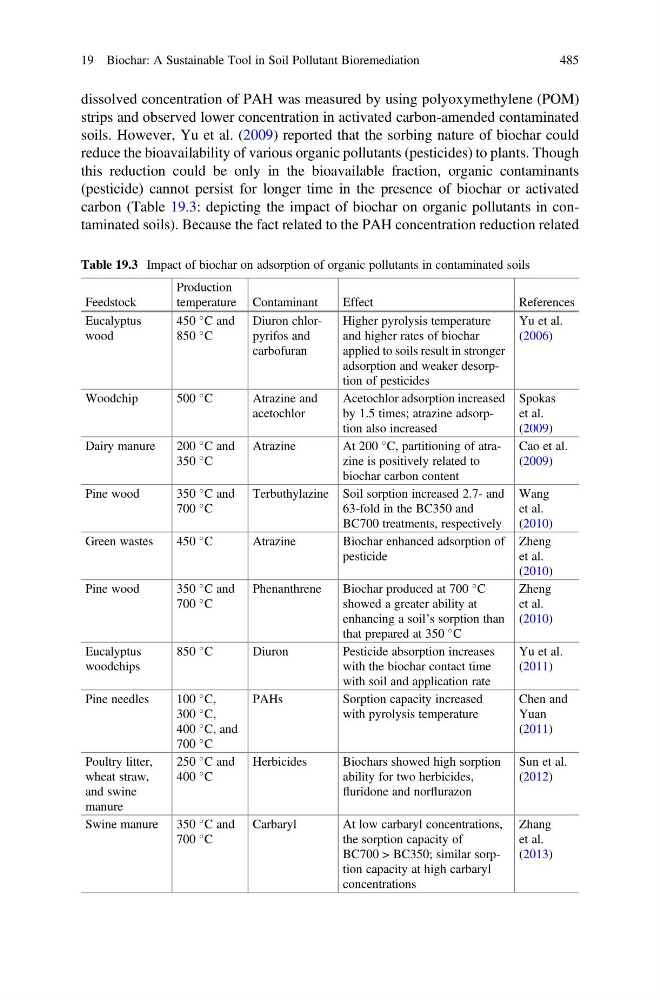
carbon (Table 19.3: depicting the impact of biochar on organic pollutants in contaminated soils). Because the fact related to the PAH concentration reduction related
Table 19.3 Impact of biochar on adsorption of organic pollutants in contaminated soils
Feedstock
Production
temperature Contaminant
Effect
References
Eucalyptus
wood
450
C and
850
C
Diuron chlorpyrifos and
carbofuran
Higher pyrolysis temperature
and higher rates of biochar
applied to soils result in stronger
adsorption and weaker desorption of pesticides
Yu et al.
(2006)
Woodchip
500
C
Atrazine and
acetochlor
Acetochlor adsorption increased
by 1.5 times; atrazine adsorption also increased
Spokas
et al.
(2009)
Dairy manure
200
C and
350
C
Atrazine
At 200
C, partitioning of atrazine is positively related to
biochar carbon content
Cao et al.
(2009)
Pine wood
350
C and
700
C
Terbuthylazine Soil sorption increased 2.7- and
63-fold in the BC350 and
BC700 treatments, respectively
Wang
et al.
(2010)
Green wastes
450
C
Atrazine
Biochar enhanced adsorption of
pesticide
Zheng
et al.
(2010)
Pine wood
350
C and
700
C
Phenanthrene
Biochar produced at 700
C
showed a greater ability at
enhancing a soil’s sorption than
that prepared at 350
C
Zheng
et al.
(2010)
Eucalyptus
woodchips
850
C
Diuron
Pesticide absorption increases
with the biochar contact time
with soil and application rate
Yu et al.
(2011)
Pine needles
100
C,
300
C,
400
C, and
700
C
PAHs
Sorption capacity increased
with pyrolysis temperature
Chen and
Yuan
(2011)
Poultry litter,
wheat straw,
and swine
manure
250
C and
400
C
Herbicides
Biochars showed high sorption
ability for two herbicides,
fluridone and norflurazon
Sun et al.
(2012)
Swine manure 350
C and
700
C
Carbaryl
At low carbaryl concentrations,
the sorption capacity of
BC700 > BC350; similar sorption capacity at high carbaryl
concentrations
Zhang
et al.
(2013)
19 Biochar: A Sustainable Tool in Soil Pollutant Bioremediation
485
strips and observed lower concentration in activated carbon-amended contaminated
soils. However, Yu et al. (2009) reported that the sorbing nature of biochar could
reduce the bioavailability of various organic pollutants (pesticides) to plants. Though
this reduction could be only in the bioavailable fraction, organic contaminants
(pesticide) cannot persist for longer time in the presence of biochar or activated
carbon (Table 19.3: depicting the impact of biochar on organic pollutants in contaminated soils). Because the fact related to the PAH concentration reduction related
Table 19.3 Impact of biochar on adsorption of organic pollutants in contaminated soils
Feedstock
Production
temperature Contaminant
Effect
References
Eucalyptus
wood
450
C and
850
C
Diuron chlorpyrifos and
carbofuran
Higher pyrolysis temperature
and higher rates of biochar
applied to soils result in stronger
adsorption and weaker desorption of pesticides
Yu et al.
(2006)
Woodchip
500
C
Atrazine and
acetochlor
Acetochlor adsorption increased
by 1.5 times; atrazine adsorption also increased
Spokas
et al.
(2009)
Dairy manure
200
C and
350
C
Atrazine
At 200
C, partitioning of atrazine is positively related to
biochar carbon content
Cao et al.
(2009)
Pine wood
350
C and
700
C
Terbuthylazine Soil sorption increased 2.7- and
63-fold in the BC350 and
BC700 treatments, respectively
Wang
et al.
(2010)
Green wastes
450
C
Atrazine
Biochar enhanced adsorption of
pesticide
Zheng
et al.
(2010)
Pine wood
350
C and
700
C
Phenanthrene
Biochar produced at 700
C
showed a greater ability at
enhancing a soil’s sorption than
that prepared at 350
C
Zheng
et al.
(2010)
Eucalyptus
woodchips
850
C
Diuron
Pesticide absorption increases
with the biochar contact time
with soil and application rate
Yu et al.
(2011)
Pine needles
100
C,
300
C,
400
C, and
700
C
PAHs
Sorption capacity increased
with pyrolysis temperature
Chen and
Yuan
(2011)
Poultry litter,
wheat straw,
and swine
manure
250
C and
400
C
Herbicides
Biochars showed high sorption
ability for two herbicides,
fluridone and norflurazon
Sun et al.
(2012)
Swine manure 350
C and
700
C
Carbaryl
At low carbaryl concentrations,
the sorption capacity of
BC700 > BC350; similar sorption capacity at high carbaryl
concentrations
Zhang
et al.
(2013)
19 Biochar: A Sustainable Tool in Soil Pollutant Bioremediation
485