

7 Impact of Biochar on Arsenic Concentration
and Mobility
Biochar can reduce the concentration and mobility of arsenic (As) in amended soil in
comparison with unamended soil. According to the previous study, an orchard
residue-mediated biochar significantly increased As concentrations in pore water
(500–2000 g L
À1 ); however, in root and shoot, As concentrations in tomato (Solanum lycopersicum L.) plants were significantly reduced compared to the control
(without biochar amendments) (Beesley et al. 2013). Moreover, Gregory et al.
(2014) reported that in the increasing dose rates of biochar from willow feedstock
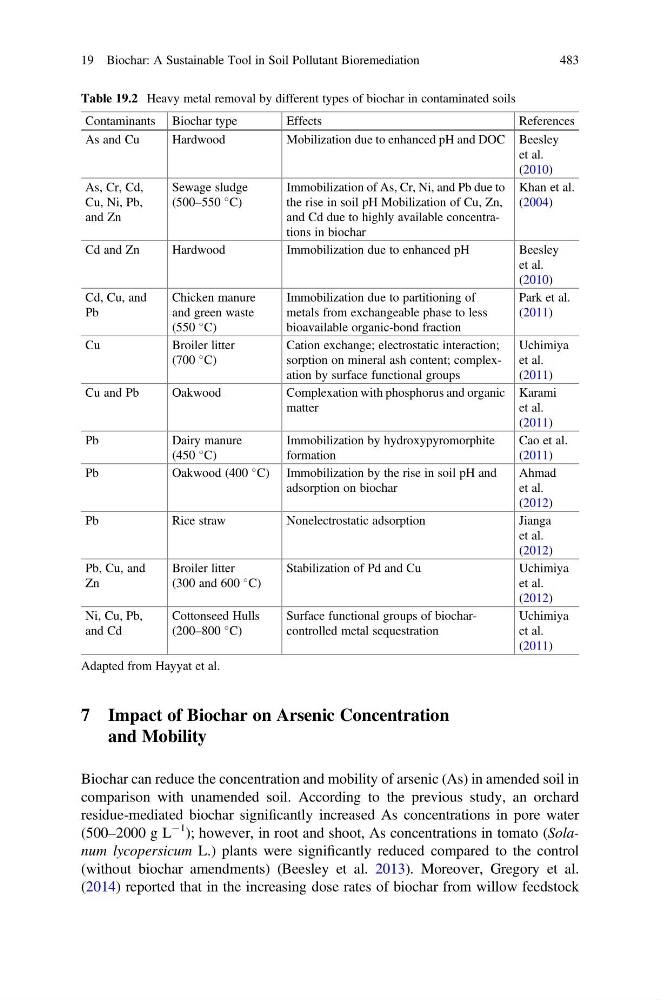
Table 19.2 Heavy metal removal by different types of biochar in contaminated soils
Contaminants Biochar type
Effects
References
As and Cu
Hardwood
Mobilization due to enhanced pH and DOC Beesley
et al.
(2010)
As, Cr, Cd,
Cu, Ni, Pb,
and Zn
Sewage sludge
(500–550
C)
Immobilization of As, Cr, Ni, and Pb due to
the rise in soil pH Mobilization of Cu, Zn,
and Cd due to highly available concentrations in biochar
Khan et al.
(2004)
Cd and Zn
Hardwood
Immobilization due to enhanced pH
Beesley
et al.
(2010)
Cd, Cu, and
Pb
Chicken manure
and green waste
(550
C)
Immobilization due to partitioning of
metals from exchangeable phase to less
bioavailable organic-bond fraction
Park et al.
(2011)
Cu
Broiler litter
(700
C)
Cation exchange; electrostatic interaction;
sorption on mineral ash content; complexation by surface functional groups
Uchimiya
et al.
(2011)
Cu and Pb
Oakwood
Complexation with phosphorus and organic
matter
Karami
et al.
(2011)
Pb
Dairy manure
(450
C)
Immobilization by hydroxypyromorphite
formation
Cao et al.
(2011)
Pb
Oakwood (400
C) Immobilization by the rise in soil pH and
adsorption on biochar
Ahmad
et al.
(2012)
Pb
Rice straw
Nonelectrostatic adsorption
Jianga
et al.
(2012)
Pb, Cu, and
Zn
Broiler litter
(300 and 600
C)
Stabilization of Pd and Cu
Uchimiya
et al.
(2012)
Ni, Cu, Pb,
and Cd
Cottonseed Hulls
(200–800
C)
Surface functional groups of biocharcontrolled metal sequestration
Uchimiya
et al.
(2011)
Adapted from Hayyat et al.
19 Biochar: A Sustainable Tool in Soil Pollutant Bioremediation
483
and Mobility
Biochar can reduce the concentration and mobility of arsenic (As) in amended soil in
comparison with unamended soil. According to the previous study, an orchard
residue-mediated biochar significantly increased As concentrations in pore water
(500–2000 g L
À1 ); however, in root and shoot, As concentrations in tomato (Solanum lycopersicum L.) plants were significantly reduced compared to the control
(without biochar amendments) (Beesley et al. 2013). Moreover, Gregory et al.
(2014) reported that in the increasing dose rates of biochar from willow feedstock
Table 19.2 Heavy metal removal by different types of biochar in contaminated soils
Contaminants Biochar type
Effects
References
As and Cu
Hardwood
Mobilization due to enhanced pH and DOC Beesley
et al.
(2010)
As, Cr, Cd,
Cu, Ni, Pb,
and Zn
Sewage sludge
(500–550
C)
Immobilization of As, Cr, Ni, and Pb due to
the rise in soil pH Mobilization of Cu, Zn,
and Cd due to highly available concentrations in biochar
Khan et al.
(2004)
Cd and Zn
Hardwood
Immobilization due to enhanced pH
Beesley
et al.
(2010)
Cd, Cu, and
Pb
Chicken manure
and green waste
(550
C)
Immobilization due to partitioning of
metals from exchangeable phase to less
bioavailable organic-bond fraction
Park et al.
(2011)
Cu
Broiler litter
(700
C)
Cation exchange; electrostatic interaction;
sorption on mineral ash content; complexation by surface functional groups
Uchimiya
et al.
(2011)
Cu and Pb
Oakwood
Complexation with phosphorus and organic
matter
Karami
et al.
(2011)
Pb
Dairy manure
(450
C)
Immobilization by hydroxypyromorphite
formation
Cao et al.
(2011)
Pb
Oakwood (400
C) Immobilization by the rise in soil pH and
adsorption on biochar
Ahmad
et al.
(2012)
Pb
Rice straw
Nonelectrostatic adsorption
Jianga
et al.
(2012)
Pb, Cu, and
Zn
Broiler litter
(300 and 600
C)
Stabilization of Pd and Cu
Uchimiya
et al.
(2012)
Ni, Cu, Pb,
and Cd
Cottonseed Hulls
(200–800
C)
Surface functional groups of biocharcontrolled metal sequestration
Uchimiya
et al.
(2011)
Adapted from Hayyat et al.
19 Biochar: A Sustainable Tool in Soil Pollutant Bioremediation
483