

5.1 Mole Percentage Guanine + Cytosine (Mol% G + C)
The base composition of DNA was used for taxonomic purposes as mole percentage
guanine + cytosine (mol% G + C). Much diversity in base composition occurs within
bacteria (25–75%) but certain microorganisms have constant GC values. Mol%
G + C can be determined by thermal denaturation of DNA, and it has been reported
that closely connected organisms have fairly similar GC profiles whereas
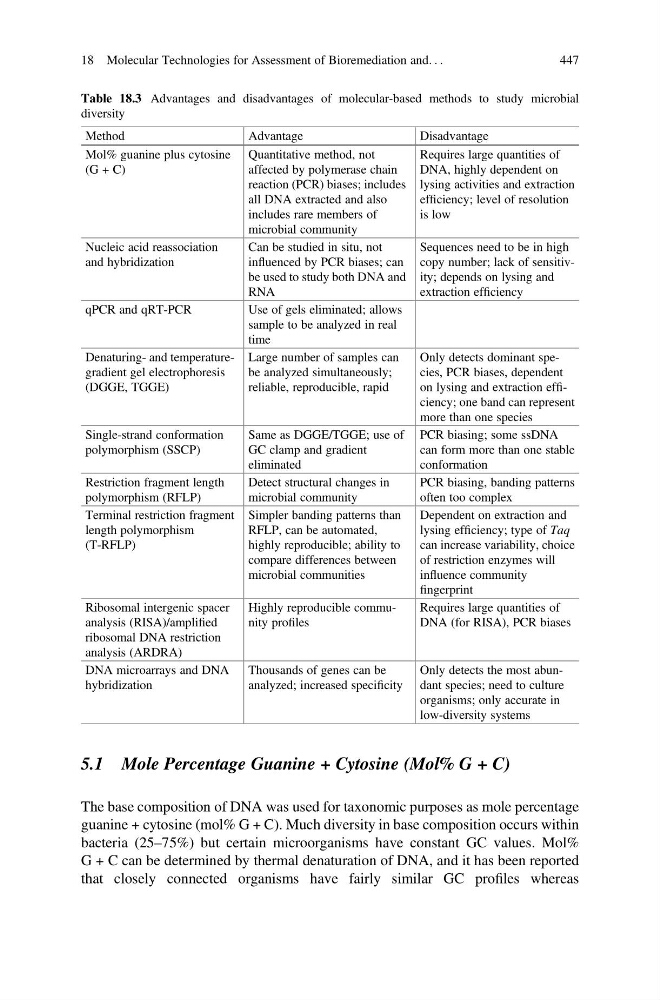
Table 18.3 Advantages and disadvantages of molecular-based methods to study microbial
diversity
Method
Advantage
Disadvantage
Mol% guanine plus cytosine
(G + C)
Quantitative method, not
affected by polymerase chain
reaction (PCR) biases; includes
all DNA extracted and also
includes rare members of
microbial community
Requires large quantities of
DNA, highly dependent on
lysing activities and extraction
efficiency; level of resolution
is low
Nucleic acid reassociation
and hybridization
Can be studied in situ, not
influenced by PCR biases; can
be used to study both DNA and
RNA
Sequences need to be in high
copy number; lack of sensitivity; depends on lysing and
extraction efficiency
qPCR and qRT-PCR
Use of gels eliminated; allows
sample to be analyzed in real
time
Denaturing- and temperaturegradient gel electrophoresis
(DGGE, TGGE)
Large number of samples can
be analyzed simultaneously;
reliable, reproducible, rapid
Only detects dominant species, PCR biases, dependent
on lysing and extraction efficiency; one band can represent
more than one species
Single-strand conformation
polymorphism (SSCP)
Same as DGGE/TGGE; use of
GC clamp and gradient
eliminated
PCR biasing; some ssDNA
can form more than one stable
conformation
Restriction fragment length
polymorphism (RFLP)
Detect structural changes in
microbial community
PCR biasing, banding patterns
often too complex
Terminal restriction fragment
length polymorphism
(T-RFLP)
Simpler banding patterns than
RFLP, can be automated,
highly reproducible; ability to
compare differences between
microbial communities
Dependent on extraction and
lysing efficiency; type of Taq
can increase variability, choice
of restriction enzymes will
influence community
fingerprint
Ribosomal intergenic spacer
analysis (RISA)/amplified
ribosomal DNA restriction
analysis (ARDRA)
Highly reproducible community profiles
Requires large quantities of
DNA (for RISA), PCR biases
DNA microarrays and DNA
hybridization
Thousands of genes can be
analyzed; increased specificity
Only detects the most abundant species; need to culture
organisms; only accurate in
low-diversity systems
18 Molecular Technologies for Assessment of Bioremediation and. . .
447
The base composition of DNA was used for taxonomic purposes as mole percentage
guanine + cytosine (mol% G + C). Much diversity in base composition occurs within
bacteria (25–75%) but certain microorganisms have constant GC values. Mol%
G + C can be determined by thermal denaturation of DNA, and it has been reported
that closely connected organisms have fairly similar GC profiles whereas
Table 18.3 Advantages and disadvantages of molecular-based methods to study microbial
diversity
Method
Advantage
Disadvantage
Mol% guanine plus cytosine
(G + C)
Quantitative method, not
affected by polymerase chain
reaction (PCR) biases; includes
all DNA extracted and also
includes rare members of
microbial community
Requires large quantities of
DNA, highly dependent on
lysing activities and extraction
efficiency; level of resolution
is low
Nucleic acid reassociation
and hybridization
Can be studied in situ, not
influenced by PCR biases; can
be used to study both DNA and
RNA
Sequences need to be in high
copy number; lack of sensitivity; depends on lysing and
extraction efficiency
qPCR and qRT-PCR
Use of gels eliminated; allows
sample to be analyzed in real
time
Denaturing- and temperaturegradient gel electrophoresis
(DGGE, TGGE)
Large number of samples can
be analyzed simultaneously;
reliable, reproducible, rapid
Only detects dominant species, PCR biases, dependent
on lysing and extraction efficiency; one band can represent
more than one species
Single-strand conformation
polymorphism (SSCP)
Same as DGGE/TGGE; use of
GC clamp and gradient
eliminated
PCR biasing; some ssDNA
can form more than one stable
conformation
Restriction fragment length
polymorphism (RFLP)
Detect structural changes in
microbial community
PCR biasing, banding patterns
often too complex
Terminal restriction fragment
length polymorphism
(T-RFLP)
Simpler banding patterns than
RFLP, can be automated,
highly reproducible; ability to
compare differences between
microbial communities
Dependent on extraction and
lysing efficiency; type of Taq
can increase variability, choice
of restriction enzymes will
influence community
fingerprint
Ribosomal intergenic spacer
analysis (RISA)/amplified
ribosomal DNA restriction
analysis (ARDRA)
Highly reproducible community profiles
Requires large quantities of
DNA (for RISA), PCR biases
DNA microarrays and DNA
hybridization
Thousands of genes can be
analyzed; increased specificity
Only detects the most abundant species; need to culture
organisms; only accurate in
low-diversity systems
18 Molecular Technologies for Assessment of Bioremediation and. . .
447