

for molecular microbiology applications in the assessment of microbial diversity and
dynamics in polluted environments to identify the predominant microbial communities or derivative genes for bioremediation.
2 A General Overview of Bioremediation
Bioremediation offers one of the best ways to destroy toxics or render them harmless
using natural biological activity. Bioremediation is important for two reasons:
1. Chemicals are not used: Use of natural microbes and no chemicals is the most
important advantage of bioremediation, because the use of chemicals in the
treatment and removal of toxics can lead to further contamination of the environment. Initially, many chemicals were used for remediation but slowly their
side effects to the environment were observed, which opened the way for use of
microbes in remediation.
2. Option of waste recycling: Bioremediation is also preferred in that once the waste
is neutralized or removed, it can be recycled, whereas in a chemical remediation
some amount of the remaining waste shows incomplete neutralization and thus
cannot enter the recycling process. Some of the advantages and disadvantages of
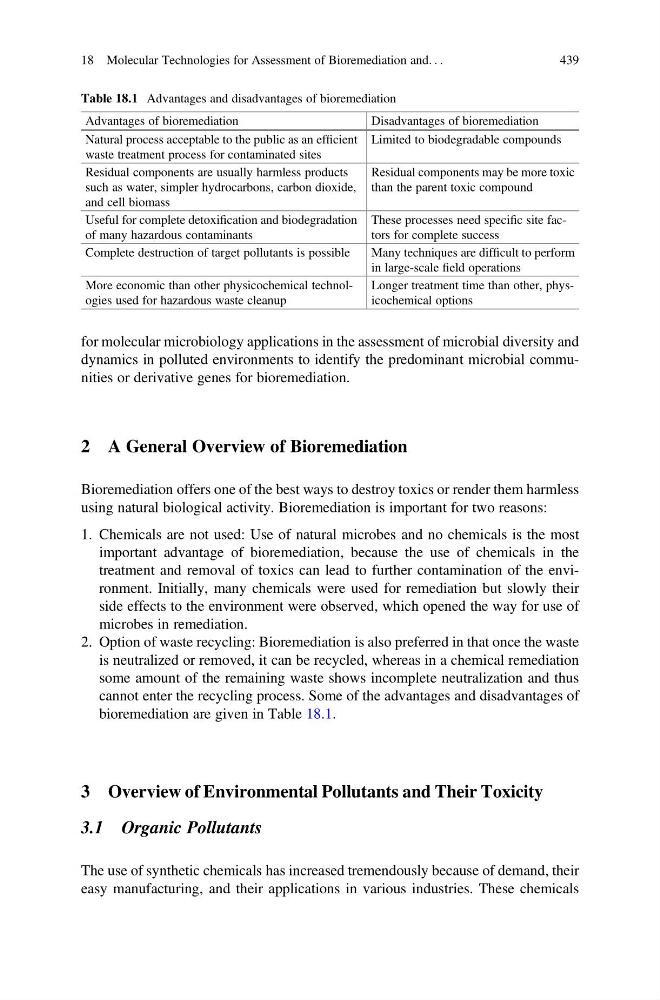
bioremediation are given in Table 18.1.
3 Overview of Environmental Pollutants and Their Toxicity
3.1 Organic Pollutants
The use of synthetic chemicals has increased tremendously because of demand, their
easy manufacturing, and their applications in various industries. These chemicals
Table 18.1 Advantages and disadvantages of bioremediation
Advantages of bioremediation
Disadvantages of bioremediation
Natural process acceptable to the public as an efficient
waste treatment process for contaminated sites
Limited to biodegradable compounds
Residual components are usually harmless products
such as water, simpler hydrocarbons, carbon dioxide,
and cell biomass
Residual components may be more toxic
than the parent toxic compound
Useful for complete detoxification and biodegradation
of many hazardous contaminants
These processes need specific site factors for complete success
Complete destruction of target pollutants is possible
Many techniques are difficult to perform
in large-scale field operations
More economic than other physicochemical technologies used for hazardous waste cleanup
Longer treatment time than other, physicochemical options
18 Molecular Technologies for Assessment of Bioremediation and. . .
439
dynamics in polluted environments to identify the predominant microbial communities or derivative genes for bioremediation.
2 A General Overview of Bioremediation
Bioremediation offers one of the best ways to destroy toxics or render them harmless
using natural biological activity. Bioremediation is important for two reasons:
1. Chemicals are not used: Use of natural microbes and no chemicals is the most
important advantage of bioremediation, because the use of chemicals in the
treatment and removal of toxics can lead to further contamination of the environment. Initially, many chemicals were used for remediation but slowly their
side effects to the environment were observed, which opened the way for use of
microbes in remediation.
2. Option of waste recycling: Bioremediation is also preferred in that once the waste
is neutralized or removed, it can be recycled, whereas in a chemical remediation
some amount of the remaining waste shows incomplete neutralization and thus
cannot enter the recycling process. Some of the advantages and disadvantages of
bioremediation are given in Table 18.1.
3 Overview of Environmental Pollutants and Their Toxicity
3.1 Organic Pollutants
The use of synthetic chemicals has increased tremendously because of demand, their
easy manufacturing, and their applications in various industries. These chemicals
Table 18.1 Advantages and disadvantages of bioremediation
Advantages of bioremediation
Disadvantages of bioremediation
Natural process acceptable to the public as an efficient
waste treatment process for contaminated sites
Limited to biodegradable compounds
Residual components are usually harmless products
such as water, simpler hydrocarbons, carbon dioxide,
and cell biomass
Residual components may be more toxic
than the parent toxic compound
Useful for complete detoxification and biodegradation
of many hazardous contaminants
These processes need specific site factors for complete success
Complete destruction of target pollutants is possible
Many techniques are difficult to perform
in large-scale field operations
More economic than other physicochemical technologies used for hazardous waste cleanup
Longer treatment time than other, physicochemical options
18 Molecular Technologies for Assessment of Bioremediation and. . .
439