

3.2 Biological Remediation
Biological remediation is mainly of two types, i.e., bioremediation and
phytoremediation.
3.2.1 Bioremediation
Bioremediation is the process for removal of environmental contaminants with the
use of biological agents mainly microorganisms (Saxena and Bharagava 2016;
Bharagava et al. 2019). Therefore, it is one of the best management tools for
remediation and recovery of contaminated environment. Most importantly, for the
success of various bioremediation technologies, the nature of contaminated site and
complexity of organisms being used must be strategized prior to treatment process.
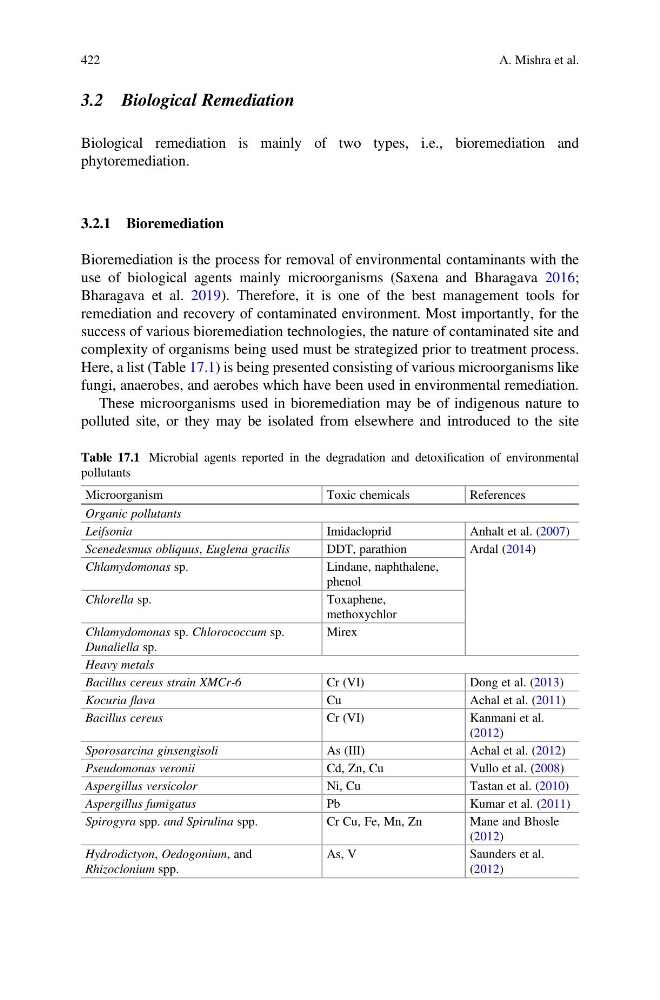
Here, a list (Table 17.1) is being presented consisting of various microorganisms like
fungi, anaerobes, and aerobes which have been used in environmental remediation.
These microorganisms used in bioremediation may be of indigenous nature to
polluted site, or they may be isolated from elsewhere and introduced to the site
Table 17.1 Microbial agents reported in the degradation and detoxification of environmental
pollutants
Microorganism
Toxic chemicals
References
Organic pollutants
Leifsonia
Imidacloprid
Anhalt et al. (2007)
Scenedesmus obliquus, Euglena gracilis
DDT, parathion
Ardal (2014)
Chlamydomonas sp.
Lindane, naphthalene,
phenol
Chlorella sp.
Toxaphene,
methoxychlor
Chlamydomonas sp. Chlorococcum sp.
Dunaliella sp.
Mirex
Heavy metals
Bacillus cereus strain XMCr-6
Cr (VI)
Dong et al. (2013)
Kocuria flava
Cu
Achal et al. (2011)
Bacillus cereus
Cr (VI)
Kanmani et al.
(2012)
Sporosarcina ginsengisoli
As (III)
Achal et al. (2012)
Pseudomonas veronii
Cd, Zn, Cu
Vullo et al. (2008)
Aspergillus versicolor
Ni, Cu
Tastan et al. (2010)
Aspergillus fumigatus
Pb
Kumar et al. (2011)
Spirogyra spp. and Spirulina spp.
Cr Cu, Fe, Mn, Zn
Mane and Bhosle
(2012)
Hydrodictyon, Oedogonium, and
Rhizoclonium spp.
As, V
Saunders et al.
(2012)
422
A. Mishra et al.
Biological remediation is mainly of two types, i.e., bioremediation and
phytoremediation.
3.2.1 Bioremediation
Bioremediation is the process for removal of environmental contaminants with the
use of biological agents mainly microorganisms (Saxena and Bharagava 2016;
Bharagava et al. 2019). Therefore, it is one of the best management tools for
remediation and recovery of contaminated environment. Most importantly, for the
success of various bioremediation technologies, the nature of contaminated site and
complexity of organisms being used must be strategized prior to treatment process.
Here, a list (Table 17.1) is being presented consisting of various microorganisms like
fungi, anaerobes, and aerobes which have been used in environmental remediation.
These microorganisms used in bioremediation may be of indigenous nature to
polluted site, or they may be isolated from elsewhere and introduced to the site
Table 17.1 Microbial agents reported in the degradation and detoxification of environmental
pollutants
Microorganism
Toxic chemicals
References
Organic pollutants
Leifsonia
Imidacloprid
Anhalt et al. (2007)
Scenedesmus obliquus, Euglena gracilis
DDT, parathion
Ardal (2014)
Chlamydomonas sp.
Lindane, naphthalene,
phenol
Chlorella sp.
Toxaphene,
methoxychlor
Chlamydomonas sp. Chlorococcum sp.
Dunaliella sp.
Mirex
Heavy metals
Bacillus cereus strain XMCr-6
Cr (VI)
Dong et al. (2013)
Kocuria flava
Cu
Achal et al. (2011)
Bacillus cereus
Cr (VI)
Kanmani et al.
(2012)
Sporosarcina ginsengisoli
As (III)
Achal et al. (2012)
Pseudomonas veronii
Cd, Zn, Cu
Vullo et al. (2008)
Aspergillus versicolor
Ni, Cu
Tastan et al. (2010)
Aspergillus fumigatus
Pb
Kumar et al. (2011)
Spirogyra spp. and Spirulina spp.
Cr Cu, Fe, Mn, Zn
Mane and Bhosle
(2012)
Hydrodictyon, Oedogonium, and
Rhizoclonium spp.
As, V
Saunders et al.
(2012)
422
A. Mishra et al.