

based on activated sludge process. In activated sludge process (ASP), aeration, and
sedimentation, two steps are used for the treatment of wastewater. During the first
step, wastewater is treated with a high concentration of microorganism and a
powerful aeration, and the retention time can vary between a couple of hours and
up to a day, while in the second step, water and sludge are separated in a sedimentation basin and parts of the sludge are pumped back to the aeration basin. For the
significant reduction in organic compounds/materials, recirculation of sludge facilitates high concentration of microorganism. In comparison to aerated lagoons,
activated sludge system is more susceptible and cannot stand fast load changes.
However, the degree of efficiency can be controlled, and very high BOD reductions
are seen (Thompson et al. 2001; Persson 2011). Although ASP is the most efficient
effluent treatment method, it is insufficient to degrade various components of pulp
and paper mill effluents. The characteristics of the effluents released after these
treatments by some large-scale pulp and paper mills do not conform the discharge
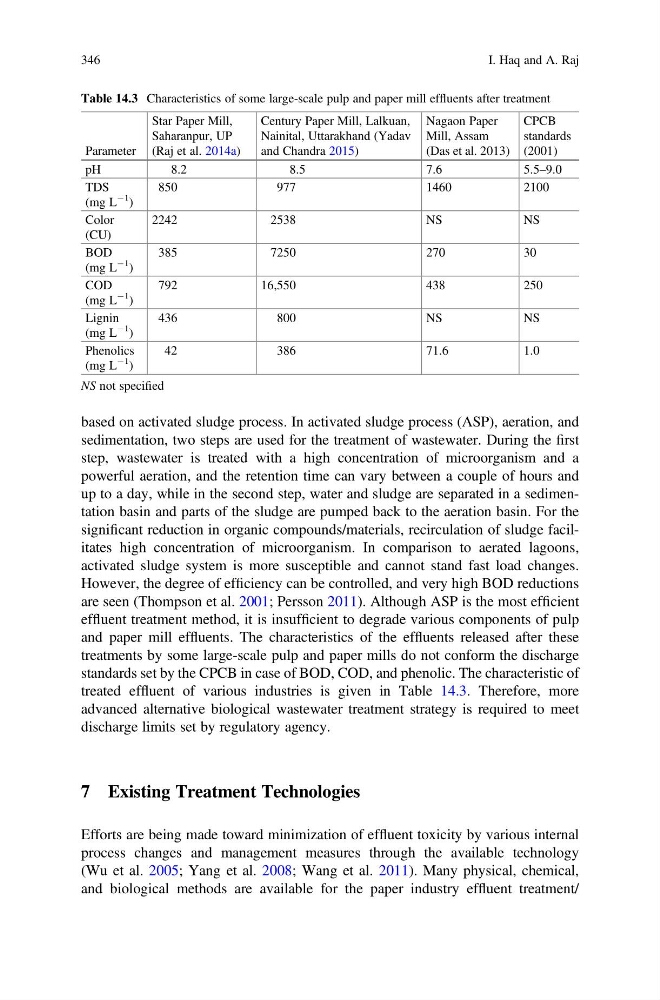
standards set by the CPCB in case of BOD, COD, and phenolic. The characteristic of
treated effluent of various industries is given in Table 14.3. Therefore, more
advanced alternative biological wastewater treatment strategy is required to meet
discharge limits set by regulatory agency.
7 Existing Treatment Technologies
Efforts are being made toward minimization of effluent toxicity by various internal
process changes and management measures through the available technology
(Wu et al. 2005; Yang et al. 2008; Wang et al. 2011). Many physical, chemical,
and biological methods are available for the paper industry effluent treatment/
Table 14.3 Characteristics of some large-scale pulp and paper mill effluents after treatment
Parameter
Star Paper Mill,
Saharanpur, UP
(Raj et al. 2014a)
Century Paper Mill, Lalkuan,
Nainital, Uttarakhand (Yadav
and Chandra 2015)
Nagaon Paper
Mill, Assam
(Das et al. 2013)
CPCB
standards
(2001)
pH
8.2
8.5
7.6
5.5–9.0
TDS
(mg L
À1
)
850
977
1460
2100
Color
(CU)
2242
2538
NS
NS
BOD
(mg L
À1
)
385
7250
270
30
COD
(mg L
À1
)
792
16,550
438
250
Lignin
(mg L
À1
)
436
800
NS
NS
Phenolics
(mg L
À1
)
42
386
71.6
1.0
NS not specified
346
I. Haq and A. Raj
sedimentation, two steps are used for the treatment of wastewater. During the first
step, wastewater is treated with a high concentration of microorganism and a
powerful aeration, and the retention time can vary between a couple of hours and
up to a day, while in the second step, water and sludge are separated in a sedimentation basin and parts of the sludge are pumped back to the aeration basin. For the
significant reduction in organic compounds/materials, recirculation of sludge facilitates high concentration of microorganism. In comparison to aerated lagoons,
activated sludge system is more susceptible and cannot stand fast load changes.
However, the degree of efficiency can be controlled, and very high BOD reductions
are seen (Thompson et al. 2001; Persson 2011). Although ASP is the most efficient
effluent treatment method, it is insufficient to degrade various components of pulp
and paper mill effluents. The characteristics of the effluents released after these
treatments by some large-scale pulp and paper mills do not conform the discharge
standards set by the CPCB in case of BOD, COD, and phenolic. The characteristic of
treated effluent of various industries is given in Table 14.3. Therefore, more
advanced alternative biological wastewater treatment strategy is required to meet
discharge limits set by regulatory agency.
7 Existing Treatment Technologies
Efforts are being made toward minimization of effluent toxicity by various internal
process changes and management measures through the available technology
(Wu et al. 2005; Yang et al. 2008; Wang et al. 2011). Many physical, chemical,
and biological methods are available for the paper industry effluent treatment/
Table 14.3 Characteristics of some large-scale pulp and paper mill effluents after treatment
Parameter
Star Paper Mill,
Saharanpur, UP
(Raj et al. 2014a)
Century Paper Mill, Lalkuan,
Nainital, Uttarakhand (Yadav
and Chandra 2015)
Nagaon Paper
Mill, Assam
(Das et al. 2013)
CPCB
standards
(2001)
pH
8.2
8.5
7.6
5.5–9.0
TDS
(mg L
À1
)
850
977
1460
2100
Color
(CU)
2242
2538
NS
NS
BOD
(mg L
À1
)
385
7250
270
30
COD
(mg L
À1
)
792
16,550
438
250
Lignin
(mg L
À1
)
436
800
NS
NS
Phenolics
(mg L
À1
)
42
386
71.6
1.0
NS not specified
346
I. Haq and A. Raj