

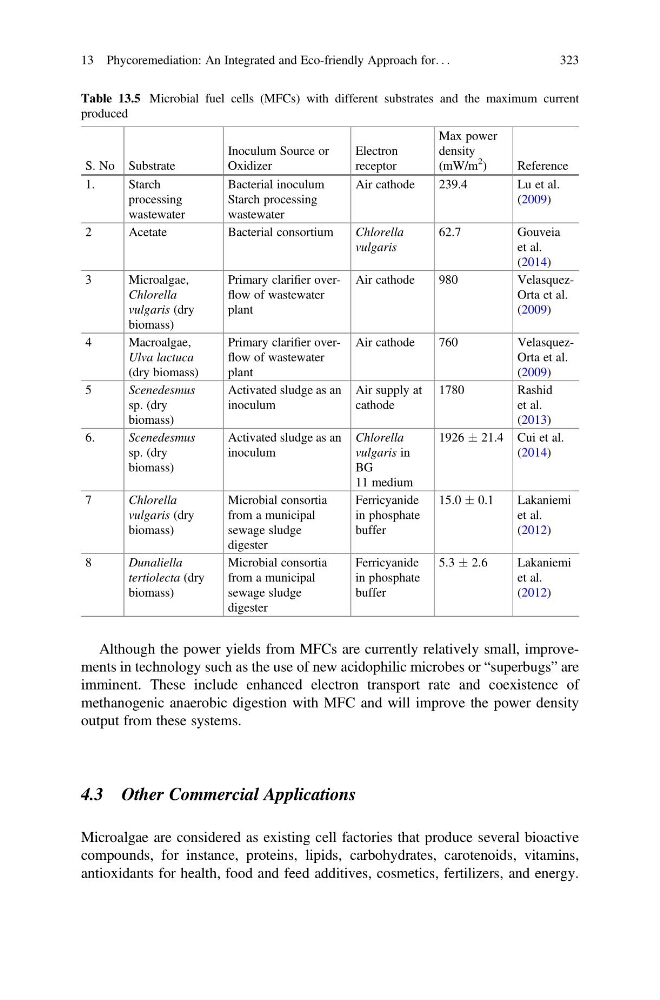
Although the power yields from MFCs are currently relatively small, improvements in technology such as the use of new acidophilic microbes or “superbugs” are
imminent. These include enhanced electron transport rate and coexistence of
methanogenic anaerobic digestion with MFC and will improve the power density
output from these systems.
4.3 Other Commercial Applications
Microalgae are considered as existing cell factories that produce several bioactive
compounds, for instance, proteins, lipids, carbohydrates, carotenoids, vitamins,
antioxidants for health, food and feed additives, cosmetics, fertilizers, and energy.
Table 13.5 Microbial fuel cells (MFCs) with different substrates and the maximum current
produced
S. No Substrate
Inoculum Source or
Oxidizer
Electron
receptor
Max power
density
(mW/m
2
)
Reference
1.
Starch
processing
wastewater
Bacterial inoculum
Starch processing
wastewater
Air cathode
239.4
Lu et al.
(2009)
2
Acetate
Bacterial consortium
Chlorella
vulgaris
62.7
Gouveia
et al.
(2014)
3
Microalgae,
Chlorella
vulgaris (dry
biomass)
Primary clarifier overflow of wastewater
plant
Air cathode
980
VelasquezOrta et al.
(2009)
4
Macroalgae,
Ulva lactuca
(dry biomass)
Primary clarifier overflow of wastewater
plant
Air cathode
760
VelasquezOrta et al.
(2009)
5
Scenedesmus
sp. (dry
biomass)
Activated sludge as an
inoculum
Air supply at
cathode
1780
Rashid
et al.
(2013)
6.
Scenedesmus
sp. (dry
biomass)
Activated sludge as an
inoculum
Chlorella
vulgaris in
BG
11 medium
1926 Æ 21.4 Cui et al.
(2014)
7
Chlorella
vulgaris (dry
biomass)
Microbial consortia
from a municipal
sewage sludge
digester
Ferricyanide
in phosphate
buffer
15.0 Æ 0.1
Lakaniemi
et al.
(2012)
8
Dunaliella
tertiolecta (dry
biomass)
Microbial consortia
from a municipal
sewage sludge
digester
Ferricyanide
in phosphate
buffer
5.3 Æ 2.6
Lakaniemi
et al.
(2012)
13 Phycoremediation: An Integrated and Eco-friendly Approach for. . .
323
imminent. These include enhanced electron transport rate and coexistence of
methanogenic anaerobic digestion with MFC and will improve the power density
output from these systems.
4.3 Other Commercial Applications
Microalgae are considered as existing cell factories that produce several bioactive
compounds, for instance, proteins, lipids, carbohydrates, carotenoids, vitamins,
antioxidants for health, food and feed additives, cosmetics, fertilizers, and energy.
Table 13.5 Microbial fuel cells (MFCs) with different substrates and the maximum current
produced
S. No Substrate
Inoculum Source or
Oxidizer
Electron
receptor
Max power
density
(mW/m
2
)
Reference
1.
Starch
processing
wastewater
Bacterial inoculum
Starch processing
wastewater
Air cathode
239.4
Lu et al.
(2009)
2
Acetate
Bacterial consortium
Chlorella
vulgaris
62.7
Gouveia
et al.
(2014)
3
Microalgae,
Chlorella
vulgaris (dry
biomass)
Primary clarifier overflow of wastewater
plant
Air cathode
980
VelasquezOrta et al.
(2009)
4
Macroalgae,
Ulva lactuca
(dry biomass)
Primary clarifier overflow of wastewater
plant
Air cathode
760
VelasquezOrta et al.
(2009)
5
Scenedesmus
sp. (dry
biomass)
Activated sludge as an
inoculum
Air supply at
cathode
1780
Rashid
et al.
(2013)
6.
Scenedesmus
sp. (dry
biomass)
Activated sludge as an
inoculum
Chlorella
vulgaris in
BG
11 medium
1926 Æ 21.4 Cui et al.
(2014)
7
Chlorella
vulgaris (dry
biomass)
Microbial consortia
from a municipal
sewage sludge
digester
Ferricyanide
in phosphate
buffer
15.0 Æ 0.1
Lakaniemi
et al.
(2012)
8
Dunaliella
tertiolecta (dry
biomass)
Microbial consortia
from a municipal
sewage sludge
digester
Ferricyanide
in phosphate
buffer
5.3 Æ 2.6
Lakaniemi
et al.
(2012)
13 Phycoremediation: An Integrated and Eco-friendly Approach for. . .
323