

(PO 4
3À
), and hydroxide (–OH) (Davis et al. 2003). The main advantage of using
biomass (nonliving or dead) as the adsorbent is, firstly, its energy-/metabolismindependent adsorption process and, secondly, its ability to proceed rapidly through
the combination of the following mechanisms, i.e., complexation, ion exchange, and
physical adsorption (e.g., electrostatic). However, the removal efficiency percentage of
heavy metal and dyes varies according to the biomass source, initial pH, temperature,
metal ion, and dye concentration of the aqueous solution being treated. Examples of
microalgae (biomass) contributing to the treatment of heavy metal- and
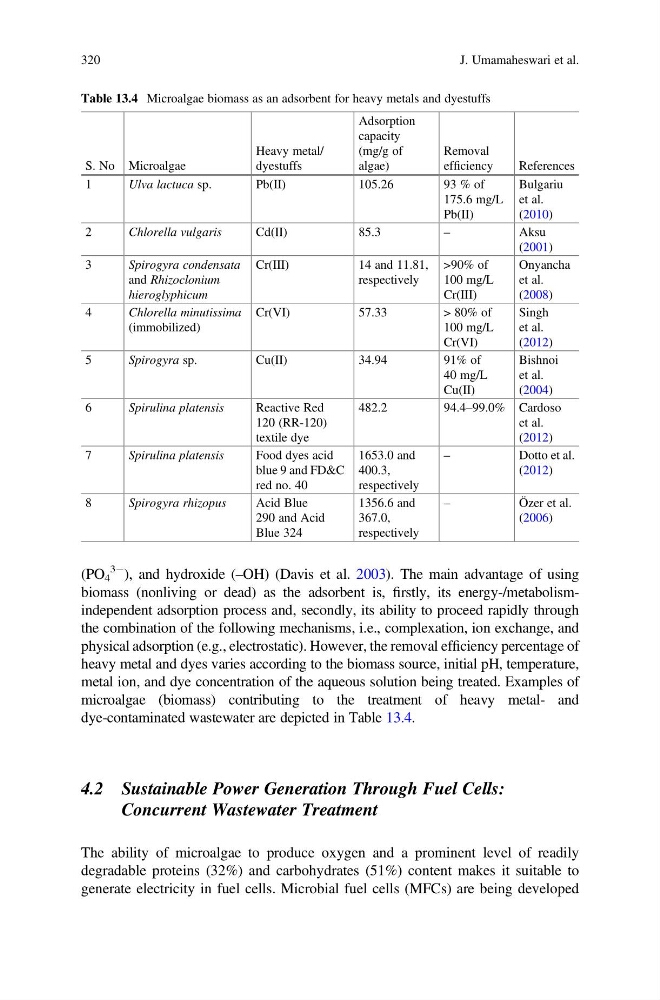
dye-contaminated wastewater are depicted in Table 13.4.
4.2 Sustainable Power Generation Through Fuel Cells:
Concurrent Wastewater Treatment
The ability of microalgae to produce oxygen and a prominent level of readily
degradable proteins (32%) and carbohydrates (51%) content makes it suitable to
generate electricity in fuel cells. Microbial fuel cells (MFCs) are being developed
Table 13.4 Microalgae biomass as an adsorbent for heavy metals and dyestuffs
S. No Microalgae
Heavy metal/
dyestuffs
Adsorption
capacity
(mg/g of
algae)
Removal
efficiency
References
1
Ulva lactuca sp.
Pb(II)
105.26
93 % of
175.6 mg/L
Pb(II)
Bulgariu
et al.
(2010)
2
Chlorella vulgaris
Cd(II)
85.3
–
Aksu
(2001)
3
Spirogyra condensata
and Rhizoclonium
hieroglyphicum
Cr(III)
14 and 11.81,
respectively
>90% of
100 mg/L
Cr(III)
Onyancha
et al.
(2008)
4
Chlorella minutissima
(immobilized)
Cr(VI)
57.33
> 80% of
100 mg/L
Cr(VI)
Singh
et al.
(2012)
5
Spirogyra sp.
Cu(II)
34.94
91% of
40 mg/L
Cu(II)
Bishnoi
et al.
(2004)
6
Spirulina platensis
Reactive Red
120 (RR-120)
textile dye
482.2
94.4–99.0% Cardoso
et al.
(2012)
7
Spirulina platensis
Food dyes acid
blue 9 and FD&C
red no. 40
1653.0 and
400.3,
respectively
–
Dotto et al.
(2012)
8
Spirogyra rhizopus
Acid Blue
290 and Acid
Blue 324
1356.6 and
367.0,
respectively
–
Özer et al.
(2006)
320
J. Umamaheswari et al.
3À
), and hydroxide (–OH) (Davis et al. 2003). The main advantage of using
biomass (nonliving or dead) as the adsorbent is, firstly, its energy-/metabolismindependent adsorption process and, secondly, its ability to proceed rapidly through
the combination of the following mechanisms, i.e., complexation, ion exchange, and
physical adsorption (e.g., electrostatic). However, the removal efficiency percentage of
heavy metal and dyes varies according to the biomass source, initial pH, temperature,
metal ion, and dye concentration of the aqueous solution being treated. Examples of
microalgae (biomass) contributing to the treatment of heavy metal- and
dye-contaminated wastewater are depicted in Table 13.4.
4.2 Sustainable Power Generation Through Fuel Cells:
Concurrent Wastewater Treatment
The ability of microalgae to produce oxygen and a prominent level of readily
degradable proteins (32%) and carbohydrates (51%) content makes it suitable to
generate electricity in fuel cells. Microbial fuel cells (MFCs) are being developed
Table 13.4 Microalgae biomass as an adsorbent for heavy metals and dyestuffs
S. No Microalgae
Heavy metal/
dyestuffs
Adsorption
capacity
(mg/g of
algae)
Removal
efficiency
References
1
Ulva lactuca sp.
Pb(II)
105.26
93 % of
175.6 mg/L
Pb(II)
Bulgariu
et al.
(2010)
2
Chlorella vulgaris
Cd(II)
85.3
–
Aksu
(2001)
3
Spirogyra condensata
and Rhizoclonium
hieroglyphicum
Cr(III)
14 and 11.81,
respectively
>90% of
100 mg/L
Cr(III)
Onyancha
et al.
(2008)
4
Chlorella minutissima
(immobilized)
Cr(VI)
57.33
> 80% of
100 mg/L
Cr(VI)
Singh
et al.
(2012)
5
Spirogyra sp.
Cu(II)
34.94
91% of
40 mg/L
Cu(II)
Bishnoi
et al.
(2004)
6
Spirulina platensis
Reactive Red
120 (RR-120)
textile dye
482.2
94.4–99.0% Cardoso
et al.
(2012)
7
Spirulina platensis
Food dyes acid
blue 9 and FD&C
red no. 40
1653.0 and
400.3,
respectively
–
Dotto et al.
(2012)
8
Spirogyra rhizopus
Acid Blue
290 and Acid
Blue 324
1356.6 and
367.0,
respectively
–
Özer et al.
(2006)
320
J. Umamaheswari et al.