

Pseudomonas putida 06909. Patel et al. (2010) studied that a recombinant bacterial
strain, Caulobacter crescentus JS4022/p723-6H, expressing RsaA-6His fusion protein can remove up to 99.9% of the Cd as compared to control bacterium which can
remove up to 37% of Cd. Arsenic removal from contaminated matrix has been also
studied using recombinant microbes by several workers (Valls and de Lorenzo 2002;
Qin et al. 2006; Yuan et al. 2008). A recombinant bacterium, E. coli (containing
arsM gene from Rhodopseudomonas palustris), can transform highly toxic inorganic
As into less toxic volatile trimethylarsine (Qin et al. 2006; Yuan et al. 2008). Further,
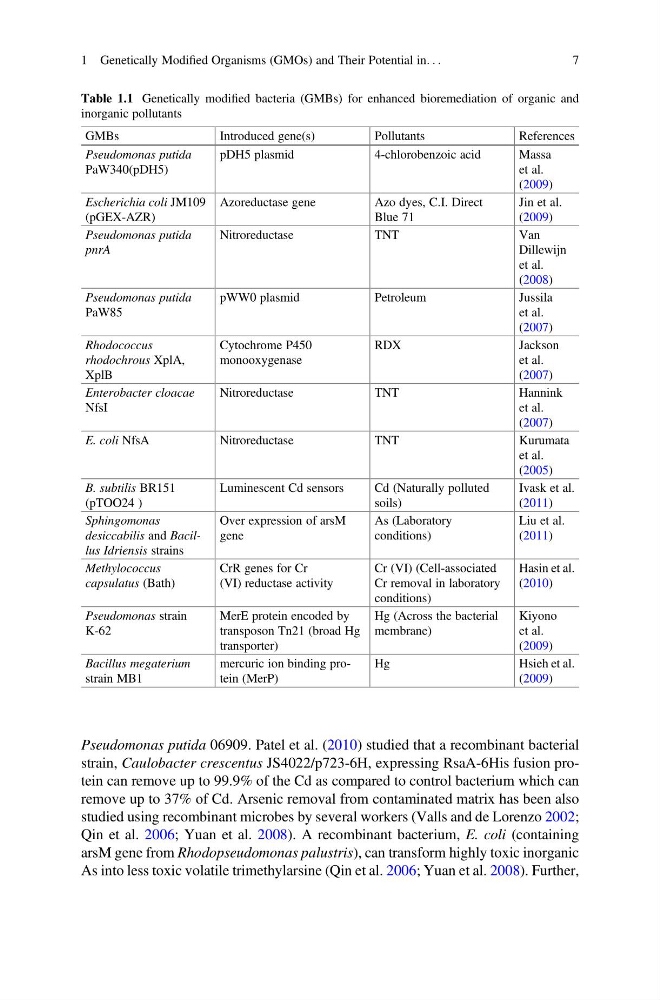
Table 1.1 Genetically modified bacteria (GMBs) for enhanced bioremediation of organic and
inorganic pollutants
GMBs
Introduced gene(s)
Pollutants
References
Pseudomonas putida
PaW340(pDH5)
pDH5 plasmid
4-chlorobenzoic acid
Massa
et al.
(2009)
Escherichia coli JM109
(pGEX-AZR)
Azoreductase gene
Azo dyes, C.I. Direct
Blue 71
Jin et al.
(2009)
Pseudomonas putida
pnrA
Nitroreductase
TNT
Van
Dillewijn
et al.
(2008)
Pseudomonas putida
PaW85
pWW0 plasmid
Petroleum
Jussila
et al.
(2007)
Rhodococcus
rhodochrous XplA,
XplB
Cytochrome P450
monooxygenase
RDX
Jackson
et al.
(2007)
Enterobacter cloacae
NfsI
Nitroreductase
TNT
Hannink
et al.
(2007)
E. coli NfsA
Nitroreductase
TNT
Kurumata
et al.
(2005)
B. subtilis BR151
(pTOO24 )
Luminescent Cd sensors
Cd (Naturally polluted
soils)
Ivask et al.
(2011)
Sphingomonas
desiccabilis and Bacillus Idriensis strains
Over expression of arsM
gene
As (Laboratory
conditions)
Liu et al.
(2011)
Methylococcus
capsulatus (Bath)
CrR genes for Cr
(VI) reductase activity
Cr (VI) (Cell-associated
Cr removal in laboratory
conditions)
Hasin et al.
(2010)
Pseudomonas strain
K-62
MerE protein encoded by
transposon Tn21 (broad Hg
transporter)
Hg (Across the bacterial
membrane)
Kiyono
et al.
(2009)
Bacillus megaterium
strain MB1
mercuric ion binding protein (MerP)
Hg
Hsieh et al.
(2009)
1 Genetically Modified Organisms (GMOs) and Their Potential in. . .
7
strain, Caulobacter crescentus JS4022/p723-6H, expressing RsaA-6His fusion protein can remove up to 99.9% of the Cd as compared to control bacterium which can
remove up to 37% of Cd. Arsenic removal from contaminated matrix has been also
studied using recombinant microbes by several workers (Valls and de Lorenzo 2002;
Qin et al. 2006; Yuan et al. 2008). A recombinant bacterium, E. coli (containing
arsM gene from Rhodopseudomonas palustris), can transform highly toxic inorganic
As into less toxic volatile trimethylarsine (Qin et al. 2006; Yuan et al. 2008). Further,
Table 1.1 Genetically modified bacteria (GMBs) for enhanced bioremediation of organic and
inorganic pollutants
GMBs
Introduced gene(s)
Pollutants
References
Pseudomonas putida
PaW340(pDH5)
pDH5 plasmid
4-chlorobenzoic acid
Massa
et al.
(2009)
Escherichia coli JM109
(pGEX-AZR)
Azoreductase gene
Azo dyes, C.I. Direct
Blue 71
Jin et al.
(2009)
Pseudomonas putida
pnrA
Nitroreductase
TNT
Van
Dillewijn
et al.
(2008)
Pseudomonas putida
PaW85
pWW0 plasmid
Petroleum
Jussila
et al.
(2007)
Rhodococcus
rhodochrous XplA,
XplB
Cytochrome P450
monooxygenase
RDX
Jackson
et al.
(2007)
Enterobacter cloacae
NfsI
Nitroreductase
TNT
Hannink
et al.
(2007)
E. coli NfsA
Nitroreductase
TNT
Kurumata
et al.
(2005)
B. subtilis BR151
(pTOO24 )
Luminescent Cd sensors
Cd (Naturally polluted
soils)
Ivask et al.
(2011)
Sphingomonas
desiccabilis and Bacillus Idriensis strains
Over expression of arsM
gene
As (Laboratory
conditions)
Liu et al.
(2011)
Methylococcus
capsulatus (Bath)
CrR genes for Cr
(VI) reductase activity
Cr (VI) (Cell-associated
Cr removal in laboratory
conditions)
Hasin et al.
(2010)
Pseudomonas strain
K-62
MerE protein encoded by
transposon Tn21 (broad Hg
transporter)
Hg (Across the bacterial
membrane)
Kiyono
et al.
(2009)
Bacillus megaterium
strain MB1
mercuric ion binding protein (MerP)
Hg
Hsieh et al.
(2009)
1 Genetically Modified Organisms (GMOs) and Their Potential in. . .
7