

and S2– to form compounds of slightly soluble carbonates and sulfides, and the
carbonates being less stable than sulfides may be transformed to more stable forms
(ITRC 2003; Sheoran andSheoran 2006). In case of Cu and Mn carbonate, accumulation in a natural wetland sediment Cu forms very insoluble compounds with
sulfion; cupric (CuS) and cuprous (Cu2S) sulfides may be ambushed by complexation with plant litter or organic matters, while Mn may be precipitated as metal
carbonates and sulfides (Dulaing et al. 2006).
6 Phytoremediation Technologies
Phytoremediation is an economically viable integrated technology in which green
plants and their associated rhizospheric microorganisms cause detoxification, degradation, and removal of chemical pollutants from the contaminated site (Saxena
et al. 2019; Saxena and Bharagava 2017; Bharagava et al. 2017b; Chandra et al.
2015). The term phytoremediation is formed from the Greek word “phyto” meaning
“plant” and the Latin word “remedium” meaning “to heal again.” The various plantbased technologies for metal decontamination include stabilization, extraction, volatilization, and rhizofiltration. The efficiency of this treatment process is governed
by various soil and plant factors such physical and chemical properties of soil, plant,
and microbial exudates, plant’s uptake ability, detoxification, metal bioavailability,
sequestration, accumulation, and translocation of metal quantity. The selection
of plants for phytoremediation is a difficult task, and generally native plants are
preferred as they offer less competition among them under certain environmental
conditions, and they should be fast growing, have high biomass, and have the ability
for heavy metal hyperaccumulation, high salt concentration tolerance, and efficient
metal translocation to aerial parts (Vangronsveld et al. 2009; Sharma and Johri
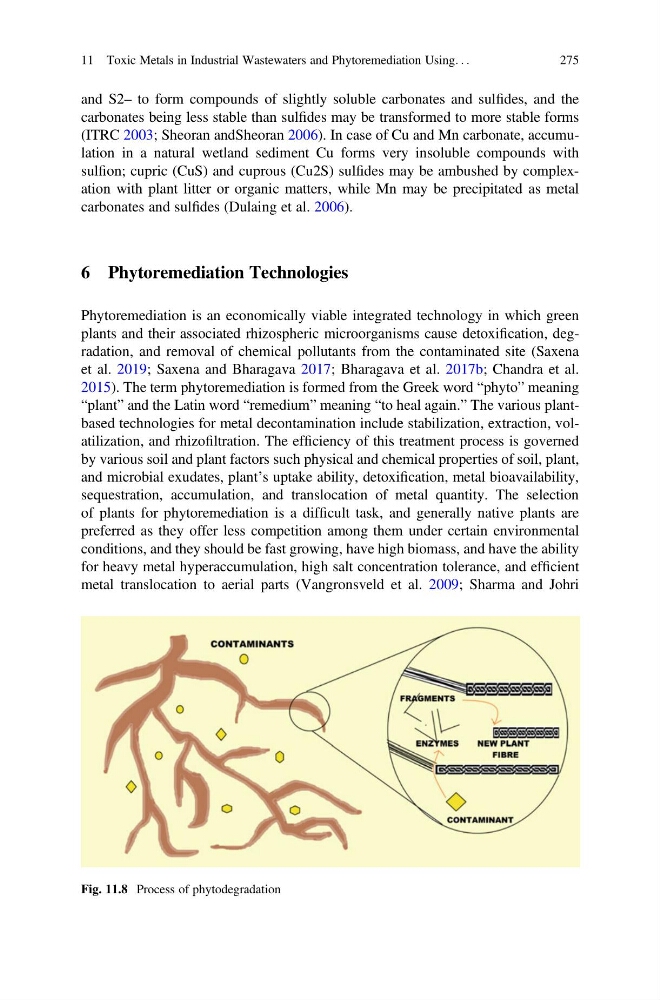
Fig. 11.8 Process of phytodegradation
11 Toxic Metals in Industrial Wastewaters and Phytoremediation Using. . .
275
carbonates being less stable than sulfides may be transformed to more stable forms
(ITRC 2003; Sheoran andSheoran 2006). In case of Cu and Mn carbonate, accumulation in a natural wetland sediment Cu forms very insoluble compounds with
sulfion; cupric (CuS) and cuprous (Cu2S) sulfides may be ambushed by complexation with plant litter or organic matters, while Mn may be precipitated as metal
carbonates and sulfides (Dulaing et al. 2006).
6 Phytoremediation Technologies
Phytoremediation is an economically viable integrated technology in which green
plants and their associated rhizospheric microorganisms cause detoxification, degradation, and removal of chemical pollutants from the contaminated site (Saxena
et al. 2019; Saxena and Bharagava 2017; Bharagava et al. 2017b; Chandra et al.
2015). The term phytoremediation is formed from the Greek word “phyto” meaning
“plant” and the Latin word “remedium” meaning “to heal again.” The various plantbased technologies for metal decontamination include stabilization, extraction, volatilization, and rhizofiltration. The efficiency of this treatment process is governed
by various soil and plant factors such physical and chemical properties of soil, plant,
and microbial exudates, plant’s uptake ability, detoxification, metal bioavailability,
sequestration, accumulation, and translocation of metal quantity. The selection
of plants for phytoremediation is a difficult task, and generally native plants are
preferred as they offer less competition among them under certain environmental
conditions, and they should be fast growing, have high biomass, and have the ability
for heavy metal hyperaccumulation, high salt concentration tolerance, and efficient
metal translocation to aerial parts (Vangronsveld et al. 2009; Sharma and Johri
Fig. 11.8 Process of phytodegradation
11 Toxic Metals in Industrial Wastewaters and Phytoremediation Using. . .
275