

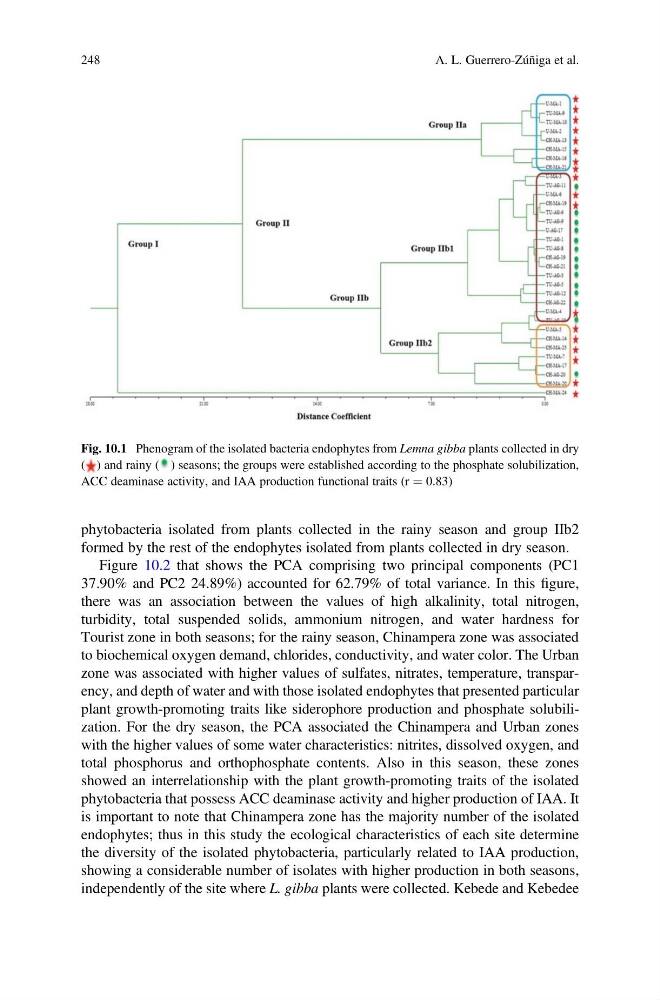
phytobacteria isolated from plants collected in the rainy season and group IIb2
formed by the rest of the endophytes isolated from plants collected in dry season.
Figure 10.2 that shows the PCA comprising two principal components (PC1
37.90% and PC2 24.89%) accounted for 62.79% of total variance. In this figure,
there was an association between the values of high alkalinity, total nitrogen,
turbidity, total suspended solids, ammonium nitrogen, and water hardness for
Tourist zone in both seasons; for the rainy season, Chinampera zone was associated
to biochemical oxygen demand, chlorides, conductivity, and water color. The Urban
zone was associated with higher values of sulfates, nitrates, temperature, transparency, and depth of water and with those isolated endophytes that presented particular
plant growth-promoting traits like siderophore production and phosphate solubilization. For the dry season, the PCA associated the Chinampera and Urban zones
with the higher values of some water characteristics: nitrites, dissolved oxygen, and
total phosphorus and orthophosphate contents. Also in this season, these zones
showed an interrelationship with the plant growth-promoting traits of the isolated
phytobacteria that possess ACC deaminase activity and higher production of IAA. It
is important to note that Chinampera zone has the majority number of the isolated
endophytes; thus in this study the ecological characteristics of each site determine
the diversity of the isolated phytobacteria, particularly related to IAA production,
showing a considerable number of isolates with higher production in both seasons,
independently of the site where L. gibba plants were collected. Kebede and Kebedee
Fig. 10.1 Phenogram of the isolated bacteria endophytes from Lemna gibba plants collected in dry
( ) and rainy ( ) seasons; the groups were established according to the phosphate solubilization,
ACC deaminase activity, and IAA production functional traits (r ¼ 0.83)
248
A. L. Guerrero-Zúñiga et al.
formed by the rest of the endophytes isolated from plants collected in dry season.
Figure 10.2 that shows the PCA comprising two principal components (PC1
37.90% and PC2 24.89%) accounted for 62.79% of total variance. In this figure,
there was an association between the values of high alkalinity, total nitrogen,
turbidity, total suspended solids, ammonium nitrogen, and water hardness for
Tourist zone in both seasons; for the rainy season, Chinampera zone was associated
to biochemical oxygen demand, chlorides, conductivity, and water color. The Urban
zone was associated with higher values of sulfates, nitrates, temperature, transparency, and depth of water and with those isolated endophytes that presented particular
plant growth-promoting traits like siderophore production and phosphate solubilization. For the dry season, the PCA associated the Chinampera and Urban zones
with the higher values of some water characteristics: nitrites, dissolved oxygen, and
total phosphorus and orthophosphate contents. Also in this season, these zones
showed an interrelationship with the plant growth-promoting traits of the isolated
phytobacteria that possess ACC deaminase activity and higher production of IAA. It
is important to note that Chinampera zone has the majority number of the isolated
endophytes; thus in this study the ecological characteristics of each site determine
the diversity of the isolated phytobacteria, particularly related to IAA production,
showing a considerable number of isolates with higher production in both seasons,
independently of the site where L. gibba plants were collected. Kebede and Kebedee
Fig. 10.1 Phenogram of the isolated bacteria endophytes from Lemna gibba plants collected in dry
( ) and rainy ( ) seasons; the groups were established according to the phosphate solubilization,
ACC deaminase activity, and IAA production functional traits (r ¼ 0.83)
248
A. L. Guerrero-Zúñiga et al.