

2.5 Electron Transfer Mechanism in MFC
Rate of transferring produced electrons onto the surface of anode is the key and
essential parameter, which influences MFCs’ performances and power generation.
There are different types of mechanisms for electron transfer in anodic compartment
including mediated electron transfer (MET) and direct electron transfer (DET).
Despite the fact, there has been no accurate and complete transport protocol up to
now belonging to transfer produced electrons by microorganisms to the surface of
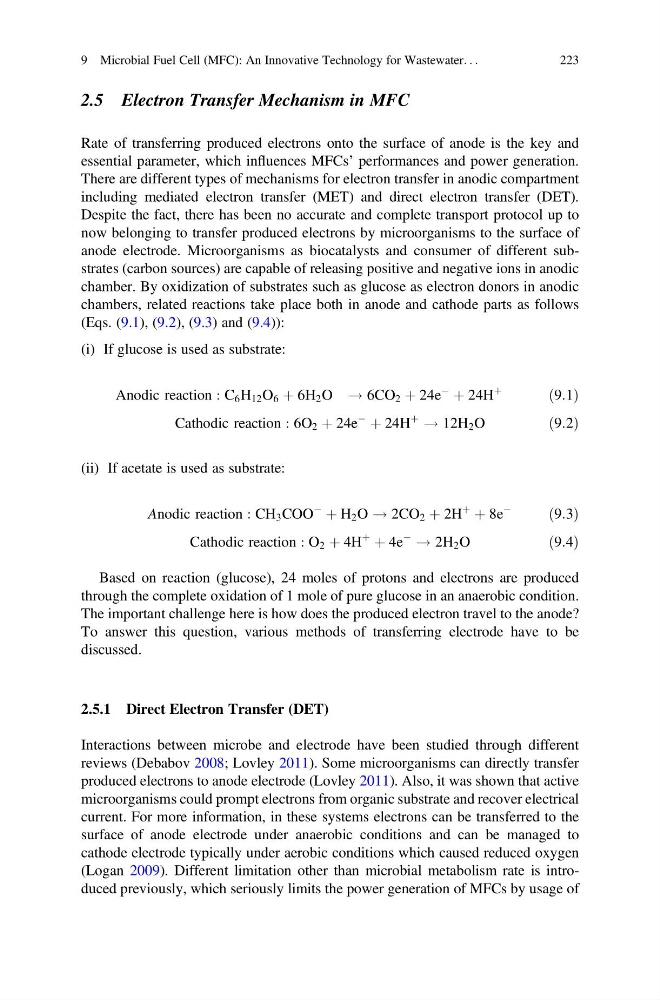
anode electrode. Microorganisms as biocatalysts and consumer of different substrates (carbon sources) are capable of releasing positive and negative ions in anodic
chamber. By oxidization of substrates such as glucose as electron donors in anodic
chambers, related reactions take place both in anode and cathode parts as follows
(Eqs. (9.1), (9.2), (9.3) and (9.4)):
(i) If glucose is used as substrate:
Anodic reaction : C 6 H 12 O 6 þ 6H 2 O ! 6CO 2 þ 24e
À
þ 24H
þ
ð9:1Þ
Cathodic reaction : 6O 2 þ 24e
À
þ 24H
þ
! 12H 2 O
ð9:2Þ
(ii) If acetate is used as substrate:
Anodic reaction : CH 3 COO
À
þ H 2 O ! 2CO 2 þ 2H
þ
þ 8e
À
ð9:3Þ
Cathodic reaction : O 2 þ 4H
þ
þ 4e
À
! 2H 2 O
ð9:4Þ
Based on reaction (glucose), 24 moles of protons and electrons are produced
through the complete oxidation of 1 mole of pure glucose in an anaerobic condition.
The important challenge here is how does the produced electron travel to the anode?
To answer this question, various methods of transferring electrode have to be
discussed.
2.5.1 Direct Electron Transfer (DET)
Interactions between microbe and electrode have been studied through different
reviews (Debabov 2008; Lovley 2011). Some microorganisms can directly transfer
produced electrons to anode electrode (Lovley 2011). Also, it was shown that active
microorganisms could prompt electrons from organic substrate and recover electrical
current. For more information, in these systems electrons can be transferred to the
surface of anode electrode under anaerobic conditions and can be managed to
cathode electrode typically under aerobic conditions which caused reduced oxygen
(Logan 2009). Different limitation other than microbial metabolism rate is introduced previously, which seriously limits the power generation of MFCs by usage of
9 Microbial Fuel Cell (MFC): An Innovative Technology for Wastewater. . .
223
Rate of transferring produced electrons onto the surface of anode is the key and
essential parameter, which influences MFCs’ performances and power generation.
There are different types of mechanisms for electron transfer in anodic compartment
including mediated electron transfer (MET) and direct electron transfer (DET).
Despite the fact, there has been no accurate and complete transport protocol up to
now belonging to transfer produced electrons by microorganisms to the surface of
anode electrode. Microorganisms as biocatalysts and consumer of different substrates (carbon sources) are capable of releasing positive and negative ions in anodic
chamber. By oxidization of substrates such as glucose as electron donors in anodic
chambers, related reactions take place both in anode and cathode parts as follows
(Eqs. (9.1), (9.2), (9.3) and (9.4)):
(i) If glucose is used as substrate:
Anodic reaction : C 6 H 12 O 6 þ 6H 2 O ! 6CO 2 þ 24e
À
þ 24H
þ
ð9:1Þ
Cathodic reaction : 6O 2 þ 24e
À
þ 24H
þ
! 12H 2 O
ð9:2Þ
(ii) If acetate is used as substrate:
Anodic reaction : CH 3 COO
À
þ H 2 O ! 2CO 2 þ 2H
þ
þ 8e
À
ð9:3Þ
Cathodic reaction : O 2 þ 4H
þ
þ 4e
À
! 2H 2 O
ð9:4Þ
Based on reaction (glucose), 24 moles of protons and electrons are produced
through the complete oxidation of 1 mole of pure glucose in an anaerobic condition.
The important challenge here is how does the produced electron travel to the anode?
To answer this question, various methods of transferring electrode have to be
discussed.
2.5.1 Direct Electron Transfer (DET)
Interactions between microbe and electrode have been studied through different
reviews (Debabov 2008; Lovley 2011). Some microorganisms can directly transfer
produced electrons to anode electrode (Lovley 2011). Also, it was shown that active
microorganisms could prompt electrons from organic substrate and recover electrical
current. For more information, in these systems electrons can be transferred to the
surface of anode electrode under anaerobic conditions and can be managed to
cathode electrode typically under aerobic conditions which caused reduced oxygen
(Logan 2009). Different limitation other than microbial metabolism rate is introduced previously, which seriously limits the power generation of MFCs by usage of
9 Microbial Fuel Cell (MFC): An Innovative Technology for Wastewater. . .
223