

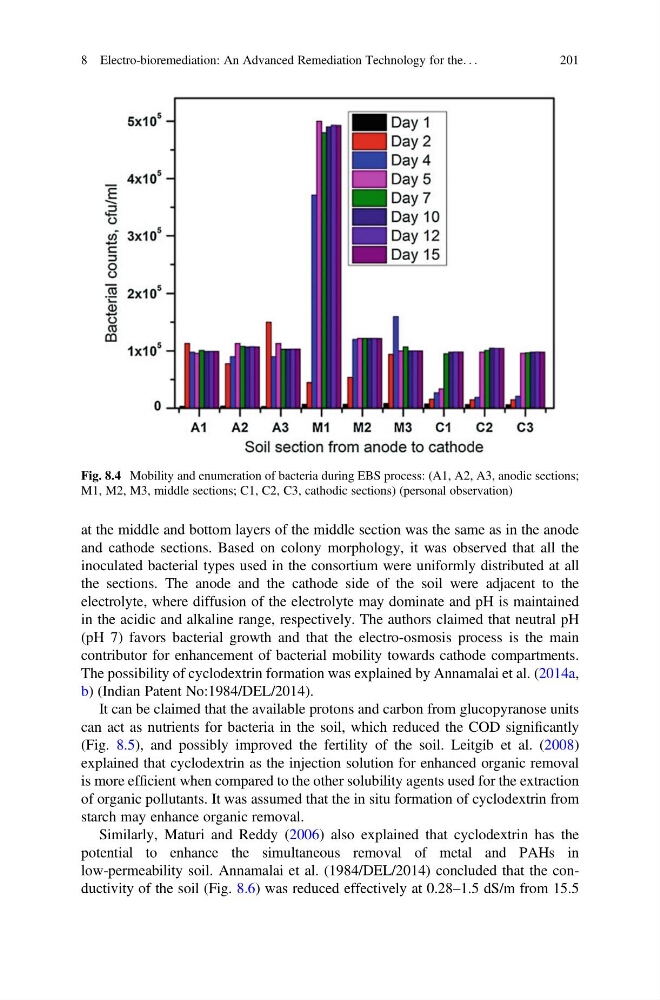
at the middle and bottom layers of the middle section was the same as in the anode
and cathode sections. Based on colony morphology, it was observed that all the
inoculated bacterial types used in the consortium were uniformly distributed at all
the sections. The anode and the cathode side of the soil were adjacent to the
electrolyte, where diffusion of the electrolyte may dominate and pH is maintained
in the acidic and alkaline range, respectively. The authors claimed that neutral pH
(pH 7) favors bacterial growth and that the electro-osmosis process is the main
contributor for enhancement of bacterial mobility towards cathode compartments.
The possibility of cyclodextrin formation was explained by Annamalai et al. (2014a,
b) (Indian Patent No:1984/DEL/2014).
It can be claimed that the available protons and carbon from glucopyranose units
can act as nutrients for bacteria in the soil, which reduced the COD significantly
(Fig. 8.5), and possibly improved the fertility of the soil. Leitgib et al. (2008)
explained that cyclodextrin as the injection solution for enhanced organic removal
is more efficient when compared to the other solubility agents used for the extraction
of organic pollutants. It was assumed that the in situ formation of cyclodextrin from
starch may enhance organic removal.
Similarly, Maturi and Reddy (2006) also explained that cyclodextrin has the
potential to enhance the simultaneous removal of metal and PAHs in
low-permeability soil. Annamalai et al. (1984/DEL/2014) concluded that the conductivity of the soil (Fig. 8.6) was reduced effectively at 0.28–1.5 dS/m from 15.5
Fig. 8.4 Mobility and enumeration of bacteria during EBS process: (A1, A2, A3, anodic sections;
M1, M2, M3, middle sections; C1, C2, C3, cathodic sections) (personal observation)
8 Electro-bioremediation: An Advanced Remediation Technology for the. . .
201
and cathode sections. Based on colony morphology, it was observed that all the
inoculated bacterial types used in the consortium were uniformly distributed at all
the sections. The anode and the cathode side of the soil were adjacent to the
electrolyte, where diffusion of the electrolyte may dominate and pH is maintained
in the acidic and alkaline range, respectively. The authors claimed that neutral pH
(pH 7) favors bacterial growth and that the electro-osmosis process is the main
contributor for enhancement of bacterial mobility towards cathode compartments.
The possibility of cyclodextrin formation was explained by Annamalai et al. (2014a,
b) (Indian Patent No:1984/DEL/2014).
It can be claimed that the available protons and carbon from glucopyranose units
can act as nutrients for bacteria in the soil, which reduced the COD significantly
(Fig. 8.5), and possibly improved the fertility of the soil. Leitgib et al. (2008)
explained that cyclodextrin as the injection solution for enhanced organic removal
is more efficient when compared to the other solubility agents used for the extraction
of organic pollutants. It was assumed that the in situ formation of cyclodextrin from
starch may enhance organic removal.
Similarly, Maturi and Reddy (2006) also explained that cyclodextrin has the
potential to enhance the simultaneous removal of metal and PAHs in
low-permeability soil. Annamalai et al. (1984/DEL/2014) concluded that the conductivity of the soil (Fig. 8.6) was reduced effectively at 0.28–1.5 dS/m from 15.5
Fig. 8.4 Mobility and enumeration of bacteria during EBS process: (A1, A2, A3, anodic sections;
M1, M2, M3, middle sections; C1, C2, C3, cathodic sections) (personal observation)
8 Electro-bioremediation: An Advanced Remediation Technology for the. . .
201