

laboratory-scale experiment, but in the field application, these types of electrode
arrangement are economically not feasible. Electrode configuration is an important
factor for efficient removal of contaminants with a significant role in cost calculation
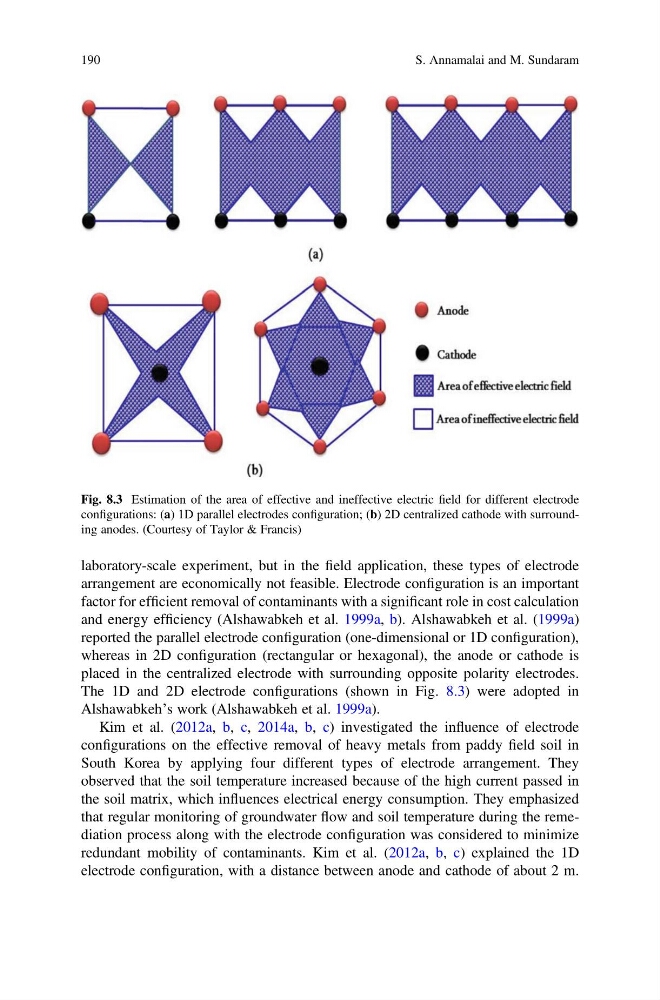
and energy efficiency (Alshawabkeh et al. 1999a, b). Alshawabkeh et al. (1999a)
reported the parallel electrode configuration (one-dimensional or 1D configuration),
whereas in 2D configuration (rectangular or hexagonal), the anode or cathode is
placed in the centralized electrode with surrounding opposite polarity electrodes.
The 1D and 2D electrode configurations (shown in Fig. 8.3) were adopted in
Alshawabkeh’s work (Alshawabkeh et al. 1999a).
Kim et al. (2012a, b, c, 2014a, b, c) investigated the influence of electrode
configurations on the effective removal of heavy metals from paddy field soil in
South Korea by applying four different types of electrode arrangement. They
observed that the soil temperature increased because of the high current passed in
the soil matrix, which influences electrical energy consumption. They emphasized
that regular monitoring of groundwater flow and soil temperature during the remediation process along with the electrode configuration was considered to minimize
redundant mobility of contaminants. Kim et al. (2012a, b, c) explained the 1D
electrode configuration, with a distance between anode and cathode of about 2 m.
Fig. 8.3 Estimation of the area of effective and ineffective electric field for different electrode
configurations: (a) 1D parallel electrodes configuration; (b) 2D centralized cathode with surrounding anodes. (Courtesy of Taylor & Francis)
190
S. Annamalai and M. Sundaram
arrangement are economically not feasible. Electrode configuration is an important
factor for efficient removal of contaminants with a significant role in cost calculation
and energy efficiency (Alshawabkeh et al. 1999a, b). Alshawabkeh et al. (1999a)
reported the parallel electrode configuration (one-dimensional or 1D configuration),
whereas in 2D configuration (rectangular or hexagonal), the anode or cathode is
placed in the centralized electrode with surrounding opposite polarity electrodes.
The 1D and 2D electrode configurations (shown in Fig. 8.3) were adopted in
Alshawabkeh’s work (Alshawabkeh et al. 1999a).
Kim et al. (2012a, b, c, 2014a, b, c) investigated the influence of electrode
configurations on the effective removal of heavy metals from paddy field soil in
South Korea by applying four different types of electrode arrangement. They
observed that the soil temperature increased because of the high current passed in
the soil matrix, which influences electrical energy consumption. They emphasized
that regular monitoring of groundwater flow and soil temperature during the remediation process along with the electrode configuration was considered to minimize
redundant mobility of contaminants. Kim et al. (2012a, b, c) explained the 1D
electrode configuration, with a distance between anode and cathode of about 2 m.
Fig. 8.3 Estimation of the area of effective and ineffective electric field for different electrode
configurations: (a) 1D parallel electrodes configuration; (b) 2D centralized cathode with surrounding anodes. (Courtesy of Taylor & Francis)
190
S. Annamalai and M. Sundaram