

give rise to nanoparticles. Examples of bottom-up approach include coprecipitation,
chemical reduction, etc. (Singh and Misra 2014). The methods for synthesis of
nanoparticles can be classified into physical, chemical, and biological methods.
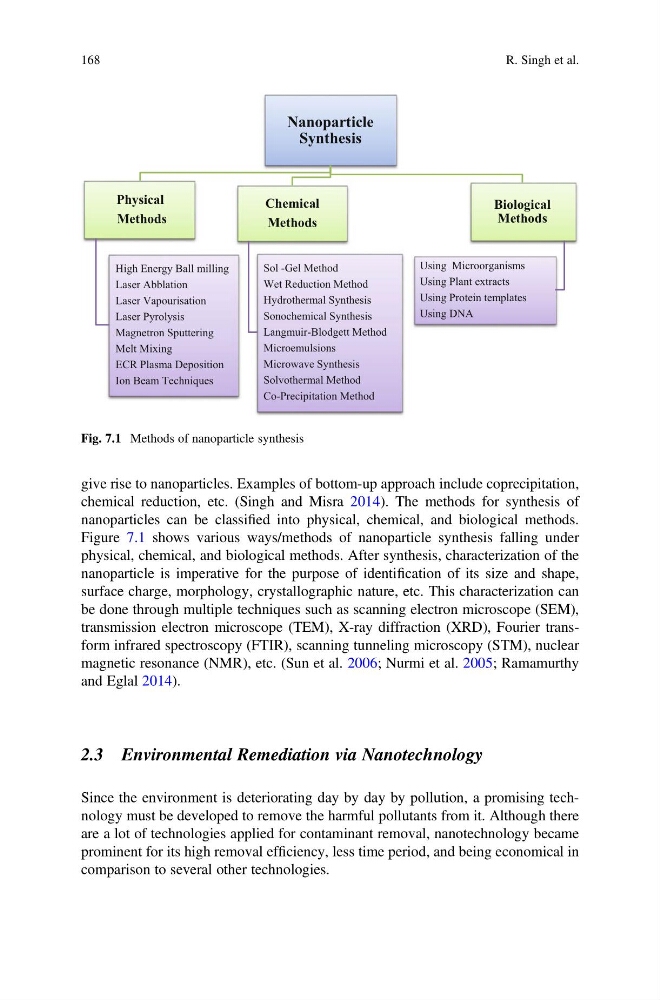
Figure 7.1 shows various ways/methods of nanoparticle synthesis falling under
physical, chemical, and biological methods. After synthesis, characterization of the
nanoparticle is imperative for the purpose of identification of its size and shape,
surface charge, morphology, crystallographic nature, etc. This characterization can
be done through multiple techniques such as scanning electron microscope (SEM),
transmission electron microscope (TEM), X-ray diffraction (XRD), Fourier transform infrared spectroscopy (FTIR), scanning tunneling microscopy (STM), nuclear
magnetic resonance (NMR), etc. (Sun et al. 2006; Nurmi et al. 2005; Ramamurthy
and Eglal 2014).
2.3 Environmental Remediation via Nanotechnology
Since the environment is deteriorating day by day by pollution, a promising technology must be developed to remove the harmful pollutants from it. Although there
are a lot of technologies applied for contaminant removal, nanotechnology became
prominent for its high removal efficiency, less time period, and being economical in
comparison to several other technologies.
Nanoparticle
Synthesis
Biological
Methods
Using Microorganisms
Using Plant extracts
Using Protein templates
Using DNA
Chemical
Methods
Sol -Gel Method
Wet Reduction Method
Hydrothermal Synthesis
Sonochemical Synthesis
Langmuir-Blodgett Method
Microemulsions
Microwave Synthesis
Solvothermal Method
Co-Precipitation Method
Physical
Methods
High Energy Ball milling
Laser Abblation
Laser Vapourisation
Laser Pyrolysis
Magnetron Sputtering
Melt Mixing
ECR Plasma Deposition
Ion Beam Techniques
Fig. 7.1 Methods of nanoparticle synthesis
168
R. Singh et al.
chemical reduction, etc. (Singh and Misra 2014). The methods for synthesis of
nanoparticles can be classified into physical, chemical, and biological methods.
Figure 7.1 shows various ways/methods of nanoparticle synthesis falling under
physical, chemical, and biological methods. After synthesis, characterization of the
nanoparticle is imperative for the purpose of identification of its size and shape,
surface charge, morphology, crystallographic nature, etc. This characterization can
be done through multiple techniques such as scanning electron microscope (SEM),
transmission electron microscope (TEM), X-ray diffraction (XRD), Fourier transform infrared spectroscopy (FTIR), scanning tunneling microscopy (STM), nuclear
magnetic resonance (NMR), etc. (Sun et al. 2006; Nurmi et al. 2005; Ramamurthy
and Eglal 2014).
2.3 Environmental Remediation via Nanotechnology
Since the environment is deteriorating day by day by pollution, a promising technology must be developed to remove the harmful pollutants from it. Although there
are a lot of technologies applied for contaminant removal, nanotechnology became
prominent for its high removal efficiency, less time period, and being economical in
comparison to several other technologies.
Nanoparticle
Synthesis
Biological
Methods
Using Microorganisms
Using Plant extracts
Using Protein templates
Using DNA
Chemical
Methods
Sol -Gel Method
Wet Reduction Method
Hydrothermal Synthesis
Sonochemical Synthesis
Langmuir-Blodgett Method
Microemulsions
Microwave Synthesis
Solvothermal Method
Co-Precipitation Method
Physical
Methods
High Energy Ball milling
Laser Abblation
Laser Vapourisation
Laser Pyrolysis
Magnetron Sputtering
Melt Mixing
ECR Plasma Deposition
Ion Beam Techniques
Fig. 7.1 Methods of nanoparticle synthesis
168
R. Singh et al.