

photochemical oxidation, sorption, and sedimentation (Kadlec and Knight 1996).
Aromatic hydrocarbons are present in the petroleum and its refined products and
have the ability to migrate within groundwater due to its high solubility and of
serious concern due to their toxic nature of disturbing water quality of receiving
water bodies (Caswell et al. 1992). Alkanes can be degraded through the process of
volatilization, and aromatic compounds are more soluble in water through dissolution process in water (Wallace 2001). Lower-molecular-weight (LMW) compounds
degrade more rapidly than the high-molecular-weight (HMW) compounds. Biodegradation and volatilization process significantly degrade the hydrocarbons. Degradation process occurs both aerobically and anaerobically depending upon the
oxygen supply and molecular structure of hydrocarbons. The rate of biodegradation
in aerobic environments is more rapid than in anaerobic environments because
oxygen is the favorite electron acceptor utilized by the microbes in the degradation
of organic carbon.
5.3.1 Hydrocarbons in Wastewaters and Role of Plants and Microbes
in Degradation
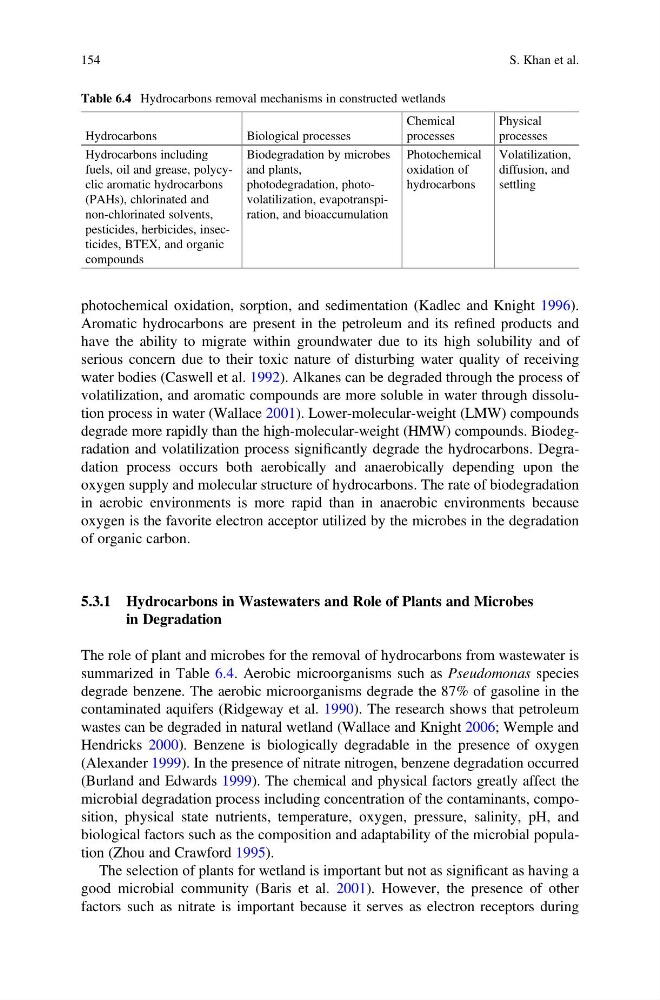
The role of plant and microbes for the removal of hydrocarbons from wastewater is
summarized in Table 6.4. Aerobic microorganisms such as Pseudomonas species
degrade benzene. The aerobic microorganisms degrade the 87% of gasoline in the
contaminated aquifers (Ridgeway et al. 1990). The research shows that petroleum
wastes can be degraded in natural wetland (Wallace and Knight 2006; Wemple and
Hendricks 2000). Benzene is biologically degradable in the presence of oxygen
(Alexander 1999). In the presence of nitrate nitrogen, benzene degradation occurred
(Burland and Edwards 1999). The chemical and physical factors greatly affect the
microbial degradation process including concentration of the contaminants, composition, physical state nutrients, temperature, oxygen, pressure, salinity, pH, and
biological factors such as the composition and adaptability of the microbial population (Zhou and Crawford 1995).
The selection of plants for wetland is important but not as significant as having a
good microbial community (Baris et al. 2001). However, the presence of other
factors such as nitrate is important because it serves as electron receptors during
Table 6.4 Hydrocarbons removal mechanisms in constructed wetlands
Hydrocarbons
Biological processes
Chemical
processes
Physical
processes
Hydrocarbons including
fuels, oil and grease, polycyclic aromatic hydrocarbons
(PAHs), chlorinated and
non-chlorinated solvents,
pesticides, herbicides, insecticides, BTEX, and organic
compounds
Biodegradation by microbes
and plants,
photodegradation, photovolatilization, evapotranspiration, and bioaccumulation
Photochemical
oxidation of
hydrocarbons
Volatilization,
diffusion, and
settling
154
S. Khan et al.
Aromatic hydrocarbons are present in the petroleum and its refined products and
have the ability to migrate within groundwater due to its high solubility and of
serious concern due to their toxic nature of disturbing water quality of receiving
water bodies (Caswell et al. 1992). Alkanes can be degraded through the process of
volatilization, and aromatic compounds are more soluble in water through dissolution process in water (Wallace 2001). Lower-molecular-weight (LMW) compounds
degrade more rapidly than the high-molecular-weight (HMW) compounds. Biodegradation and volatilization process significantly degrade the hydrocarbons. Degradation process occurs both aerobically and anaerobically depending upon the
oxygen supply and molecular structure of hydrocarbons. The rate of biodegradation
in aerobic environments is more rapid than in anaerobic environments because
oxygen is the favorite electron acceptor utilized by the microbes in the degradation
of organic carbon.
5.3.1 Hydrocarbons in Wastewaters and Role of Plants and Microbes
in Degradation
The role of plant and microbes for the removal of hydrocarbons from wastewater is
summarized in Table 6.4. Aerobic microorganisms such as Pseudomonas species
degrade benzene. The aerobic microorganisms degrade the 87% of gasoline in the
contaminated aquifers (Ridgeway et al. 1990). The research shows that petroleum
wastes can be degraded in natural wetland (Wallace and Knight 2006; Wemple and
Hendricks 2000). Benzene is biologically degradable in the presence of oxygen
(Alexander 1999). In the presence of nitrate nitrogen, benzene degradation occurred
(Burland and Edwards 1999). The chemical and physical factors greatly affect the
microbial degradation process including concentration of the contaminants, composition, physical state nutrients, temperature, oxygen, pressure, salinity, pH, and
biological factors such as the composition and adaptability of the microbial population (Zhou and Crawford 1995).
The selection of plants for wetland is important but not as significant as having a
good microbial community (Baris et al. 2001). However, the presence of other
factors such as nitrate is important because it serves as electron receptors during
Table 6.4 Hydrocarbons removal mechanisms in constructed wetlands
Hydrocarbons
Biological processes
Chemical
processes
Physical
processes
Hydrocarbons including
fuels, oil and grease, polycyclic aromatic hydrocarbons
(PAHs), chlorinated and
non-chlorinated solvents,
pesticides, herbicides, insecticides, BTEX, and organic
compounds
Biodegradation by microbes
and plants,
photodegradation, photovolatilization, evapotranspiration, and bioaccumulation
Photochemical
oxidation of
hydrocarbons
Volatilization,
diffusion, and
settling
154
S. Khan et al.