

inconsistency. In Europe, the usually constructed wetlands design horizontal flow
system is used in which common reed (Phragmites australis) is grown (Vymazal
et al. 1998). Other extensively important plants for wastewater treatment in
constructed wetland are shown in Table 6.1 (Vymazal et al. 2007; Mbuligwe
2005). The main macrophyte species used in constructed wetlands in Portugal are
P. australis, Cyperus spp., Juncus effusus (soft rush), Iris pseudacorus (yellow iris),
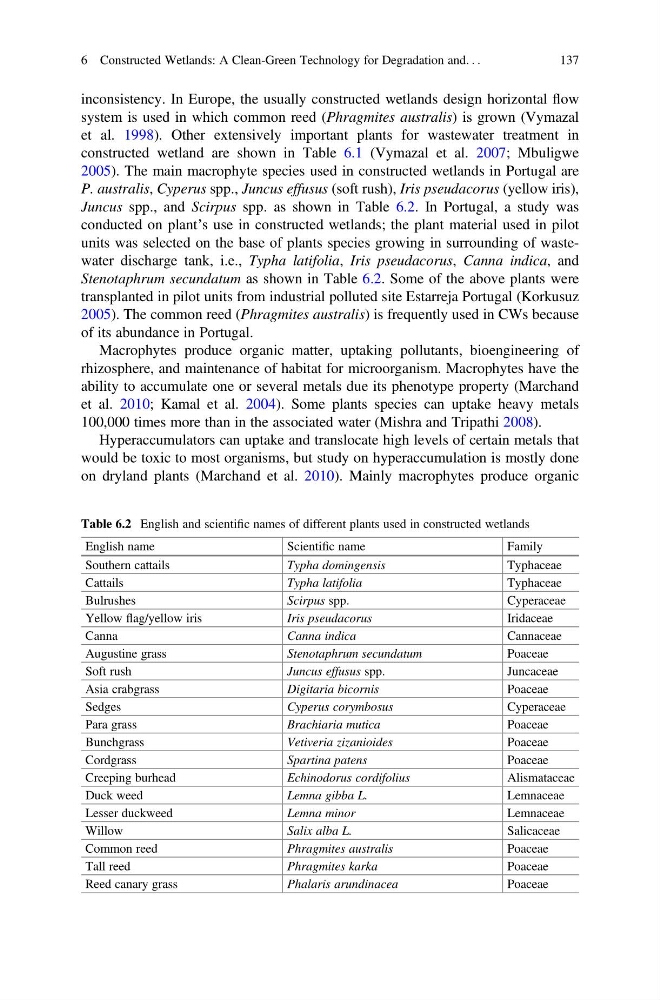
Juncus spp., and Scirpus spp. as shown in Table 6.2. In Portugal, a study was
conducted on plant’s use in constructed wetlands; the plant material used in pilot
units was selected on the base of plants species growing in surrounding of wastewater discharge tank, i.e., Typha latifolia, Iris pseudacorus, Canna indica, and
Stenotaphrum secundatum as shown in Table 6.2. Some of the above plants were
transplanted in pilot units from industrial polluted site Estarreja Portugal (Korkusuz
2005). The common reed (Phragmites australis) is frequently used in CWs because
of its abundance in Portugal.
Macrophytes produce organic matter, uptaking pollutants, bioengineering of
rhizosphere, and maintenance of habitat for microorganism. Macrophytes have the
ability to accumulate one or several metals due its phenotype property (Marchand
et al. 2010; Kamal et al. 2004). Some plants species can uptake heavy metals
100,000 times more than in the associated water (Mishra and Tripathi 2008).
Hyperaccumulators can uptake and translocate high levels of certain metals that
would be toxic to most organisms, but study on hyperaccumulation is mostly done
on dryland plants (Marchand et al. 2010). Mainly macrophytes produce organic
Table 6.2 English and scientific names of different plants used in constructed wetlands
English name
Scientific name
Family
Southern cattails
Typha domingensis
Typhaceae
Cattails
Typha latifolia
Typhaceae
Bulrushes
Scirpus spp.
Cyperaceae
Yellow flag/yellow iris
Iris pseudacorus
Iridaceae
Canna
Canna indica
Cannaceae
Augustine grass
Stenotaphrum secundatum
Poaceae
Soft rush
Juncus effusus spp.
Juncaceae
Asia crabgrass
Digitaria bicornis
Poaceae
Sedges
Cyperus corymbosus
Cyperaceae
Para grass
Brachiaria mutica
Poaceae
Bunchgrass
Vetiveria zizanioides
Poaceae
Cordgrass
Spartina patens
Poaceae
Creeping burhead
Echinodorus cordifolius
Alismataceae
Duck weed
Lemna gibba L.
Lemnaceae
Lesser duckweed
Lemna minor
Lemnaceae
Willow
Salix alba L.
Salicaceae
Common reed
Phragmites australis
Poaceae
Tall reed
Phragmites karka
Poaceae
Reed canary grass
Phalaris arundinacea
Poaceae
6 Constructed Wetlands: A Clean-Green Technology for Degradation and. . .
137
system is used in which common reed (Phragmites australis) is grown (Vymazal
et al. 1998). Other extensively important plants for wastewater treatment in
constructed wetland are shown in Table 6.1 (Vymazal et al. 2007; Mbuligwe
2005). The main macrophyte species used in constructed wetlands in Portugal are
P. australis, Cyperus spp., Juncus effusus (soft rush), Iris pseudacorus (yellow iris),
Juncus spp., and Scirpus spp. as shown in Table 6.2. In Portugal, a study was
conducted on plant’s use in constructed wetlands; the plant material used in pilot
units was selected on the base of plants species growing in surrounding of wastewater discharge tank, i.e., Typha latifolia, Iris pseudacorus, Canna indica, and
Stenotaphrum secundatum as shown in Table 6.2. Some of the above plants were
transplanted in pilot units from industrial polluted site Estarreja Portugal (Korkusuz
2005). The common reed (Phragmites australis) is frequently used in CWs because
of its abundance in Portugal.
Macrophytes produce organic matter, uptaking pollutants, bioengineering of
rhizosphere, and maintenance of habitat for microorganism. Macrophytes have the
ability to accumulate one or several metals due its phenotype property (Marchand
et al. 2010; Kamal et al. 2004). Some plants species can uptake heavy metals
100,000 times more than in the associated water (Mishra and Tripathi 2008).
Hyperaccumulators can uptake and translocate high levels of certain metals that
would be toxic to most organisms, but study on hyperaccumulation is mostly done
on dryland plants (Marchand et al. 2010). Mainly macrophytes produce organic
Table 6.2 English and scientific names of different plants used in constructed wetlands
English name
Scientific name
Family
Southern cattails
Typha domingensis
Typhaceae
Cattails
Typha latifolia
Typhaceae
Bulrushes
Scirpus spp.
Cyperaceae
Yellow flag/yellow iris
Iris pseudacorus
Iridaceae
Canna
Canna indica
Cannaceae
Augustine grass
Stenotaphrum secundatum
Poaceae
Soft rush
Juncus effusus spp.
Juncaceae
Asia crabgrass
Digitaria bicornis
Poaceae
Sedges
Cyperus corymbosus
Cyperaceae
Para grass
Brachiaria mutica
Poaceae
Bunchgrass
Vetiveria zizanioides
Poaceae
Cordgrass
Spartina patens
Poaceae
Creeping burhead
Echinodorus cordifolius
Alismataceae
Duck weed
Lemna gibba L.
Lemnaceae
Lesser duckweed
Lemna minor
Lemnaceae
Willow
Salix alba L.
Salicaceae
Common reed
Phragmites australis
Poaceae
Tall reed
Phragmites karka
Poaceae
Reed canary grass
Phalaris arundinacea
Poaceae
6 Constructed Wetlands: A Clean-Green Technology for Degradation and. . .
137