

properties. The plant growth-promoting rhizobacteria (PGPR), which enhance and
assist the phytoremediation process, can also be engineered genetically for preferred
properties such as withstanding biotic and abiotic stress, improved bio-derivative
enzymes, metal homeostasis, metal chelation and transport, regulation of metal
uptake, and mitigating risks (Abou-Shanab et al. 2006; Singh et al. 2011). A few
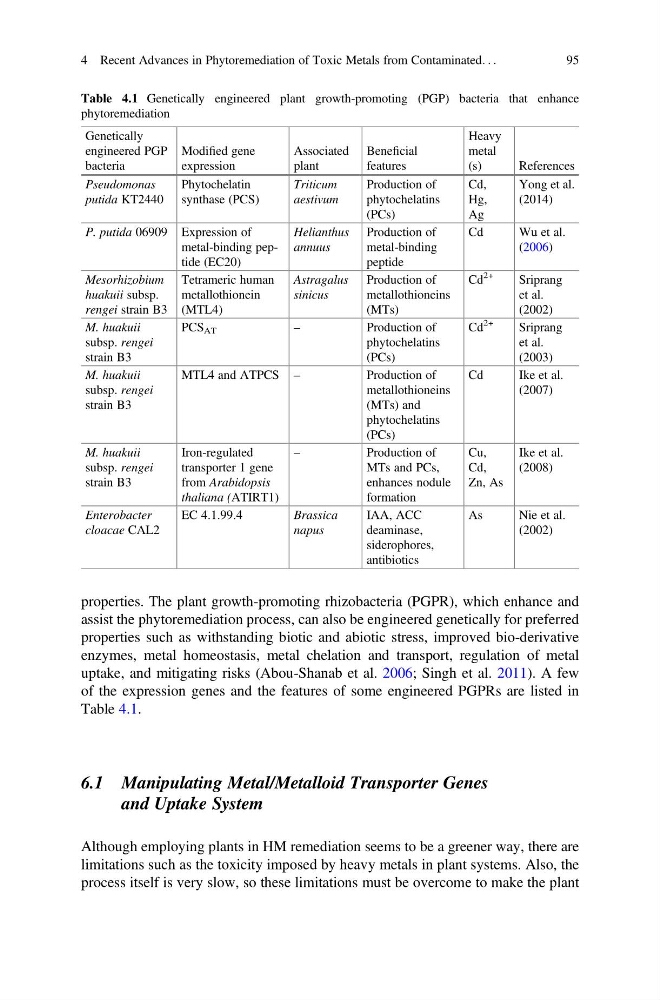
of the expression genes and the features of some engineered PGPRs are listed in
Table 4.1.
6.1 Manipulating Metal/Metalloid Transporter Genes
and Uptake System
Although employing plants in HM remediation seems to be a greener way, there are
limitations such as the toxicity imposed by heavy metals in plant systems. Also, the
process itself is very slow, so these limitations must be overcome to make the plant
Table 4.1 Genetically engineered plant growth-promoting (PGP) bacteria that enhance
phytoremediation
Genetically
engineered PGP
bacteria
Modified gene
expression
Associated
plant
Beneficial
features
Heavy
metal
(s)
References
Pseudomonas
putida KT2440
Phytochelatin
synthase (PCS)
Triticum
aestivum
Production of
phytochelatins
(PCs)
Cd,
Hg,
Ag
Yong et al.
(2014)
P. putida 06909 Expression of
metal-binding peptide (EC20)
Helianthus
annuus
Production of
metal-binding
peptide
Cd
Wu et al.
(2006)
Mesorhizobium
huakuii subsp.
rengei strain B3
Tetrameric human
metallothionein
(MTL4)
Astragalus
sinicus
Production of
metallothioneins
(MTs)
Cd
2+
Sriprang
et al.
(2002)
M. huakuii
subsp. rengei
strain B3
PCS AT
–
Production of
phytochelatins
(PCs)
Cd
2+
Sriprang
et al.
(2003)
M. huakuii
subsp. rengei
strain B3
MTL4 and ATPCS –
Production of
metallothioneins
(MTs) and
phytochelatins
(PCs)
Cd
Ike et al.
(2007)
M. huakuii
subsp. rengei
strain B3
Iron-regulated
transporter 1 gene
from Arabidopsis
thaliana (ATIRT1)
–
Production of
MTs and PCs,
enhances nodule
formation
Cu,
Cd,
Zn, As
Ike et al.
(2008)
Enterobacter
cloacae CAL2
EC 4.1.99.4
Brassica
napus
IAA, ACC
deaminase,
siderophores,
antibiotics
As
Nie et al.
(2002)
4 Recent Advances in Phytoremediation of Toxic Metals from Contaminated. . .
95
assist the phytoremediation process, can also be engineered genetically for preferred
properties such as withstanding biotic and abiotic stress, improved bio-derivative
enzymes, metal homeostasis, metal chelation and transport, regulation of metal
uptake, and mitigating risks (Abou-Shanab et al. 2006; Singh et al. 2011). A few
of the expression genes and the features of some engineered PGPRs are listed in
Table 4.1.
6.1 Manipulating Metal/Metalloid Transporter Genes
and Uptake System
Although employing plants in HM remediation seems to be a greener way, there are
limitations such as the toxicity imposed by heavy metals in plant systems. Also, the
process itself is very slow, so these limitations must be overcome to make the plant
Table 4.1 Genetically engineered plant growth-promoting (PGP) bacteria that enhance
phytoremediation
Genetically
engineered PGP
bacteria
Modified gene
expression
Associated
plant
Beneficial
features
Heavy
metal
(s)
References
Pseudomonas
putida KT2440
Phytochelatin
synthase (PCS)
Triticum
aestivum
Production of
phytochelatins
(PCs)
Cd,
Hg,
Ag
Yong et al.
(2014)
P. putida 06909 Expression of
metal-binding peptide (EC20)
Helianthus
annuus
Production of
metal-binding
peptide
Cd
Wu et al.
(2006)
Mesorhizobium
huakuii subsp.
rengei strain B3
Tetrameric human
metallothionein
(MTL4)
Astragalus
sinicus
Production of
metallothioneins
(MTs)
Cd
2+
Sriprang
et al.
(2002)
M. huakuii
subsp. rengei
strain B3
PCS AT
–
Production of
phytochelatins
(PCs)
Cd
2+
Sriprang
et al.
(2003)
M. huakuii
subsp. rengei
strain B3
MTL4 and ATPCS –
Production of
metallothioneins
(MTs) and
phytochelatins
(PCs)
Cd
Ike et al.
(2007)
M. huakuii
subsp. rengei
strain B3
Iron-regulated
transporter 1 gene
from Arabidopsis
thaliana (ATIRT1)
–
Production of
MTs and PCs,
enhances nodule
formation
Cu,
Cd,
Zn, As
Ike et al.
(2008)
Enterobacter
cloacae CAL2
EC 4.1.99.4
Brassica
napus
IAA, ACC
deaminase,
siderophores,
antibiotics
As
Nie et al.
(2002)
4 Recent Advances in Phytoremediation of Toxic Metals from Contaminated. . .
95