

this action (Brown et al. 1999). Actually, HM activity is often promoted in
rhizospheric areas. As mentioned earlier, most metals or metalloids become more
active under acidic condition because of their more soluble cationic forms. Further,
oxidizing and aerobic conditions also contribute to the activation of HMs in soil
compared to reducing and anaerobic conditions, under which heavy metals exist in
sulfide or carbonate precipitate forms. The bioavailability sequence of the following
metals in soil under the same conditions is Zn > Cu > Cd > Ni > Pb. The uptake of
most metals into the roots takes place in the aqueous phase. There are many transport
sites in the root cellular membrane; the roots absorb metal ions from the soil solution
(Fig. 4.2). This process is divided into two steps, a fast linear dynamics stage and a
following slower saturated adsorption stage, related to the adsorption of the root
cellular wall and passage through the root cellular membrane, respectively (Lasat
et al. 1996). The charge of the metal ion limits its free access across the cellular
membrane, which hence needs the assistance of membrane proteins for effective
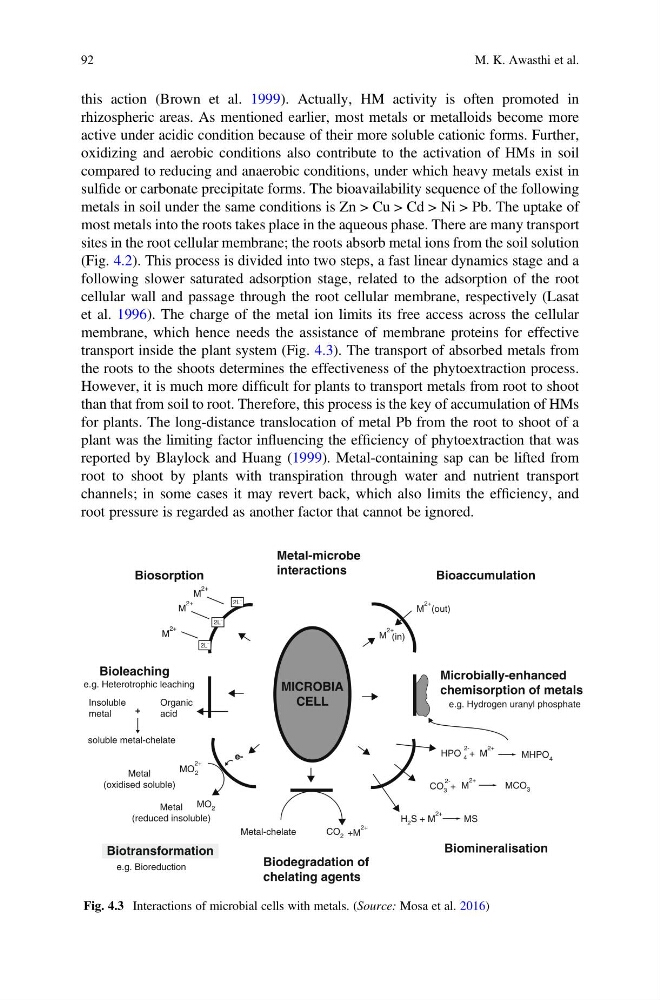
transport inside the plant system (Fig. 4.3). The transport of absorbed metals from
the roots to the shoots determines the effectiveness of the phytoextraction process.
However, it is much more difficult for plants to transport metals from root to shoot
than that from soil to root. Therefore, this process is the key of accumulation of HMs
for plants. The long-distance translocation of metal Pb from the root to shoot of a
plant was the limiting factor influencing the efficiency of phytoextraction that was
reported by Blaylock and Huang (1999). Metal-containing sap can be lifted from
root to shoot by plants with transpiration through water and nutrient transport
channels; in some cases it may revert back, which also limits the efficiency, and
root pressure is regarded as another factor that cannot be ignored.
Biosorption
M
2+ (out)
M
2+
(in)
M
2+
2L –
2L –
2L –
M
2+
M
2+
e.g. Heterotrophic leaching
Insoluble
metal
Organic
acid
soluble metal-chelate
Metal
(oxidised soluble)
Metal
(reduced insoluble)
Metal-chelate
e.g. Hydrogen uranyl phosphate
MHPO 4
M
2+
M
2+
HPO 4
2+
CO 3
2+
CO 2
H 2 S + M
2+
+M
2+
Biotransformation
e.g. Bioreduction
MO
2+
2
MO 2
Bioleaching
Metal-microbe
interactions
Bioaccumulation
Microbially-enhanced
chemisorption of metals
Biomineralisation
Biodegradation of
chelating agents
MCO 3
MS
MICROBIA
CELL
+
eFig. 4.3 Interactions of microbial cells with metals. (Source: Mosa et al. 2016)
92
M. K. Awasthi et al.
rhizospheric areas. As mentioned earlier, most metals or metalloids become more
active under acidic condition because of their more soluble cationic forms. Further,
oxidizing and aerobic conditions also contribute to the activation of HMs in soil
compared to reducing and anaerobic conditions, under which heavy metals exist in
sulfide or carbonate precipitate forms. The bioavailability sequence of the following
metals in soil under the same conditions is Zn > Cu > Cd > Ni > Pb. The uptake of
most metals into the roots takes place in the aqueous phase. There are many transport
sites in the root cellular membrane; the roots absorb metal ions from the soil solution
(Fig. 4.2). This process is divided into two steps, a fast linear dynamics stage and a
following slower saturated adsorption stage, related to the adsorption of the root
cellular wall and passage through the root cellular membrane, respectively (Lasat
et al. 1996). The charge of the metal ion limits its free access across the cellular
membrane, which hence needs the assistance of membrane proteins for effective
transport inside the plant system (Fig. 4.3). The transport of absorbed metals from
the roots to the shoots determines the effectiveness of the phytoextraction process.
However, it is much more difficult for plants to transport metals from root to shoot
than that from soil to root. Therefore, this process is the key of accumulation of HMs
for plants. The long-distance translocation of metal Pb from the root to shoot of a
plant was the limiting factor influencing the efficiency of phytoextraction that was
reported by Blaylock and Huang (1999). Metal-containing sap can be lifted from
root to shoot by plants with transpiration through water and nutrient transport
channels; in some cases it may revert back, which also limits the efficiency, and
root pressure is regarded as another factor that cannot be ignored.
Biosorption
M
2+ (out)
M
2+
(in)
M
2+
2L –
2L –
2L –
M
2+
M
2+
e.g. Heterotrophic leaching
Insoluble
metal
Organic
acid
soluble metal-chelate
Metal
(oxidised soluble)
Metal
(reduced insoluble)
Metal-chelate
e.g. Hydrogen uranyl phosphate
MHPO 4
M
2+
M
2+
HPO 4
2+
CO 3
2+
CO 2
H 2 S + M
2+
+M
2+
Biotransformation
e.g. Bioreduction
MO
2+
2
MO 2
Bioleaching
Metal-microbe
interactions
Bioaccumulation
Microbially-enhanced
chemisorption of metals
Biomineralisation
Biodegradation of
chelating agents
MCO 3
MS
MICROBIA
CELL
+
eFig. 4.3 Interactions of microbial cells with metals. (Source: Mosa et al. 2016)
92
M. K. Awasthi et al.