

Forest Resources of Jharkhand, Eastern India …
63
2 Forests of Jharkhand
Forest resource plays an important role in the development of Jharkhand, as a very
significant proportion of the population is directly or indirectly dependent on it for
their daily household needs. Physiographically, it has four major plateaus separated
by narrow steep slopes of which the Chhotanagpur plateaus is most prominent. Jharkhand has been blessed with the rich variety of forests comprising of dry peninsular
sal forests, northern dry mixed deciduous forests, moist peninsular sal forests, dry
deciduous scrubland, and dry bamboo brake. Dry peninsular sal forests (45.03%)
and dry mixed deciduous forests (41.21%) are the major forest types of the state
(ISFR 2015) and cover most of the forest area and are home to some of the finest
timber producing trees. The total carbon stock of forests in the state is 222.82 million tonnes (817.23 million tonnes of CO 2 equivalent) which is 3.15% of total forest
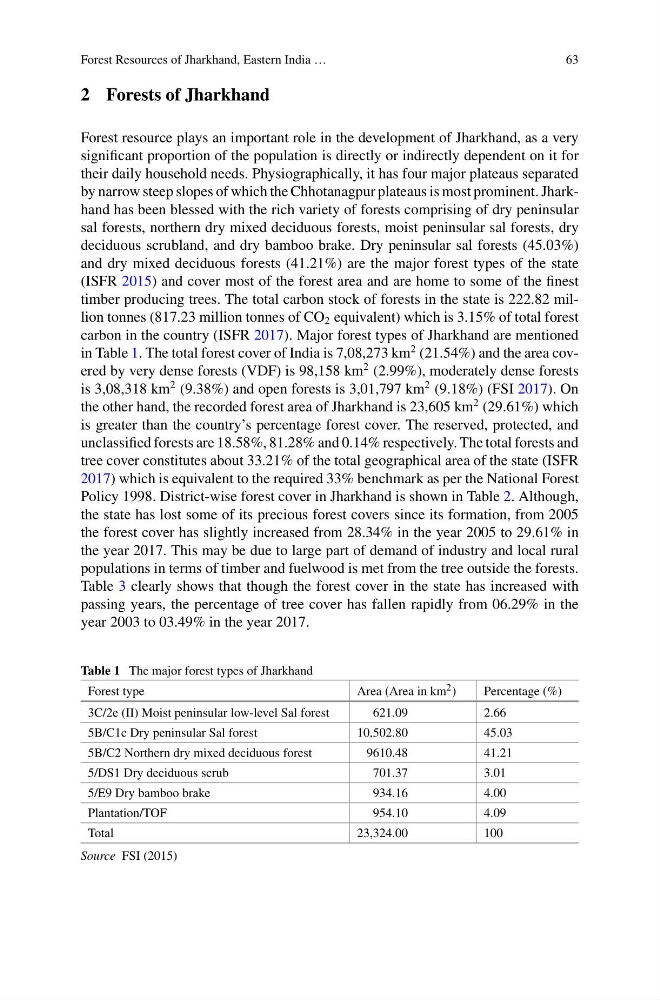
carbon in the country (ISFR 2017). Major forest types of Jharkhand are mentioned
in Table 1. The total forest cover of India is 7,08,273 km
2 (21.54%) and the area covered by very dense forests (VDF) is 98,158 km
2 (2.99%), moderately dense forests
is 3,08,318 km
2 (9.38%) and open forests is 3,01,797 km
2 (9.18%) (FSI 2017). On
the other hand, the recorded forest area of Jharkhand is 23,605 km
2 (29.61%) which
is greater than the country’s percentage forest cover. The reserved, protected, and
unclassified forests are 18.58%, 81.28% and 0.14% respectively. The total forests and
tree cover constitutes about 33.21% of the total geographical area of the state (ISFR
2017) which is equivalent to the required 33% benchmark as per the National Forest
Policy 1998. District-wise forest cover in Jharkhand is shown in Table 2. Although,
the state has lost some of its precious forest covers since its formation, from 2005
the forest cover has slightly increased from 28.34% in the year 2005 to 29.61% in
the year 2017. This may be due to large part of demand of industry and local rural
populations in terms of timber and fuelwood is met from the tree outside the forests.
Table 3 clearly shows that though the forest cover in the state has increased with
passing years, the percentage of tree cover has fallen rapidly from 06.29% in the
year 2003 to 03.49% in the year 2017.
Table 1 The major forest types of Jharkhand
Forest type
Area (Area in km 2 )
Percentage (%)
3C/2e (II) Moist peninsular low-level Sal forest
621.09
2.66
5B/C1c Dry peninsular Sal forest
10,502.80
45.03
5B/C2 Northern dry mixed deciduous forest
9610.48
41.21
5/DS1 Dry deciduous scrub
701.37
3.01
5/E9 Dry bamboo brake
934.16
4.00
Plantation/TOF
954.10
4.09
Total
23,324.00
100
Source FSI (2015)
63
2 Forests of Jharkhand
Forest resource plays an important role in the development of Jharkhand, as a very
significant proportion of the population is directly or indirectly dependent on it for
their daily household needs. Physiographically, it has four major plateaus separated
by narrow steep slopes of which the Chhotanagpur plateaus is most prominent. Jharkhand has been blessed with the rich variety of forests comprising of dry peninsular
sal forests, northern dry mixed deciduous forests, moist peninsular sal forests, dry
deciduous scrubland, and dry bamboo brake. Dry peninsular sal forests (45.03%)
and dry mixed deciduous forests (41.21%) are the major forest types of the state
(ISFR 2015) and cover most of the forest area and are home to some of the finest
timber producing trees. The total carbon stock of forests in the state is 222.82 million tonnes (817.23 million tonnes of CO 2 equivalent) which is 3.15% of total forest
carbon in the country (ISFR 2017). Major forest types of Jharkhand are mentioned
in Table 1. The total forest cover of India is 7,08,273 km
2 (21.54%) and the area covered by very dense forests (VDF) is 98,158 km
2 (2.99%), moderately dense forests
is 3,08,318 km
2 (9.38%) and open forests is 3,01,797 km
2 (9.18%) (FSI 2017). On
the other hand, the recorded forest area of Jharkhand is 23,605 km
2 (29.61%) which
is greater than the country’s percentage forest cover. The reserved, protected, and
unclassified forests are 18.58%, 81.28% and 0.14% respectively. The total forests and
tree cover constitutes about 33.21% of the total geographical area of the state (ISFR
2017) which is equivalent to the required 33% benchmark as per the National Forest
Policy 1998. District-wise forest cover in Jharkhand is shown in Table 2. Although,
the state has lost some of its precious forest covers since its formation, from 2005
the forest cover has slightly increased from 28.34% in the year 2005 to 29.61% in
the year 2017. This may be due to large part of demand of industry and local rural
populations in terms of timber and fuelwood is met from the tree outside the forests.
Table 3 clearly shows that though the forest cover in the state has increased with
passing years, the percentage of tree cover has fallen rapidly from 06.29% in the
year 2003 to 03.49% in the year 2017.
Table 1 The major forest types of Jharkhand
Forest type
Area (Area in km 2 )
Percentage (%)
3C/2e (II) Moist peninsular low-level Sal forest
621.09
2.66
5B/C1c Dry peninsular Sal forest
10,502.80
45.03
5B/C2 Northern dry mixed deciduous forest
9610.48
41.21
5/DS1 Dry deciduous scrub
701.37
3.01
5/E9 Dry bamboo brake
934.16
4.00
Plantation/TOF
954.10
4.09
Total
23,324.00
100
Source FSI (2015)