

52
S. Dhyani and D. Dhyani
Tolma and Suraithota village of Niti valley. Though, collection of morals has always
been a second priority for locals but increasing rates and easy availability in nearby
markets has led to regular forays and collection of MAPs from forests. According
to Singh and Rawat (2000) the total income earned in a season provides 20–30% of
the annual cash income in 140 villages while Prasad et al. (2002) have reported an
annual income of US$ 150 for 1600 households in 40 villages. The benefits to rural
livelihoods are significant and widespread and large number of rural folks thus earn
a significant amount of economic benefits out of it (Negi 2006; Singh and Rawat
2000; Prasad et al. 2002).
4.4.5 Forest Fires for Quality Fodder Demands
Fires in the state occur during the pre-monsoon summer period of moisture stress
and are mostly man made. Forest fires are prominent from March to May to clear
forest understory by locals so that good under storey shrubs and herbs, grasses emerge
during-and post-monsoon to provide green feedstock for cattle in the villages. Besides
the direct losses of biodiversity, the other damage due to these fires is loss of soil
fertility, soil erosion, drying up of water resources etc. In 2016 huge damage of forest
biodiversity happened due to man-made forest fires. Forest fires are an integral part of
the Chir-Pine (Pinus roxburghii)-Banj oak (Quercus leucotrichophora) forest zone
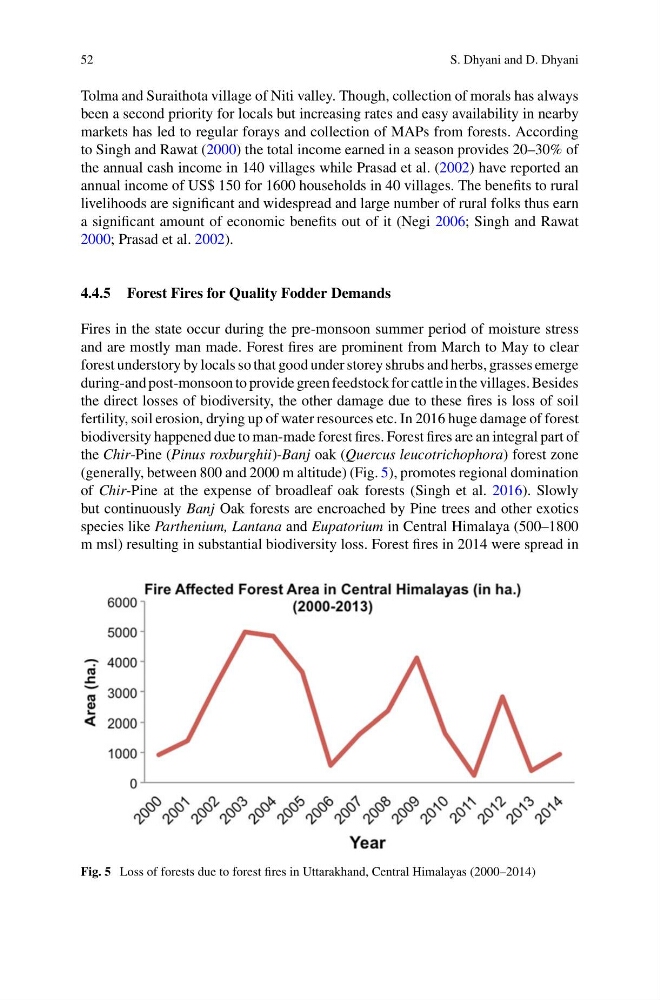
(generally, between 800 and 2000 m altitude) (Fig. 5), promotes regional domination
of Chir-Pine at the expense of broadleaf oak forests (Singh et al. 2016). Slowly
but continuously Banj Oak forests are encroached by Pine trees and other exotics
species like Parthenium, Lantana and Eupatorium in Central Himalaya (500–1800
m msl) resulting in substantial biodiversity loss. Forest fires in 2014 were spread in
Fig. 5 Loss of forests due to forest fires in Uttarakhand, Central Himalayas (2000–2014)
S. Dhyani and D. Dhyani
Tolma and Suraithota village of Niti valley. Though, collection of morals has always
been a second priority for locals but increasing rates and easy availability in nearby
markets has led to regular forays and collection of MAPs from forests. According
to Singh and Rawat (2000) the total income earned in a season provides 20–30% of
the annual cash income in 140 villages while Prasad et al. (2002) have reported an
annual income of US$ 150 for 1600 households in 40 villages. The benefits to rural
livelihoods are significant and widespread and large number of rural folks thus earn
a significant amount of economic benefits out of it (Negi 2006; Singh and Rawat
2000; Prasad et al. 2002).
4.4.5 Forest Fires for Quality Fodder Demands
Fires in the state occur during the pre-monsoon summer period of moisture stress
and are mostly man made. Forest fires are prominent from March to May to clear
forest understory by locals so that good under storey shrubs and herbs, grasses emerge
during-and post-monsoon to provide green feedstock for cattle in the villages. Besides
the direct losses of biodiversity, the other damage due to these fires is loss of soil
fertility, soil erosion, drying up of water resources etc. In 2016 huge damage of forest
biodiversity happened due to man-made forest fires. Forest fires are an integral part of
the Chir-Pine (Pinus roxburghii)-Banj oak (Quercus leucotrichophora) forest zone
(generally, between 800 and 2000 m altitude) (Fig. 5), promotes regional domination
of Chir-Pine at the expense of broadleaf oak forests (Singh et al. 2016). Slowly
but continuously Banj Oak forests are encroached by Pine trees and other exotics
species like Parthenium, Lantana and Eupatorium in Central Himalaya (500–1800
m msl) resulting in substantial biodiversity loss. Forest fires in 2014 were spread in
Fig. 5 Loss of forests due to forest fires in Uttarakhand, Central Himalayas (2000–2014)