

430
N. Roy et al.
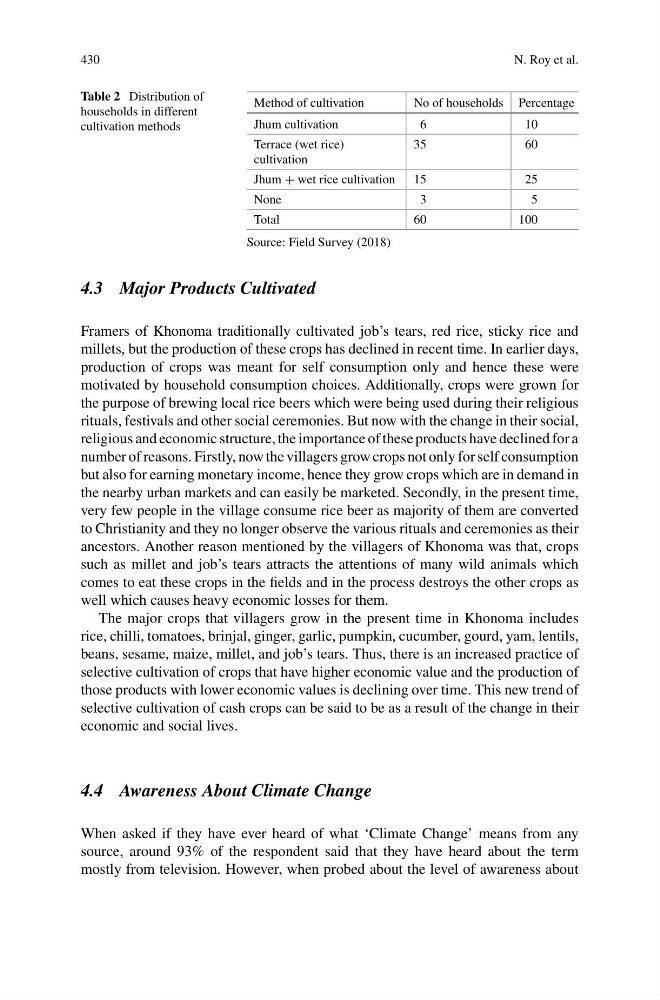
Table 2 Distribution of
households in different
cultivation methods
Method of cultivation
No of households Percentage
Jhum cultivation
6
10
Terrace (wet rice)
cultivation
35
60
Jhum + wet rice cultivation 15
25
None
3
5
Total
60
100
Source: Field Survey (2018)
4.3 Major Products Cultivated
Framers of Khonoma traditionally cultivated job’s tears, red rice, sticky rice and
millets, but the production of these crops has declined in recent time. In earlier days,
production of crops was meant for self consumption only and hence these were
motivated by household consumption choices. Additionally, crops were grown for
the purpose of brewing local rice beers which were being used during their religious
rituals, festivals and other social ceremonies. But now with the change in their social,
religious and economic structure, the importance of these products have declined for a
number of reasons. Firstly, now the villagers grow crops not only for self consumption
but also for earning monetary income, hence they grow crops which are in demand in
the nearby urban markets and can easily be marketed. Secondly, in the present time,
very few people in the village consume rice beer as majority of them are converted
to Christianity and they no longer observe the various rituals and ceremonies as their
ancestors. Another reason mentioned by the villagers of Khonoma was that, crops
such as millet and job’s tears attracts the attentions of many wild animals which
comes to eat these crops in the fields and in the process destroys the other crops as
well which causes heavy economic losses for them.
The major crops that villagers grow in the present time in Khonoma includes
rice, chilli, tomatoes, brinjal, ginger, garlic, pumpkin, cucumber, gourd, yam, lentils,
beans, sesame, maize, millet, and job’s tears. Thus, there is an increased practice of
selective cultivation of crops that have higher economic value and the production of
those products with lower economic values is declining over time. This new trend of
selective cultivation of cash crops can be said to be as a result of the change in their
economic and social lives.
4.4 Awareness About Climate Change
When asked if they have ever heard of what ‘Climate Change’ means from any
source, around 93% of the respondent said that they have heard about the term
mostly from television. However, when probed about the level of awareness about
N. Roy et al.
Table 2 Distribution of
households in different
cultivation methods
Method of cultivation
No of households Percentage
Jhum cultivation
6
10
Terrace (wet rice)
cultivation
35
60
Jhum + wet rice cultivation 15
25
None
3
5
Total
60
100
Source: Field Survey (2018)
4.3 Major Products Cultivated
Framers of Khonoma traditionally cultivated job’s tears, red rice, sticky rice and
millets, but the production of these crops has declined in recent time. In earlier days,
production of crops was meant for self consumption only and hence these were
motivated by household consumption choices. Additionally, crops were grown for
the purpose of brewing local rice beers which were being used during their religious
rituals, festivals and other social ceremonies. But now with the change in their social,
religious and economic structure, the importance of these products have declined for a
number of reasons. Firstly, now the villagers grow crops not only for self consumption
but also for earning monetary income, hence they grow crops which are in demand in
the nearby urban markets and can easily be marketed. Secondly, in the present time,
very few people in the village consume rice beer as majority of them are converted
to Christianity and they no longer observe the various rituals and ceremonies as their
ancestors. Another reason mentioned by the villagers of Khonoma was that, crops
such as millet and job’s tears attracts the attentions of many wild animals which
comes to eat these crops in the fields and in the process destroys the other crops as
well which causes heavy economic losses for them.
The major crops that villagers grow in the present time in Khonoma includes
rice, chilli, tomatoes, brinjal, ginger, garlic, pumpkin, cucumber, gourd, yam, lentils,
beans, sesame, maize, millet, and job’s tears. Thus, there is an increased practice of
selective cultivation of crops that have higher economic value and the production of
those products with lower economic values is declining over time. This new trend of
selective cultivation of cash crops can be said to be as a result of the change in their
economic and social lives.
4.4 Awareness About Climate Change
When asked if they have ever heard of what ‘Climate Change’ means from any
source, around 93% of the respondent said that they have heard about the term
mostly from television. However, when probed about the level of awareness about