

428
N. Roy et al.
Table 1 The primary
occupation
Primary occupation
Households (in %)
Agriculture
65
Cottage industries
6
Government/private employee
18
Daily wage labour
2
Business
3
Others
6
Source: Field survey (2018)
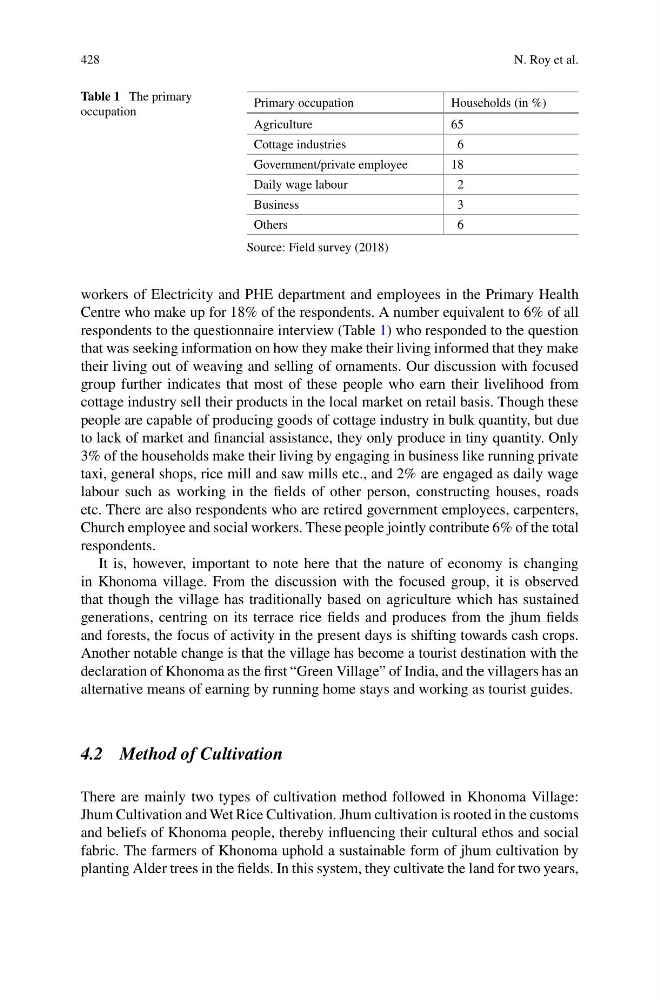
workers of Electricity and PHE department and employees in the Primary Health
Centre who make up for 18% of the respondents. A number equivalent to 6% of all
respondents to the questionnaire interview (Table 1) who responded to the question
that was seeking information on how they make their living informed that they make
their living out of weaving and selling of ornaments. Our discussion with focused
group further indicates that most of these people who earn their livelihood from
cottage industry sell their products in the local market on retail basis. Though these
people are capable of producing goods of cottage industry in bulk quantity, but due
to lack of market and financial assistance, they only produce in tiny quantity. Only
3% of the households make their living by engaging in business like running private
taxi, general shops, rice mill and saw mills etc., and 2% are engaged as daily wage
labour such as working in the fields of other person, constructing houses, roads
etc. There are also respondents who are retired government employees, carpenters,
Church employee and social workers. These people jointly contribute 6% of the total
respondents.
It is, however, important to note here that the nature of economy is changing
in Khonoma village. From the discussion with the focused group, it is observed
that though the village has traditionally based on agriculture which has sustained
generations, centring on its terrace rice fields and produces from the jhum fields
and forests, the focus of activity in the present days is shifting towards cash crops.
Another notable change is that the village has become a tourist destination with the
declaration of Khonoma as the first “Green Village” of India, and the villagers has an
alternative means of earning by running home stays and working as tourist guides.
4.2 Method of Cultivation
There are mainly two types of cultivation method followed in Khonoma Village:
Jhum Cultivation and Wet Rice Cultivation. Jhum cultivation is rooted in the customs
and beliefs of Khonoma people, thereby influencing their cultural ethos and social
fabric. The farmers of Khonoma uphold a sustainable form of jhum cultivation by
planting Alder trees in the fields. In this system, they cultivate the land for two years,
N. Roy et al.
Table 1 The primary
occupation
Primary occupation
Households (in %)
Agriculture
65
Cottage industries
6
Government/private employee
18
Daily wage labour
2
Business
3
Others
6
Source: Field survey (2018)
workers of Electricity and PHE department and employees in the Primary Health
Centre who make up for 18% of the respondents. A number equivalent to 6% of all
respondents to the questionnaire interview (Table 1) who responded to the question
that was seeking information on how they make their living informed that they make
their living out of weaving and selling of ornaments. Our discussion with focused
group further indicates that most of these people who earn their livelihood from
cottage industry sell their products in the local market on retail basis. Though these
people are capable of producing goods of cottage industry in bulk quantity, but due
to lack of market and financial assistance, they only produce in tiny quantity. Only
3% of the households make their living by engaging in business like running private
taxi, general shops, rice mill and saw mills etc., and 2% are engaged as daily wage
labour such as working in the fields of other person, constructing houses, roads
etc. There are also respondents who are retired government employees, carpenters,
Church employee and social workers. These people jointly contribute 6% of the total
respondents.
It is, however, important to note here that the nature of economy is changing
in Khonoma village. From the discussion with the focused group, it is observed
that though the village has traditionally based on agriculture which has sustained
generations, centring on its terrace rice fields and produces from the jhum fields
and forests, the focus of activity in the present days is shifting towards cash crops.
Another notable change is that the village has become a tourist destination with the
declaration of Khonoma as the first “Green Village” of India, and the villagers has an
alternative means of earning by running home stays and working as tourist guides.
4.2 Method of Cultivation
There are mainly two types of cultivation method followed in Khonoma Village:
Jhum Cultivation and Wet Rice Cultivation. Jhum cultivation is rooted in the customs
and beliefs of Khonoma people, thereby influencing their cultural ethos and social
fabric. The farmers of Khonoma uphold a sustainable form of jhum cultivation by
planting Alder trees in the fields. In this system, they cultivate the land for two years,