

Spatial Shift in Chickpeas in India
403
5 Data and Methodology
The study is based on the secondary data collected from the Directorate of Economics
and Statistics (DES), Ministry of Agriculture and Indian Institute of Pulses Research.
All India wise and State wise yearly data on Area, Production and Yield of chickpeas
were collected from 1964 to 2017. To examine the trends in Area, Production and
Productivity of chickpeas Compound Annual Growth Rate were used.
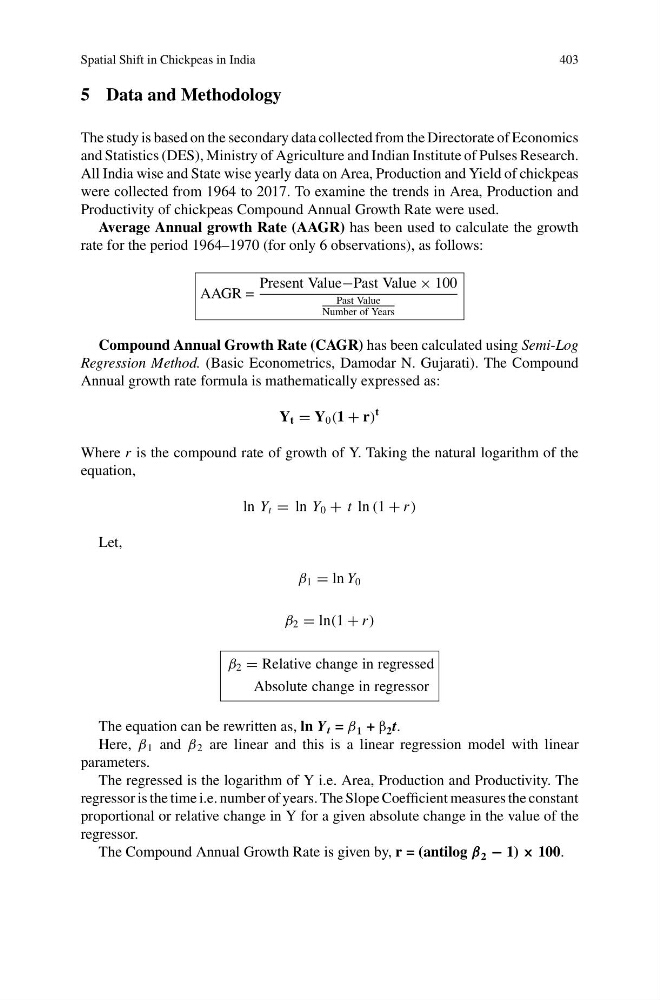
Average Annual growth Rate (AAGR) has been used to calculate the growth
rate for the period 1964–1970 (for only 6 observations), as follows:
AAGR =
Present Value−Past Value × 100
Past Value
Number of Years
Compound Annual Growth Rate (CAGR) has been calculated using Semi-Log
Regression Method. (Basic Econometrics, Damodar N. Gujarati). The Compound
Annual growth rate formula is mathematically expressed as:
Y t = Y 0 (1 + r)
t
Where r is the compound rate of growth of Y. Taking the natural logarithm of the
equation,
ln Y t = ln Y 0 + t ln (1 + r )
Let,
β 1 = ln Y 0
β 2 = ln(1 + r )
β 2 = Relative change in regressed
Absolute change in regressor
The equation can be rewritten as, ln Y t = β 1 + β 2 t.
Here, β 1 and β 2 are linear and this is a linear regression model with linear
parameters.
The regressed is the logarithm of Y i.e. Area, Production and Productivity. The
regressor is the time i.e. number of years. The Slope Coefficient measures the constant
proportional or relative change in Y for a given absolute change in the value of the
regressor.
The Compound Annual Growth Rate is given by, r = (antilog β 2 − 1) × 100.
403
5 Data and Methodology
The study is based on the secondary data collected from the Directorate of Economics
and Statistics (DES), Ministry of Agriculture and Indian Institute of Pulses Research.
All India wise and State wise yearly data on Area, Production and Yield of chickpeas
were collected from 1964 to 2017. To examine the trends in Area, Production and
Productivity of chickpeas Compound Annual Growth Rate were used.
Average Annual growth Rate (AAGR) has been used to calculate the growth
rate for the period 1964–1970 (for only 6 observations), as follows:
AAGR =
Present Value−Past Value × 100
Past Value
Number of Years
Compound Annual Growth Rate (CAGR) has been calculated using Semi-Log
Regression Method. (Basic Econometrics, Damodar N. Gujarati). The Compound
Annual growth rate formula is mathematically expressed as:
Y t = Y 0 (1 + r)
t
Where r is the compound rate of growth of Y. Taking the natural logarithm of the
equation,
ln Y t = ln Y 0 + t ln (1 + r )
Let,
β 1 = ln Y 0
β 2 = ln(1 + r )
β 2 = Relative change in regressed
Absolute change in regressor
The equation can be rewritten as, ln Y t = β 1 + β 2 t.
Here, β 1 and β 2 are linear and this is a linear regression model with linear
parameters.
The regressed is the logarithm of Y i.e. Area, Production and Productivity. The
regressor is the time i.e. number of years. The Slope Coefficient measures the constant
proportional or relative change in Y for a given absolute change in the value of the
regressor.
The Compound Annual Growth Rate is given by, r = (antilog β 2 − 1) × 100.