

Climate Change and Adaptation Strategies in the Gir Kesar …
393
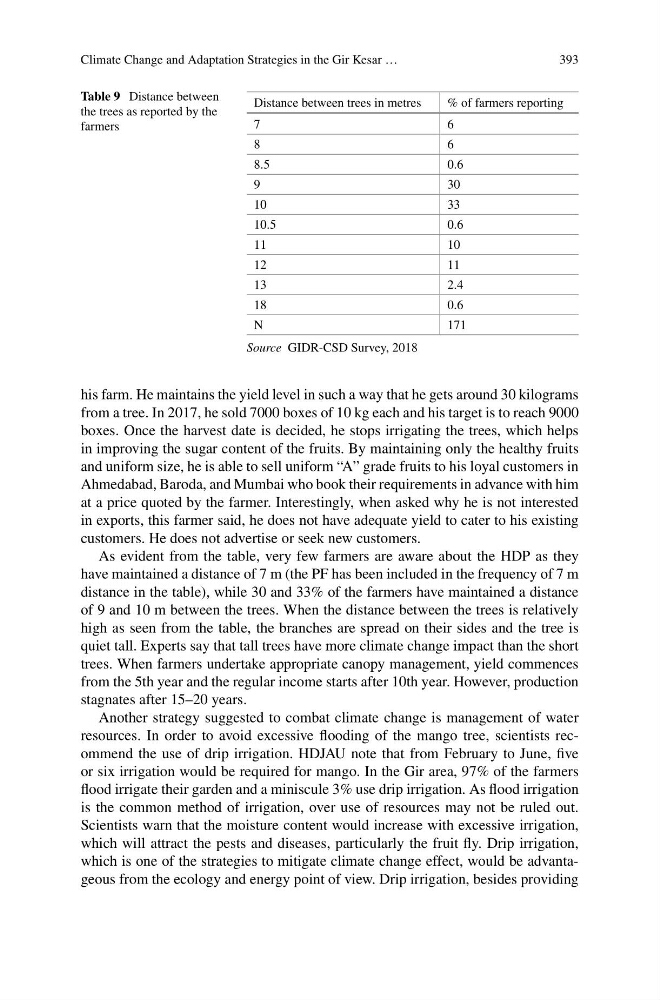
Table 9 Distance between
the trees as reported by the
farmers
Distance between trees in metres
% of farmers reporting
7
6
8
6
8.5
0.6
9
30
10
33
10.5
0.6
11
10
12
11
13
2.4
18
0.6
N
171
Source GIDR-CSD Survey, 2018
his farm. He maintains the yield level in such a way that he gets around 30 kilograms
from a tree. In 2017, he sold 7000 boxes of 10 kg each and his target is to reach 9000
boxes. Once the harvest date is decided, he stops irrigating the trees, which helps
in improving the sugar content of the fruits. By maintaining only the healthy fruits
and uniform size, he is able to sell uniform “A” grade fruits to his loyal customers in
Ahmedabad, Baroda, and Mumbai who book their requirements in advance with him
at a price quoted by the farmer. Interestingly, when asked why he is not interested
in exports, this farmer said, he does not have adequate yield to cater to his existing
customers. He does not advertise or seek new customers.
As evident from the table, very few farmers are aware about the HDP as they
have maintained a distance of 7 m (the PF has been included in the frequency of 7 m
distance in the table), while 30 and 33% of the farmers have maintained a distance
of 9 and 10 m between the trees. When the distance between the trees is relatively
high as seen from the table, the branches are spread on their sides and the tree is
quiet tall. Experts say that tall trees have more climate change impact than the short
trees. When farmers undertake appropriate canopy management, yield commences
from the 5th year and the regular income starts after 10th year. However, production
stagnates after 15–20 years.
Another strategy suggested to combat climate change is management of water
resources. In order to avoid excessive flooding of the mango tree, scientists recommend the use of drip irrigation. HDJAU note that from February to June, five
or six irrigation would be required for mango. In the Gir area, 97% of the farmers
flood irrigate their garden and a miniscule 3% use drip irrigation. As flood irrigation
is the common method of irrigation, over use of resources may not be ruled out.
Scientists warn that the moisture content would increase with excessive irrigation,
which will attract the pests and diseases, particularly the fruit fly. Drip irrigation,
which is one of the strategies to mitigate climate change effect, would be advantageous from the ecology and energy point of view. Drip irrigation, besides providing
393
Table 9 Distance between
the trees as reported by the
farmers
Distance between trees in metres
% of farmers reporting
7
6
8
6
8.5
0.6
9
30
10
33
10.5
0.6
11
10
12
11
13
2.4
18
0.6
N
171
Source GIDR-CSD Survey, 2018
his farm. He maintains the yield level in such a way that he gets around 30 kilograms
from a tree. In 2017, he sold 7000 boxes of 10 kg each and his target is to reach 9000
boxes. Once the harvest date is decided, he stops irrigating the trees, which helps
in improving the sugar content of the fruits. By maintaining only the healthy fruits
and uniform size, he is able to sell uniform “A” grade fruits to his loyal customers in
Ahmedabad, Baroda, and Mumbai who book their requirements in advance with him
at a price quoted by the farmer. Interestingly, when asked why he is not interested
in exports, this farmer said, he does not have adequate yield to cater to his existing
customers. He does not advertise or seek new customers.
As evident from the table, very few farmers are aware about the HDP as they
have maintained a distance of 7 m (the PF has been included in the frequency of 7 m
distance in the table), while 30 and 33% of the farmers have maintained a distance
of 9 and 10 m between the trees. When the distance between the trees is relatively
high as seen from the table, the branches are spread on their sides and the tree is
quiet tall. Experts say that tall trees have more climate change impact than the short
trees. When farmers undertake appropriate canopy management, yield commences
from the 5th year and the regular income starts after 10th year. However, production
stagnates after 15–20 years.
Another strategy suggested to combat climate change is management of water
resources. In order to avoid excessive flooding of the mango tree, scientists recommend the use of drip irrigation. HDJAU note that from February to June, five
or six irrigation would be required for mango. In the Gir area, 97% of the farmers
flood irrigate their garden and a miniscule 3% use drip irrigation. As flood irrigation
is the common method of irrigation, over use of resources may not be ruled out.
Scientists warn that the moisture content would increase with excessive irrigation,
which will attract the pests and diseases, particularly the fruit fly. Drip irrigation,
which is one of the strategies to mitigate climate change effect, would be advantageous from the ecology and energy point of view. Drip irrigation, besides providing