

346
R. Mandal and M. Sarma
Appendix 1
See Table 5.
Appendix 2
Estimation of National and State-specific Food Insecurity Lines
The report of the Expert Group (Rangarajan) to the Planning Commission (Government of India 2014) has outlined the normative requirements of expenditures on
food comprising calories, proteins and fats. This recommended expenditures (per
capita per month) amount on calories, proteins and fats are used as the benchmark
for measuring food insecurity in this study. Thus, the national food insecurity lines
have been defined as the monthly per capita food expenditure (calorie + protein +
fat) of Rs. 554 in rural areas and Rs 656 in urban areas. These national food insecurity lines are then adjusted as follows to estimate state specific food insecurity lines
(separately for rural and urban areas) so as to capture spatial variations in the price
level.
The ratio of price index of a state to the national average is worked out as follows.
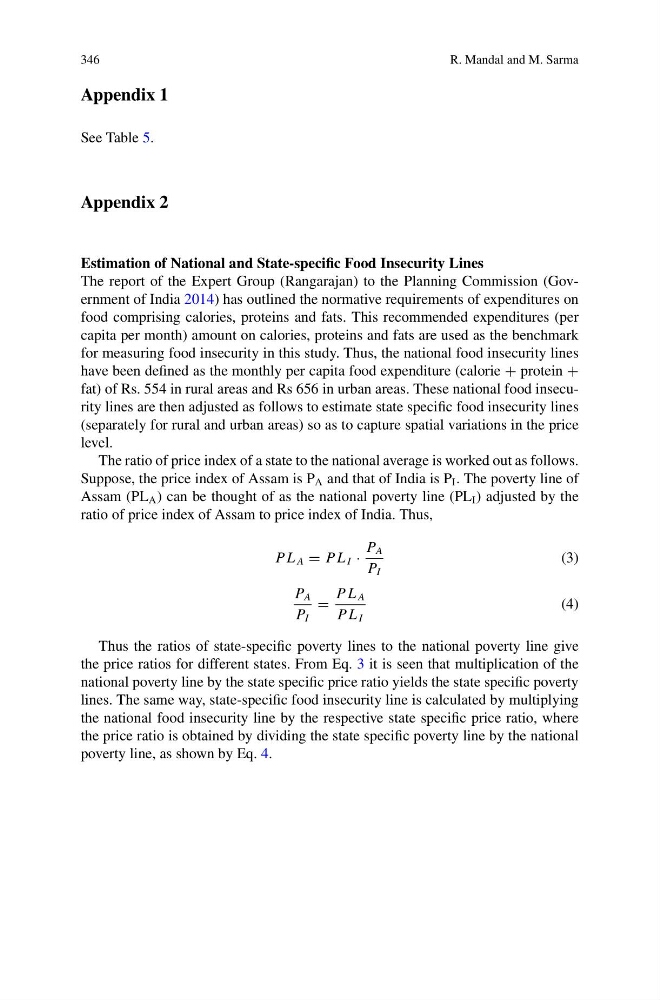
Suppose, the price index of Assam is P A and that of India is P I . The poverty line of
Assam (PL A ) can be thought of as the national poverty line (PL I ) adjusted by the
ratio of price index of Assam to price index of India. Thus,
P L A = P L I ·
P A
P I
(3)
P A
P I
=
P L A
P L I
(4)
Thus the ratios of state-specific poverty lines to the national poverty line give
the price ratios for different states. From Eq. 3 it is seen that multiplication of the
national poverty line by the state specific price ratio yields the state specific poverty
lines. The same way, state-specific food insecurity line is calculated by multiplying
the national food insecurity line by the respective state specific price ratio, where
the price ratio is obtained by dividing the state specific poverty line by the national
poverty line, as shown by Eq. 4.
R. Mandal and M. Sarma
Appendix 1
See Table 5.
Appendix 2
Estimation of National and State-specific Food Insecurity Lines
The report of the Expert Group (Rangarajan) to the Planning Commission (Government of India 2014) has outlined the normative requirements of expenditures on
food comprising calories, proteins and fats. This recommended expenditures (per
capita per month) amount on calories, proteins and fats are used as the benchmark
for measuring food insecurity in this study. Thus, the national food insecurity lines
have been defined as the monthly per capita food expenditure (calorie + protein +
fat) of Rs. 554 in rural areas and Rs 656 in urban areas. These national food insecurity lines are then adjusted as follows to estimate state specific food insecurity lines
(separately for rural and urban areas) so as to capture spatial variations in the price
level.
The ratio of price index of a state to the national average is worked out as follows.
Suppose, the price index of Assam is P A and that of India is P I . The poverty line of
Assam (PL A ) can be thought of as the national poverty line (PL I ) adjusted by the
ratio of price index of Assam to price index of India. Thus,
P L A = P L I ·
P A
P I
(3)
P A
P I
=
P L A
P L I
(4)
Thus the ratios of state-specific poverty lines to the national poverty line give
the price ratios for different states. From Eq. 3 it is seen that multiplication of the
national poverty line by the state specific price ratio yields the state specific poverty
lines. The same way, state-specific food insecurity line is calculated by multiplying
the national food insecurity line by the respective state specific price ratio, where
the price ratio is obtained by dividing the state specific poverty line by the national
poverty line, as shown by Eq. 4.