

340
R. Mandal and M. Sarma
F I i =
1
1 + e −Z
(1)
where,
Z = β 0 + β 1 W S i + β 2 PC I i + β 3 H S i + β 4 D R i + β 5 Remit i
+ β 6 Pov i + β 7 Cultivation i + β 8 F AE i
+ β 9 Ur i + β 10 Hindu i + β 11 O BC i + β 12 SC i + β 13 ST i + β 14 OC i + u i (2)
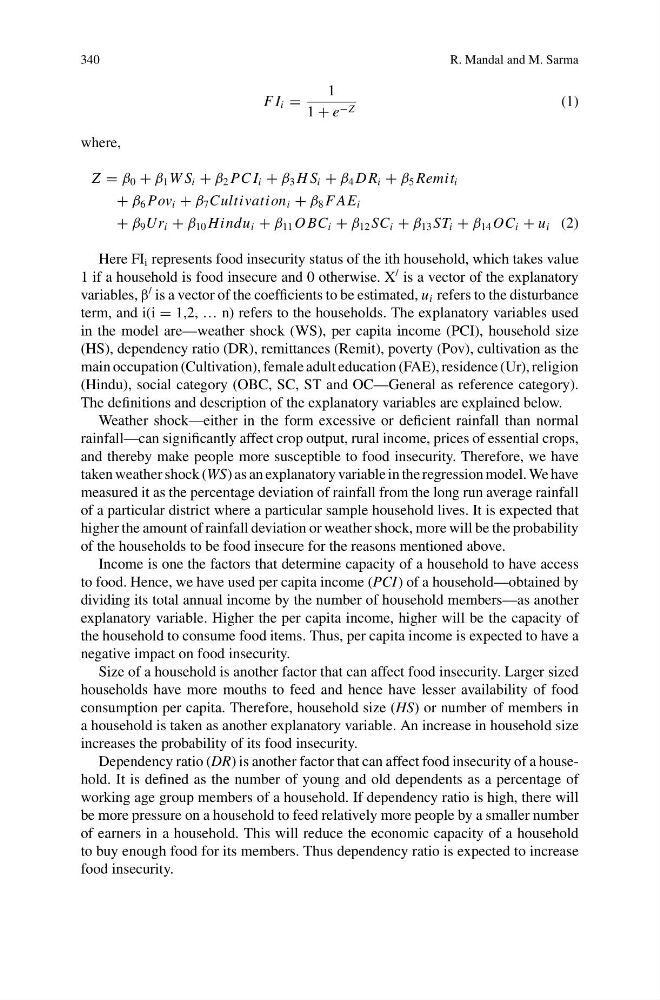
Here FI i represents food insecurity status of the ith household, which takes value
1 if a household is food insecure and 0 otherwise. X
/ is a vector of the explanatory
variables, β
/ is a vector of the coefficients to be estimated, u i refers to the disturbance
term, and i(i = 1,2, … n) refers to the households. The explanatory variables used
in the model are—weather shock (WS), per capita income (PCI), household size
(HS), dependency ratio (DR), remittances (Remit), poverty (Pov), cultivation as the
main occupation (Cultivation), female adult education (FAE), residence (Ur), religion
(Hindu), social category (OBC, SC, ST and OC—General as reference category).
The definitions and description of the explanatory variables are explained below.
Weather shock—either in the form excessive or deficient rainfall than normal
rainfall—can significantly affect crop output, rural income, prices of essential crops,
and thereby make people more susceptible to food insecurity. Therefore, we have
taken weather shock (WS) as an explanatory variable in the regression model. We have
measured it as the percentage deviation of rainfall from the long run average rainfall
of a particular district where a particular sample household lives. It is expected that
higher the amount of rainfall deviation or weather shock, more will be the probability
of the households to be food insecure for the reasons mentioned above.
Income is one the factors that determine capacity of a household to have access
to food. Hence, we have used per capita income (PCI) of a household—obtained by
dividing its total annual income by the number of household members—as another
explanatory variable. Higher the per capita income, higher will be the capacity of
the household to consume food items. Thus, per capita income is expected to have a
negative impact on food insecurity.
Size of a household is another factor that can affect food insecurity. Larger sized
households have more mouths to feed and hence have lesser availability of food
consumption per capita. Therefore, household size (HS) or number of members in
a household is taken as another explanatory variable. An increase in household size
increases the probability of its food insecurity.
Dependency ratio (DR) is another factor that can affect food insecurity of a household. It is defined as the number of young and old dependents as a percentage of
working age group members of a household. If dependency ratio is high, there will
be more pressure on a household to feed relatively more people by a smaller number
of earners in a household. This will reduce the economic capacity of a household
to buy enough food for its members. Thus dependency ratio is expected to increase
food insecurity.
R. Mandal and M. Sarma
F I i =
1
1 + e −Z
(1)
where,
Z = β 0 + β 1 W S i + β 2 PC I i + β 3 H S i + β 4 D R i + β 5 Remit i
+ β 6 Pov i + β 7 Cultivation i + β 8 F AE i
+ β 9 Ur i + β 10 Hindu i + β 11 O BC i + β 12 SC i + β 13 ST i + β 14 OC i + u i (2)
Here FI i represents food insecurity status of the ith household, which takes value
1 if a household is food insecure and 0 otherwise. X
/ is a vector of the explanatory
variables, β
/ is a vector of the coefficients to be estimated, u i refers to the disturbance
term, and i(i = 1,2, … n) refers to the households. The explanatory variables used
in the model are—weather shock (WS), per capita income (PCI), household size
(HS), dependency ratio (DR), remittances (Remit), poverty (Pov), cultivation as the
main occupation (Cultivation), female adult education (FAE), residence (Ur), religion
(Hindu), social category (OBC, SC, ST and OC—General as reference category).
The definitions and description of the explanatory variables are explained below.
Weather shock—either in the form excessive or deficient rainfall than normal
rainfall—can significantly affect crop output, rural income, prices of essential crops,
and thereby make people more susceptible to food insecurity. Therefore, we have
taken weather shock (WS) as an explanatory variable in the regression model. We have
measured it as the percentage deviation of rainfall from the long run average rainfall
of a particular district where a particular sample household lives. It is expected that
higher the amount of rainfall deviation or weather shock, more will be the probability
of the households to be food insecure for the reasons mentioned above.
Income is one the factors that determine capacity of a household to have access
to food. Hence, we have used per capita income (PCI) of a household—obtained by
dividing its total annual income by the number of household members—as another
explanatory variable. Higher the per capita income, higher will be the capacity of
the household to consume food items. Thus, per capita income is expected to have a
negative impact on food insecurity.
Size of a household is another factor that can affect food insecurity. Larger sized
households have more mouths to feed and hence have lesser availability of food
consumption per capita. Therefore, household size (HS) or number of members in
a household is taken as another explanatory variable. An increase in household size
increases the probability of its food insecurity.
Dependency ratio (DR) is another factor that can affect food insecurity of a household. It is defined as the number of young and old dependents as a percentage of
working age group members of a household. If dependency ratio is high, there will
be more pressure on a household to feed relatively more people by a smaller number
of earners in a household. This will reduce the economic capacity of a household
to buy enough food for its members. Thus dependency ratio is expected to increase
food insecurity.