

322
L. Kapoor and S. Usha
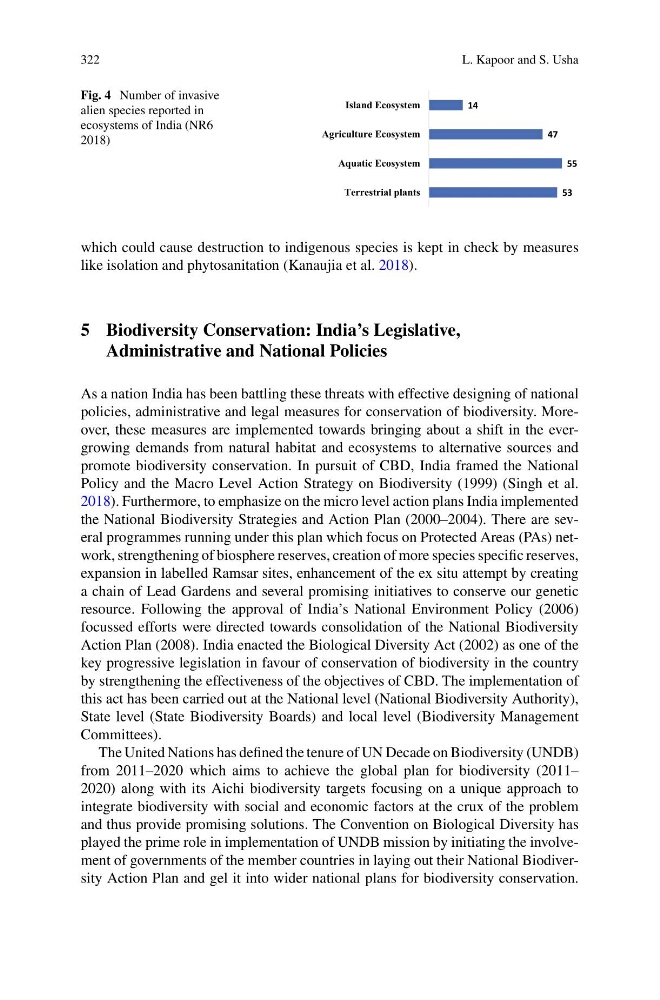
Fig. 4 Number of invasive
alien species reported in
ecosystems of India (NR6
2018)
53
55
47
14
Terrestrial plants
Aquatic Ecosystem
Agriculture Ecosystem
Island Ecosystem
which could cause destruction to indigenous species is kept in check by measures
like isolation and phytosanitation (Kanaujia et al. 2018).
5 Biodiversity Conservation: India’s Legislative,
Administrative and National Policies
As a nation India has been battling these threats with effective designing of national
policies, administrative and legal measures for conservation of biodiversity. Moreover, these measures are implemented towards bringing about a shift in the evergrowing demands from natural habitat and ecosystems to alternative sources and
promote biodiversity conservation. In pursuit of CBD, India framed the National
Policy and the Macro Level Action Strategy on Biodiversity (1999) (Singh et al.
2018). Furthermore, to emphasize on the micro level action plans India implemented
the National Biodiversity Strategies and Action Plan (2000–2004). There are several programmes running under this plan which focus on Protected Areas (PAs) network, strengthening of biosphere reserves, creation of more species specific reserves,
expansion in labelled Ramsar sites, enhancement of the ex situ attempt by creating
a chain of Lead Gardens and several promising initiatives to conserve our genetic
resource. Following the approval of India’s National Environment Policy (2006)
focussed efforts were directed towards consolidation of the National Biodiversity
Action Plan (2008). India enacted the Biological Diversity Act (2002) as one of the
key progressive legislation in favour of conservation of biodiversity in the country
by strengthening the effectiveness of the objectives of CBD. The implementation of
this act has been carried out at the National level (National Biodiversity Authority),
State level (State Biodiversity Boards) and local level (Biodiversity Management
Committees).
The United Nations has defined the tenure of UN Decade on Biodiversity (UNDB)
from 2011–2020 which aims to achieve the global plan for biodiversity (2011–
2020) along with its Aichi biodiversity targets focusing on a unique approach to
integrate biodiversity with social and economic factors at the crux of the problem
and thus provide promising solutions. The Convention on Biological Diversity has
played the prime role in implementation of UNDB mission by initiating the involvement of governments of the member countries in laying out their National Biodiversity Action Plan and gel it into wider national plans for biodiversity conservation.
L. Kapoor and S. Usha
Fig. 4 Number of invasive
alien species reported in
ecosystems of India (NR6
2018)
53
55
47
14
Terrestrial plants
Aquatic Ecosystem
Agriculture Ecosystem
Island Ecosystem
which could cause destruction to indigenous species is kept in check by measures
like isolation and phytosanitation (Kanaujia et al. 2018).
5 Biodiversity Conservation: India’s Legislative,
Administrative and National Policies
As a nation India has been battling these threats with effective designing of national
policies, administrative and legal measures for conservation of biodiversity. Moreover, these measures are implemented towards bringing about a shift in the evergrowing demands from natural habitat and ecosystems to alternative sources and
promote biodiversity conservation. In pursuit of CBD, India framed the National
Policy and the Macro Level Action Strategy on Biodiversity (1999) (Singh et al.
2018). Furthermore, to emphasize on the micro level action plans India implemented
the National Biodiversity Strategies and Action Plan (2000–2004). There are several programmes running under this plan which focus on Protected Areas (PAs) network, strengthening of biosphere reserves, creation of more species specific reserves,
expansion in labelled Ramsar sites, enhancement of the ex situ attempt by creating
a chain of Lead Gardens and several promising initiatives to conserve our genetic
resource. Following the approval of India’s National Environment Policy (2006)
focussed efforts were directed towards consolidation of the National Biodiversity
Action Plan (2008). India enacted the Biological Diversity Act (2002) as one of the
key progressive legislation in favour of conservation of biodiversity in the country
by strengthening the effectiveness of the objectives of CBD. The implementation of
this act has been carried out at the National level (National Biodiversity Authority),
State level (State Biodiversity Boards) and local level (Biodiversity Management
Committees).
The United Nations has defined the tenure of UN Decade on Biodiversity (UNDB)
from 2011–2020 which aims to achieve the global plan for biodiversity (2011–
2020) along with its Aichi biodiversity targets focusing on a unique approach to
integrate biodiversity with social and economic factors at the crux of the problem
and thus provide promising solutions. The Convention on Biological Diversity has
played the prime role in implementation of UNDB mission by initiating the involvement of governments of the member countries in laying out their National Biodiversity Action Plan and gel it into wider national plans for biodiversity conservation.