

Climate Change Impacts and Implications: An Indian Perspective
21
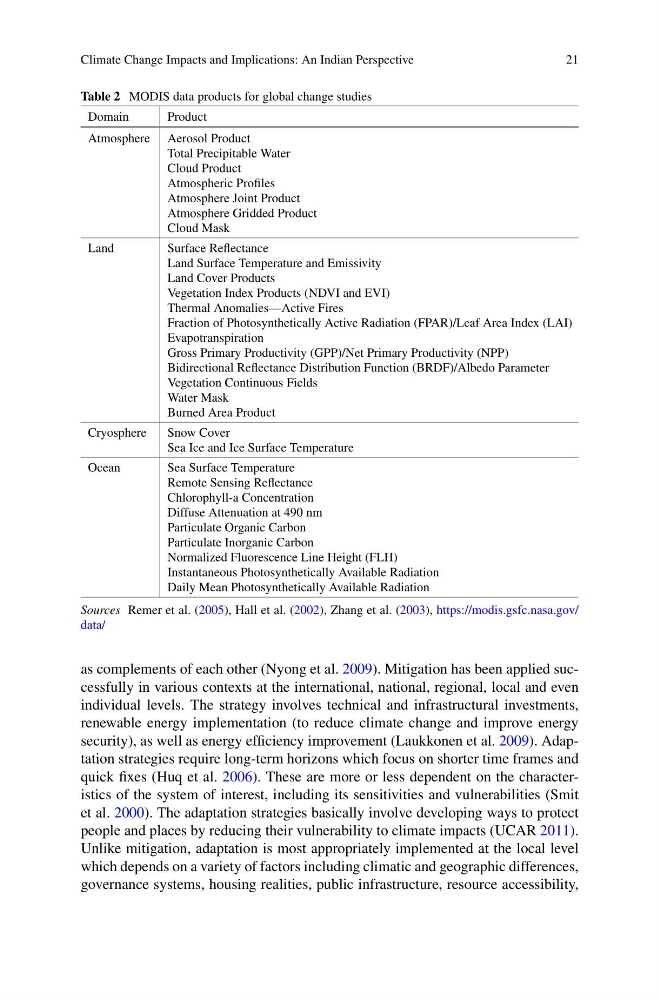
Table 2 MODIS data products for global change studies
Domain
Product
Atmosphere Aerosol Product
Total Precipitable Water
Cloud Product
Atmospheric Profiles
Atmosphere Joint Product
Atmosphere Gridded Product
Cloud Mask
Land
Surface Reflectance
Land Surface Temperature and Emissivity
Land Cover Products
Vegetation Index Products (NDVI and EVI)
Thermal Anomalies—Active Fires
Fraction of Photosynthetically Active Radiation (FPAR)/Leaf Area Index (LAI)
Evapotranspiration
Gross Primary Productivity (GPP)/Net Primary Productivity (NPP)
Bidirectional Reflectance Distribution Function (BRDF)/Albedo Parameter
Vegetation Continuous Fields
Water Mask
Burned Area Product
Cryosphere
Snow Cover
Sea Ice and Ice Surface Temperature
Ocean
Sea Surface Temperature
Remote Sensing Reflectance
Chlorophyll-a Concentration
Diffuse Attenuation at 490 nm
Particulate Organic Carbon
Particulate Inorganic Carbon
Normalized Fluorescence Line Height (FLH)
Instantaneous Photosynthetically Available Radiation
Daily Mean Photosynthetically Available Radiation
Sources Remer et al. (2005), Hall et al. (2002), Zhang et al. (2003), https://modis.gsfc.nasa.gov/
data/
as complements of each other (Nyong et al. 2009). Mitigation has been applied successfully in various contexts at the international, national, regional, local and even
individual levels. The strategy involves technical and infrastructural investments,
renewable energy implementation (to reduce climate change and improve energy
security), as well as energy efficiency improvement (Laukkonen et al. 2009). Adaptation strategies require long-term horizons which focus on shorter time frames and
quick fixes (Huq et al. 2006). These are more or less dependent on the characteristics of the system of interest, including its sensitivities and vulnerabilities (Smit
et al. 2000). The adaptation strategies basically involve developing ways to protect
people and places by reducing their vulnerability to climate impacts (UCAR 2011).
Unlike mitigation, adaptation is most appropriately implemented at the local level
which depends on a variety of factors including climatic and geographic differences,
governance systems, housing realities, public infrastructure, resource accessibility,
21
Table 2 MODIS data products for global change studies
Domain
Product
Atmosphere Aerosol Product
Total Precipitable Water
Cloud Product
Atmospheric Profiles
Atmosphere Joint Product
Atmosphere Gridded Product
Cloud Mask
Land
Surface Reflectance
Land Surface Temperature and Emissivity
Land Cover Products
Vegetation Index Products (NDVI and EVI)
Thermal Anomalies—Active Fires
Fraction of Photosynthetically Active Radiation (FPAR)/Leaf Area Index (LAI)
Evapotranspiration
Gross Primary Productivity (GPP)/Net Primary Productivity (NPP)
Bidirectional Reflectance Distribution Function (BRDF)/Albedo Parameter
Vegetation Continuous Fields
Water Mask
Burned Area Product
Cryosphere
Snow Cover
Sea Ice and Ice Surface Temperature
Ocean
Sea Surface Temperature
Remote Sensing Reflectance
Chlorophyll-a Concentration
Diffuse Attenuation at 490 nm
Particulate Organic Carbon
Particulate Inorganic Carbon
Normalized Fluorescence Line Height (FLH)
Instantaneous Photosynthetically Available Radiation
Daily Mean Photosynthetically Available Radiation
Sources Remer et al. (2005), Hall et al. (2002), Zhang et al. (2003), https://modis.gsfc.nasa.gov/
data/
as complements of each other (Nyong et al. 2009). Mitigation has been applied successfully in various contexts at the international, national, regional, local and even
individual levels. The strategy involves technical and infrastructural investments,
renewable energy implementation (to reduce climate change and improve energy
security), as well as energy efficiency improvement (Laukkonen et al. 2009). Adaptation strategies require long-term horizons which focus on shorter time frames and
quick fixes (Huq et al. 2006). These are more or less dependent on the characteristics of the system of interest, including its sensitivities and vulnerabilities (Smit
et al. 2000). The adaptation strategies basically involve developing ways to protect
people and places by reducing their vulnerability to climate impacts (UCAR 2011).
Unlike mitigation, adaptation is most appropriately implemented at the local level
which depends on a variety of factors including climatic and geographic differences,
governance systems, housing realities, public infrastructure, resource accessibility,