

308
J. Narayana et al.
emissions through sequestration. Hence the quantification of carbon sequestration
by trees is essential both globally and locally in the perspective of combating climate
change.
The study was carried out for a time period of 9 months from September 2018 to
May 2019. A non-destructive method was followed on the basis of DBH (Diameter at
breast height). Quantitative floristic inventories based on small sized permanent plots
(1–2 ha) have been used in recent years to characterize the vegetation in different
tropical forests by documenting their structure, composition and diversity. Here the
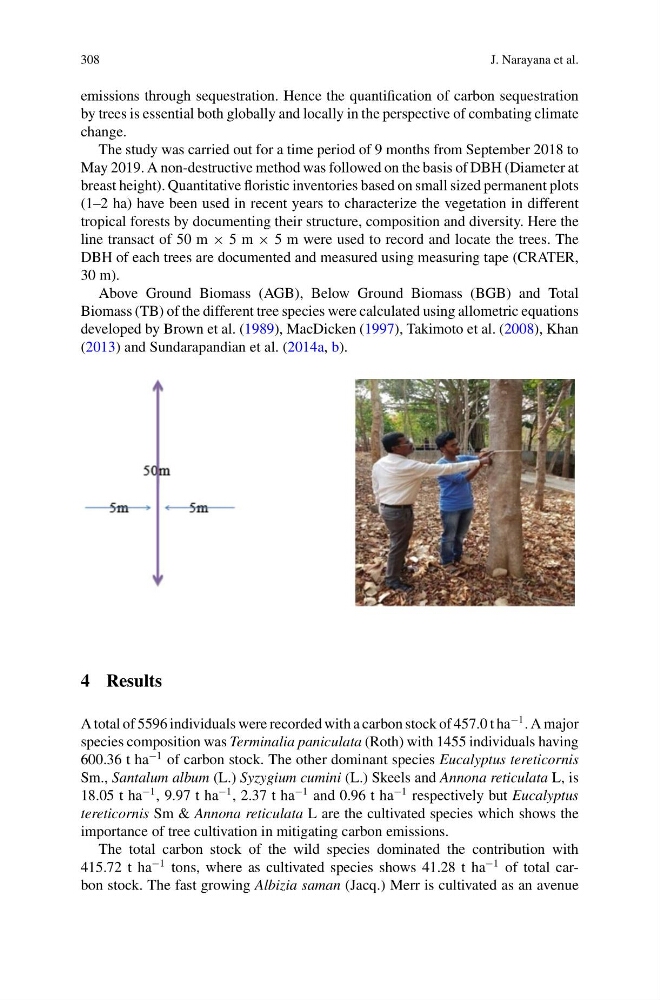
line transact of 50 m × 5 m × 5 m were used to record and locate the trees. The
DBH of each trees are documented and measured using measuring tape (CRATER,
30 m).
Above Ground Biomass (AGB), Below Ground Biomass (BGB) and Total
Biomass (TB) of the different tree species were calculated using allometric equations
developed by Brown et al. (1989), MacDicken (1997), Takimoto et al. (2008), Khan
(2013) and Sundarapandian et al. (2014a, b).
4 Results
A total of 5596 individuals were recorded with a carbon stock of 457.0 t ha
−1 . A major
species composition was Terminalia paniculata (Roth) with 1455 individuals having
600.36 t ha
−1 of carbon stock. The other dominant species Eucalyptus tereticornis
Sm., Santalum album (L.) Syzygium cumini (L.) Skeels and Annona reticulata L, is
18.05 t ha
−1 , 9.97 t ha
−1 , 2.37 t ha
−1 and 0.96 t ha
−1 respectively but Eucalyptus
tereticornis Sm & Annona reticulata L are the cultivated species which shows the
importance of tree cultivation in mitigating carbon emissions.
The total carbon stock of the wild species dominated the contribution with
415.72 t ha
−1 tons, where as cultivated species shows 41.28 t ha
−1 of total carbon stock. The fast growing Albizia saman (Jacq.) Merr is cultivated as an avenue
J. Narayana et al.
emissions through sequestration. Hence the quantification of carbon sequestration
by trees is essential both globally and locally in the perspective of combating climate
change.
The study was carried out for a time period of 9 months from September 2018 to
May 2019. A non-destructive method was followed on the basis of DBH (Diameter at
breast height). Quantitative floristic inventories based on small sized permanent plots
(1–2 ha) have been used in recent years to characterize the vegetation in different
tropical forests by documenting their structure, composition and diversity. Here the
line transact of 50 m × 5 m × 5 m were used to record and locate the trees. The
DBH of each trees are documented and measured using measuring tape (CRATER,
30 m).
Above Ground Biomass (AGB), Below Ground Biomass (BGB) and Total
Biomass (TB) of the different tree species were calculated using allometric equations
developed by Brown et al. (1989), MacDicken (1997), Takimoto et al. (2008), Khan
(2013) and Sundarapandian et al. (2014a, b).
4 Results
A total of 5596 individuals were recorded with a carbon stock of 457.0 t ha
−1 . A major
species composition was Terminalia paniculata (Roth) with 1455 individuals having
600.36 t ha
−1 of carbon stock. The other dominant species Eucalyptus tereticornis
Sm., Santalum album (L.) Syzygium cumini (L.) Skeels and Annona reticulata L, is
18.05 t ha
−1 , 9.97 t ha
−1 , 2.37 t ha
−1 and 0.96 t ha
−1 respectively but Eucalyptus
tereticornis Sm & Annona reticulata L are the cultivated species which shows the
importance of tree cultivation in mitigating carbon emissions.
The total carbon stock of the wild species dominated the contribution with
415.72 t ha
−1 tons, where as cultivated species shows 41.28 t ha
−1 of total carbon stock. The fast growing Albizia saman (Jacq.) Merr is cultivated as an avenue