

Assessment of Different Aspects of Elephant Depredation …
253
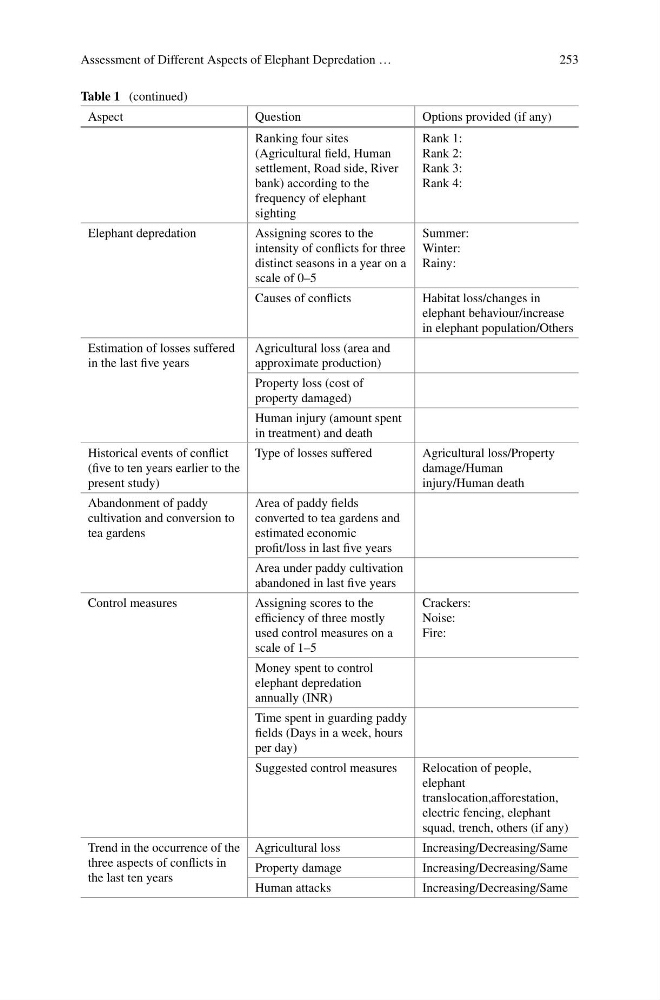
Table 1 (continued)
Aspect
Question
Options provided (if any)
Ranking four sites
(Agricultural field, Human
settlement, Road side, River
bank) according to the
frequency of elephant
sighting
Rank 1:
Rank 2:
Rank 3:
Rank 4:
Elephant depredation
Assigning scores to the
intensity of conflicts for three
distinct seasons in a year on a
scale of 0–5
Summer:
Winter:
Rainy:
Causes of conflicts
Habitat loss/changes in
elephant behaviour/increase
in elephant population/Others
Estimation of losses suffered
in the last five years
Agricultural loss (area and
approximate production)
Property loss (cost of
property damaged)
Human injury (amount spent
in treatment) and death
Historical events of conflict
(five to ten years earlier to the
present study)
Type of losses suffered
Agricultural loss/Property
damage/Human
injury/Human death
Abandonment of paddy
cultivation and conversion to
tea gardens
Area of paddy fields
converted to tea gardens and
estimated economic
profit/loss in last five years
Area under paddy cultivation
abandoned in last five years
Control measures
Assigning scores to the
efficiency of three mostly
used control measures on a
scale of 1–5
Crackers:
Noise:
Fire:
Money spent to control
elephant depredation
annually (INR)
Time spent in guarding paddy
fields (Days in a week, hours
per day)
Suggested control measures
Relocation of people,
elephant
translocation,afforestation,
electric fencing, elephant
squad, trench, others (if any)
Trend in the occurrence of the
three aspects of conflicts in
the last ten years
Agricultural loss
Increasing/Decreasing/Same
Property damage
Increasing/Decreasing/Same
Human attacks
Increasing/Decreasing/Same
253
Table 1 (continued)
Aspect
Question
Options provided (if any)
Ranking four sites
(Agricultural field, Human
settlement, Road side, River
bank) according to the
frequency of elephant
sighting
Rank 1:
Rank 2:
Rank 3:
Rank 4:
Elephant depredation
Assigning scores to the
intensity of conflicts for three
distinct seasons in a year on a
scale of 0–5
Summer:
Winter:
Rainy:
Causes of conflicts
Habitat loss/changes in
elephant behaviour/increase
in elephant population/Others
Estimation of losses suffered
in the last five years
Agricultural loss (area and
approximate production)
Property loss (cost of
property damaged)
Human injury (amount spent
in treatment) and death
Historical events of conflict
(five to ten years earlier to the
present study)
Type of losses suffered
Agricultural loss/Property
damage/Human
injury/Human death
Abandonment of paddy
cultivation and conversion to
tea gardens
Area of paddy fields
converted to tea gardens and
estimated economic
profit/loss in last five years
Area under paddy cultivation
abandoned in last five years
Control measures
Assigning scores to the
efficiency of three mostly
used control measures on a
scale of 1–5
Crackers:
Noise:
Fire:
Money spent to control
elephant depredation
annually (INR)
Time spent in guarding paddy
fields (Days in a week, hours
per day)
Suggested control measures
Relocation of people,
elephant
translocation,afforestation,
electric fencing, elephant
squad, trench, others (if any)
Trend in the occurrence of the
three aspects of conflicts in
the last ten years
Agricultural loss
Increasing/Decreasing/Same
Property damage
Increasing/Decreasing/Same
Human attacks
Increasing/Decreasing/Same