

Biology, Uses and Conservation of Trillium govanianum
237
2 Biology
2.1 Distribution
T. govanianum is distributed in the Himalayan range of Afghanistan, China (Tibet),
Eastern & Western Himalayas (India), Nepal and Pakistan (Roskov et al. 2018). In
Indian Himalayan Region, the species is found in the temperate and sub-alpine forest from Kashmir to Sikkim at an altitude of 2400–3500 m (Polunin and Stainton
1984; Hooker 1894). The species is more common in western Himalayan region
as compared to eastern region (Chauhan et al. 2018). The main areas of its distribution in Uttarakhand are Munsiyari, Tungnath, Kedarnath, Pindari, Govind Pashu
Vihar, Gangotri, Harshil, Panchachuli and Sunderdhunga. In Himachal Pradesh, the
species is commonly reported from Kullu, Shimla, Kinnaur and Lahaul-Spiti while in
Jammu and Kashmir, the species grows in Fatehpur, Gulmarg, Kanzalwan, Pahalgam,
Poonch, Gurez, Sonamarg areas.
2.2 Morphology and Life Cycle
T. govanianum is a rhizomatous herb with a 10–20 cm tall stem. Leaves are broadly
ovate, acute, stalked appearing in a whorl of three at maturity. At reproduction,
usually, a single solitary flower of 2-3 cm emerges at the shoot apex with six distinctly yellow and basifixed stamen, a whorl each of petals and sepals, and a three
celled purplish-brown ovary that produces multiple seeds. Like other Trillium species,
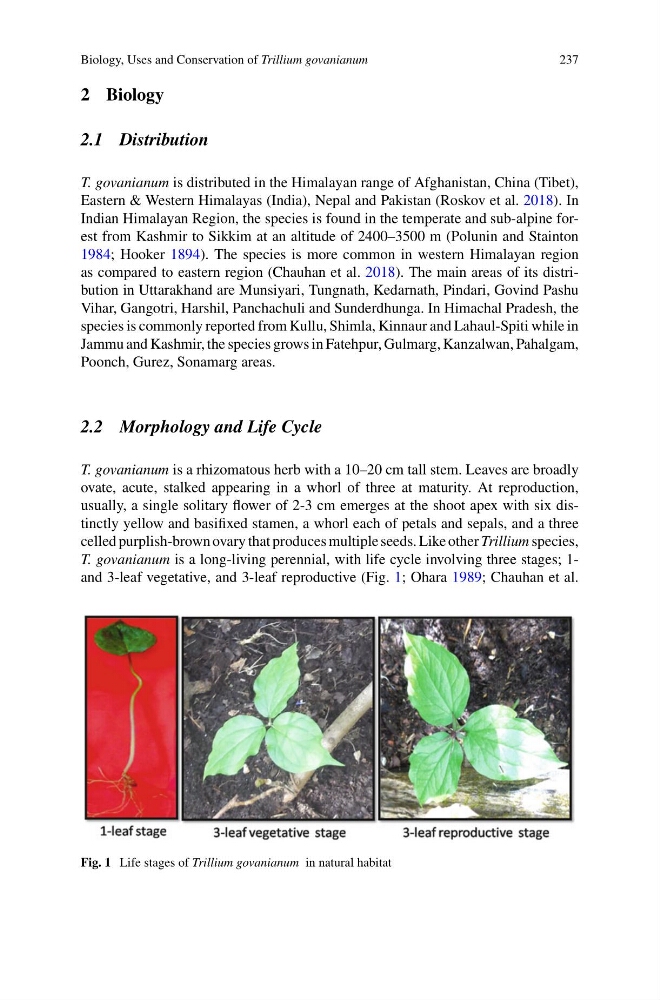
T. govanianum is a long-living perennial, with life cycle involving three stages; 1and 3-leaf vegetative, and 3-leaf reproductive (Fig. 1; Ohara 1989; Chauhan et al.
Fig. 1 Life stages of Trillium govanianum in natural habitat
237
2 Biology
2.1 Distribution
T. govanianum is distributed in the Himalayan range of Afghanistan, China (Tibet),
Eastern & Western Himalayas (India), Nepal and Pakistan (Roskov et al. 2018). In
Indian Himalayan Region, the species is found in the temperate and sub-alpine forest from Kashmir to Sikkim at an altitude of 2400–3500 m (Polunin and Stainton
1984; Hooker 1894). The species is more common in western Himalayan region
as compared to eastern region (Chauhan et al. 2018). The main areas of its distribution in Uttarakhand are Munsiyari, Tungnath, Kedarnath, Pindari, Govind Pashu
Vihar, Gangotri, Harshil, Panchachuli and Sunderdhunga. In Himachal Pradesh, the
species is commonly reported from Kullu, Shimla, Kinnaur and Lahaul-Spiti while in
Jammu and Kashmir, the species grows in Fatehpur, Gulmarg, Kanzalwan, Pahalgam,
Poonch, Gurez, Sonamarg areas.
2.2 Morphology and Life Cycle
T. govanianum is a rhizomatous herb with a 10–20 cm tall stem. Leaves are broadly
ovate, acute, stalked appearing in a whorl of three at maturity. At reproduction,
usually, a single solitary flower of 2-3 cm emerges at the shoot apex with six distinctly yellow and basifixed stamen, a whorl each of petals and sepals, and a three
celled purplish-brown ovary that produces multiple seeds. Like other Trillium species,
T. govanianum is a long-living perennial, with life cycle involving three stages; 1and 3-leaf vegetative, and 3-leaf reproductive (Fig. 1; Ohara 1989; Chauhan et al.
Fig. 1 Life stages of Trillium govanianum in natural habitat