

226
J. Purkayastha et al.
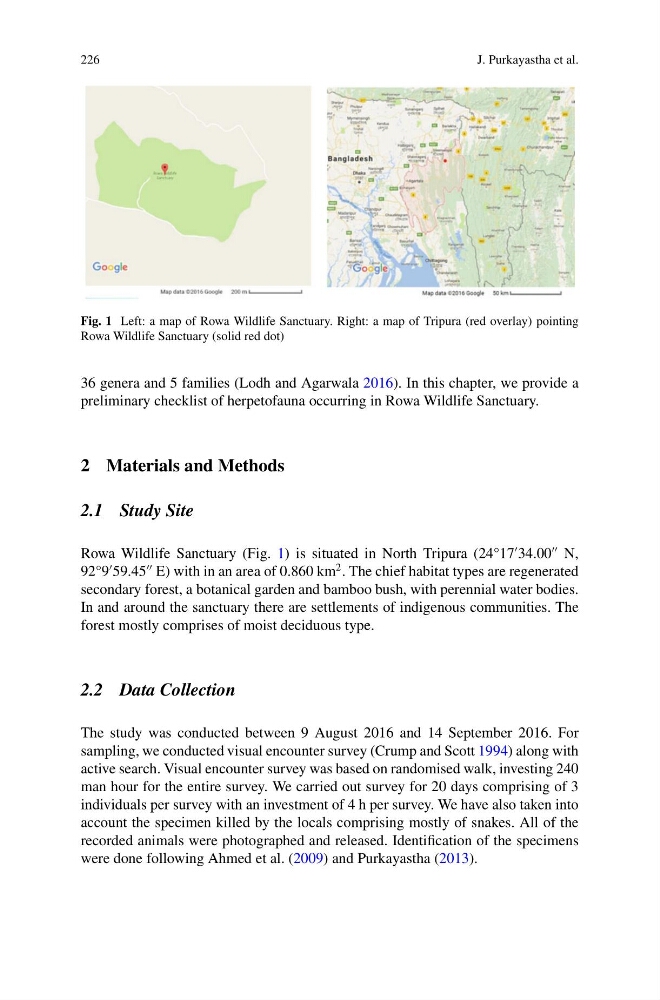
Fig. 1 Left: a map of Rowa Wildlife Sanctuary. Right: a map of Tripura (red overlay) pointing
Rowa Wildlife Sanctuary (solid red dot)
36 genera and 5 families (Lodh and Agarwala 2016). In this chapter, we provide a
preliminary checklist of herpetofauna occurring in Rowa Wildlife Sanctuary.
2 Materials and Methods
2.1 Study Site
Rowa Wildlife Sanctuary (Fig. 1) is situated in North Tripura (24°17
34.00
N,
92°9
59.45
E) with in an area of 0.860 km
2 . The chief habitat types are regenerated
secondary forest, a botanical garden and bamboo bush, with perennial water bodies.
In and around the sanctuary there are settlements of indigenous communities. The
forest mostly comprises of moist deciduous type.
2.2 Data Collection
The study was conducted between 9 August 2016 and 14 September 2016. For
sampling, we conducted visual encounter survey (Crump and Scott 1994) along with
active search. Visual encounter survey was based on randomised walk, investing 240
man hour for the entire survey. We carried out survey for 20 days comprising of 3
individuals per survey with an investment of 4 h per survey. We have also taken into
account the specimen killed by the locals comprising mostly of snakes. All of the
recorded animals were photographed and released. Identification of the specimens
were done following Ahmed et al. (2009) and Purkayastha (2013).
J. Purkayastha et al.
Fig. 1 Left: a map of Rowa Wildlife Sanctuary. Right: a map of Tripura (red overlay) pointing
Rowa Wildlife Sanctuary (solid red dot)
36 genera and 5 families (Lodh and Agarwala 2016). In this chapter, we provide a
preliminary checklist of herpetofauna occurring in Rowa Wildlife Sanctuary.
2 Materials and Methods
2.1 Study Site
Rowa Wildlife Sanctuary (Fig. 1) is situated in North Tripura (24°17
34.00
N,
92°9
59.45
E) with in an area of 0.860 km
2 . The chief habitat types are regenerated
secondary forest, a botanical garden and bamboo bush, with perennial water bodies.
In and around the sanctuary there are settlements of indigenous communities. The
forest mostly comprises of moist deciduous type.
2.2 Data Collection
The study was conducted between 9 August 2016 and 14 September 2016. For
sampling, we conducted visual encounter survey (Crump and Scott 1994) along with
active search. Visual encounter survey was based on randomised walk, investing 240
man hour for the entire survey. We carried out survey for 20 days comprising of 3
individuals per survey with an investment of 4 h per survey. We have also taken into
account the specimen killed by the locals comprising mostly of snakes. All of the
recorded animals were photographed and released. Identification of the specimens
were done following Ahmed et al. (2009) and Purkayastha (2013).