

222
J. Purkayastha et al.
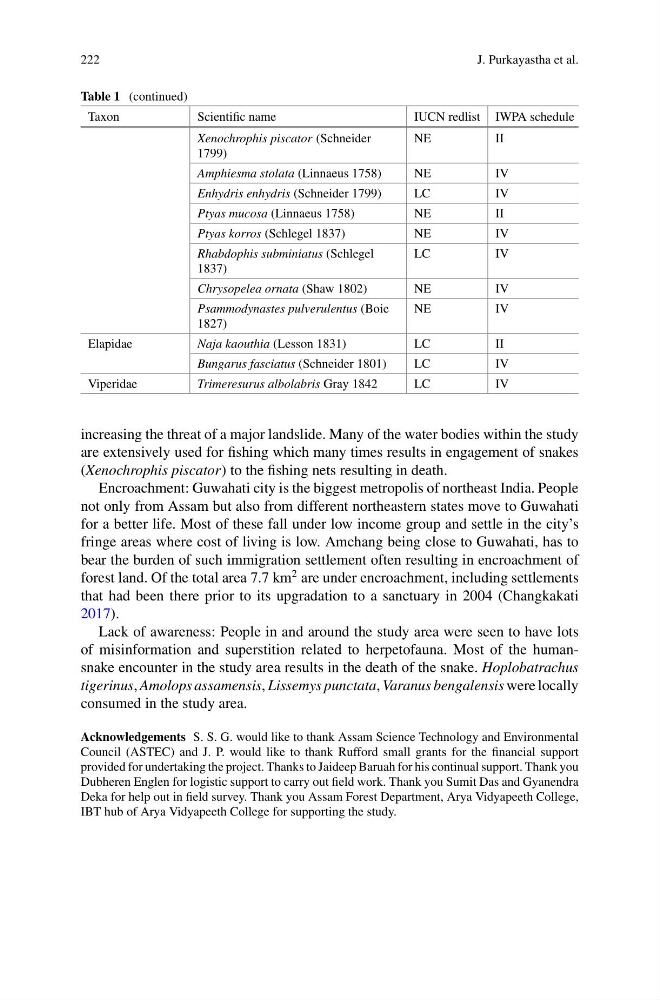
Table 1 (continued)
Taxon
Scientific name
IUCN redlist IWPA schedule
Xenochrophis piscator (Schneider
1799)
NE
II
Amphiesma stolata (Linnaeus 1758)
NE
IV
Enhydris enhydris (Schneider 1799)
LC
IV
Ptyas mucosa (Linnaeus 1758)
NE
II
Ptyas korros (Schlegel 1837)
NE
IV
Rhabdophis subminiatus (Schlegel
1837)
LC
IV
Chrysopelea ornata (Shaw 1802)
NE
IV
Psammodynastes pulverulentus (Boie
1827)
NE
IV
Elapidae
Naja kaouthia (Lesson 1831)
LC
II
Bungarus fasciatus (Schneider 1801)
LC
IV
Viperidae
Trimeresurus albolabris Gray 1842
LC
IV
increasing the threat of a major landslide. Many of the water bodies within the study
are extensively used for fishing which many times results in engagement of snakes
(Xenochrophis piscator) to the fishing nets resulting in death.
Encroachment: Guwahati city is the biggest metropolis of northeast India. People
not only from Assam but also from different northeastern states move to Guwahati
for a better life. Most of these fall under low income group and settle in the city’s
fringe areas where cost of living is low. Amchang being close to Guwahati, has to
bear the burden of such immigration settlement often resulting in encroachment of
forest land. Of the total area 7.7 km
2 are under encroachment, including settlements
that had been there prior to its upgradation to a sanctuary in 2004 (Changkakati
2017).
Lack of awareness: People in and around the study area were seen to have lots
of misinformation and superstition related to herpetofauna. Most of the humansnake encounter in the study area results in the death of the snake. Hoplobatrachus
tigerinus, Amolops assamensis, Lissemys punctata, Varanus bengalensis were locally
consumed in the study area.
Acknowledgements S. S. G. would like to thank Assam Science Technology and Environmental
Council (ASTEC) and J. P. would like to thank Rufford small grants for the financial support
provided for undertaking the project. Thanks to Jaideep Baruah for his continual support. Thank you
Dubheren Englen for logistic support to carry out field work. Thank you Sumit Das and Gyanendra
Deka for help out in field survey. Thank you Assam Forest Department, Arya Vidyapeeth College,
IBT hub of Arya Vidyapeeth College for supporting the study.
J. Purkayastha et al.
Table 1 (continued)
Taxon
Scientific name
IUCN redlist IWPA schedule
Xenochrophis piscator (Schneider
1799)
NE
II
Amphiesma stolata (Linnaeus 1758)
NE
IV
Enhydris enhydris (Schneider 1799)
LC
IV
Ptyas mucosa (Linnaeus 1758)
NE
II
Ptyas korros (Schlegel 1837)
NE
IV
Rhabdophis subminiatus (Schlegel
1837)
LC
IV
Chrysopelea ornata (Shaw 1802)
NE
IV
Psammodynastes pulverulentus (Boie
1827)
NE
IV
Elapidae
Naja kaouthia (Lesson 1831)
LC
II
Bungarus fasciatus (Schneider 1801)
LC
IV
Viperidae
Trimeresurus albolabris Gray 1842
LC
IV
increasing the threat of a major landslide. Many of the water bodies within the study
are extensively used for fishing which many times results in engagement of snakes
(Xenochrophis piscator) to the fishing nets resulting in death.
Encroachment: Guwahati city is the biggest metropolis of northeast India. People
not only from Assam but also from different northeastern states move to Guwahati
for a better life. Most of these fall under low income group and settle in the city’s
fringe areas where cost of living is low. Amchang being close to Guwahati, has to
bear the burden of such immigration settlement often resulting in encroachment of
forest land. Of the total area 7.7 km
2 are under encroachment, including settlements
that had been there prior to its upgradation to a sanctuary in 2004 (Changkakati
2017).
Lack of awareness: People in and around the study area were seen to have lots
of misinformation and superstition related to herpetofauna. Most of the humansnake encounter in the study area results in the death of the snake. Hoplobatrachus
tigerinus, Amolops assamensis, Lissemys punctata, Varanus bengalensis were locally
consumed in the study area.
Acknowledgements S. S. G. would like to thank Assam Science Technology and Environmental
Council (ASTEC) and J. P. would like to thank Rufford small grants for the financial support
provided for undertaking the project. Thanks to Jaideep Baruah for his continual support. Thank you
Dubheren Englen for logistic support to carry out field work. Thank you Sumit Das and Gyanendra
Deka for help out in field survey. Thank you Assam Forest Department, Arya Vidyapeeth College,
IBT hub of Arya Vidyapeeth College for supporting the study.