

Plant Diversity and Distribution Pattern in Tropical Dry …
173
species composition of the tropical dry deciduous forest at Sathanur reserve forest
of Eastern Ghats. Furthermore, an attempt was also made to understand the factors
responsible for spatial variation in plant diversity.
2 Materials and Methods
2.1 Study Area
Sathanur reserve forest (longitude 78°51
10
and latitude 12°4
48
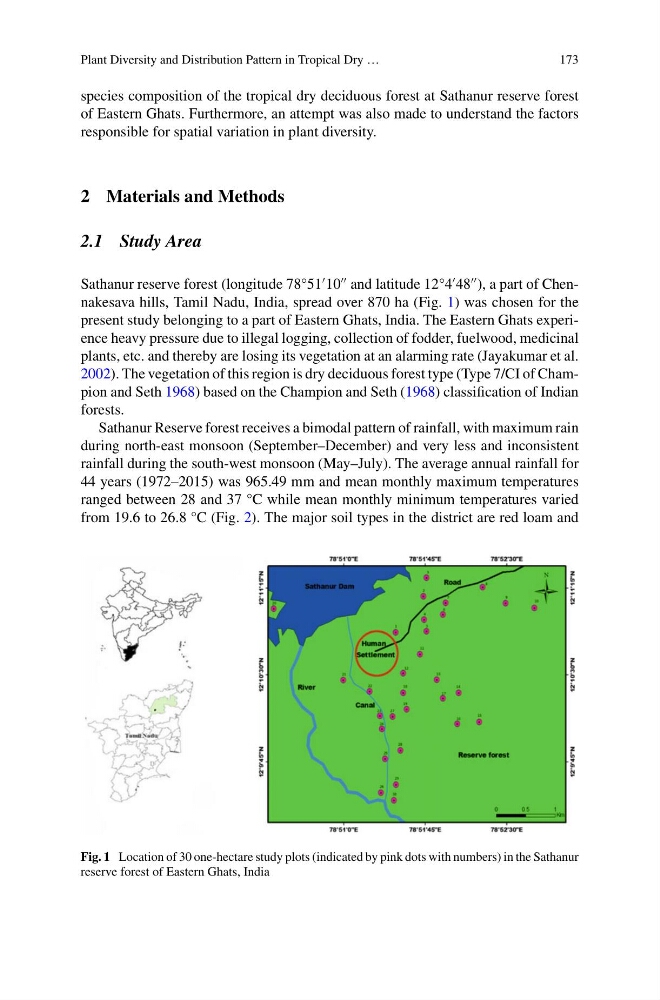
), a part of Chennakesava hills, Tamil Nadu, India, spread over 870 ha (Fig. 1) was chosen for the
present study belonging to a part of Eastern Ghats, India. The Eastern Ghats experience heavy pressure due to illegal logging, collection of fodder, fuelwood, medicinal
plants, etc. and thereby are losing its vegetation at an alarming rate (Jayakumar et al.
2002). The vegetation of this region is dry deciduous forest type (Type 7/CI of Champion and Seth 1968) based on the Champion and Seth (1968) classification of Indian
forests.
Sathanur Reserve forest receives a bimodal pattern of rainfall, with maximum rain
during north-east monsoon (September–December) and very less and inconsistent
rainfall during the south-west monsoon (May–July). The average annual rainfall for
44 years (1972–2015) was 965.49 mm and mean monthly maximum temperatures
ranged between 28 and 37 °C while mean monthly minimum temperatures varied
from 19.6 to 26.8 °C (Fig. 2). The major soil types in the district are red loam and
Fig. 1 Location of 30 one-hectare study plots (indicated by pink dots with numbers) in the Sathanur
reserve forest of Eastern Ghats, India
173
species composition of the tropical dry deciduous forest at Sathanur reserve forest
of Eastern Ghats. Furthermore, an attempt was also made to understand the factors
responsible for spatial variation in plant diversity.
2 Materials and Methods
2.1 Study Area
Sathanur reserve forest (longitude 78°51
10
and latitude 12°4
48
), a part of Chennakesava hills, Tamil Nadu, India, spread over 870 ha (Fig. 1) was chosen for the
present study belonging to a part of Eastern Ghats, India. The Eastern Ghats experience heavy pressure due to illegal logging, collection of fodder, fuelwood, medicinal
plants, etc. and thereby are losing its vegetation at an alarming rate (Jayakumar et al.
2002). The vegetation of this region is dry deciduous forest type (Type 7/CI of Champion and Seth 1968) based on the Champion and Seth (1968) classification of Indian
forests.
Sathanur Reserve forest receives a bimodal pattern of rainfall, with maximum rain
during north-east monsoon (September–December) and very less and inconsistent
rainfall during the south-west monsoon (May–July). The average annual rainfall for
44 years (1972–2015) was 965.49 mm and mean monthly maximum temperatures
ranged between 28 and 37 °C while mean monthly minimum temperatures varied
from 19.6 to 26.8 °C (Fig. 2). The major soil types in the district are red loam and
Fig. 1 Location of 30 one-hectare study plots (indicated by pink dots with numbers) in the Sathanur
reserve forest of Eastern Ghats, India