

Medicinal Plant Biodiversity in India: Harnessing Opportunities …
165
Analysis of both the communities reveals the following:
1. Bhotiya community of central Himalaya region domesticated some species of
medicinal plants and Soligas dependency on forest produce including medicinal
plants is significantly high.
2. Both the communities depend on medicinal plants for curing ailments as well as
income generation which inevitably contributes to their access to food.
3. Many factors which are similar to other parts of the world such as urbanisation,
encroachment, destructive harvesting and lack awareness are threatening the cultivation and conservation of medicinal plants in Himalayan as well as at BRTTR
region.
4. Primarily both the communities rely on medicinal plants as subsidiary occupation.
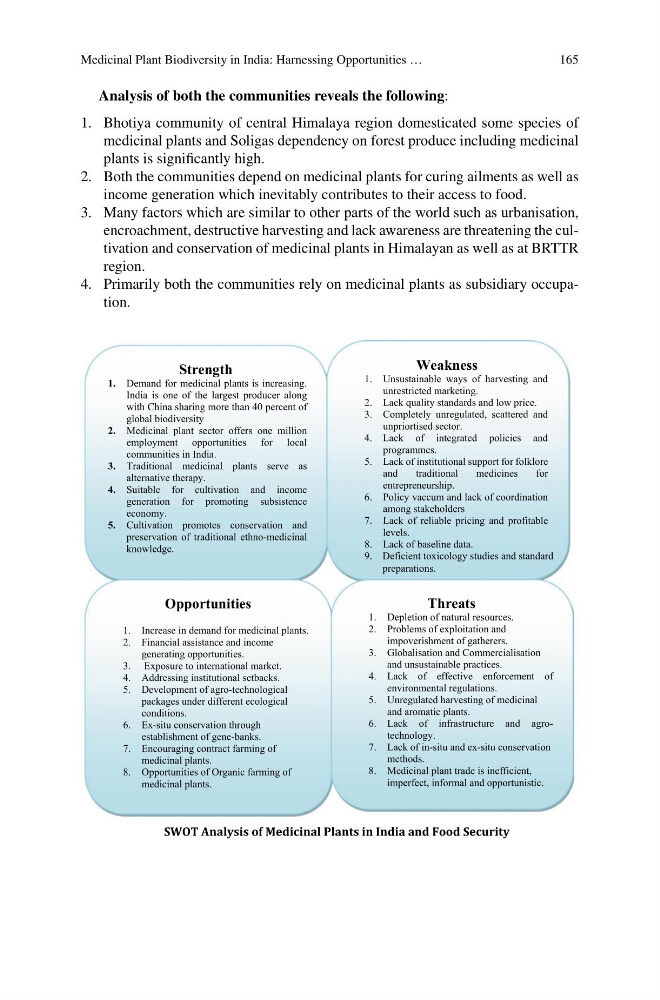
SWOT Analysis of Medicinal Plants in India and Food Security
Strength
1. Demand for medicinal plants is increasing.
India is one of the largest producer along
with China sharing more than 40 percent of
global biodiversity
2. Medicinal plant sector offers one million
employment opportunities for local
communities in India.
3. Traditional medicinal plants serve as
alternative therapy.
4. Suitable for cultivation and income
generation for promoting subsistence
economy.
5. Cultivation promotes conservation and
preservation of traditional ethno-medicinal
knowledge.
Weakness
1. Unsustainable ways of harvesting and
unrestricted marketing.
2. Lack quality standards and low price.
3. Completely unregulated, scattered and
unpriortised sector.
4. Lack of integrated policies and
programmes.
5. Lack of institutional support for folklore
and
traditional
medicines
for
entrepreneurship.
6. Policy vaccum and lack of coordination
among stakeholders
7. Lack of reliable pricing and profitable
levels.
8. Lack of baseline data.
9. Deficient toxicology studies and standard
preparations.
Opportunities
1. Increase in demand for medicinal plants.
2. Financial assistance and income
generating opportunities.
3. Exposure to international market.
4. Addressing institutional setbacks.
5. Development of agro-technological
packages under different ecological
conditions.
6. Ex-situ conservation through
establishment of gene-banks.
7. Encouraging contract farming of
medicinal plants.
8. Opportunities of Organic farming of
medicinal plants.
Threats
1. Depletion of natural resources.
2. Problems of exploitation and
impoverishment of gatherers.
3. Globalisation and Commercialisation
and unsustainable practices.
4. Lack of effective enforcement of
environmental regulations.
5. Unregulated harvesting of medicinal
and aromatic plants.
6. Lack of infrastructure and agrotechnology.
7. Lack of in-situ and ex-situ conservation
methods.
8. Medicinal plant trade is inefficient,
imperfect, informal and opportunistic.
165
Analysis of both the communities reveals the following:
1. Bhotiya community of central Himalaya region domesticated some species of
medicinal plants and Soligas dependency on forest produce including medicinal
plants is significantly high.
2. Both the communities depend on medicinal plants for curing ailments as well as
income generation which inevitably contributes to their access to food.
3. Many factors which are similar to other parts of the world such as urbanisation,
encroachment, destructive harvesting and lack awareness are threatening the cultivation and conservation of medicinal plants in Himalayan as well as at BRTTR
region.
4. Primarily both the communities rely on medicinal plants as subsidiary occupation.
SWOT Analysis of Medicinal Plants in India and Food Security
Strength
1. Demand for medicinal plants is increasing.
India is one of the largest producer along
with China sharing more than 40 percent of
global biodiversity
2. Medicinal plant sector offers one million
employment opportunities for local
communities in India.
3. Traditional medicinal plants serve as
alternative therapy.
4. Suitable for cultivation and income
generation for promoting subsistence
economy.
5. Cultivation promotes conservation and
preservation of traditional ethno-medicinal
knowledge.
Weakness
1. Unsustainable ways of harvesting and
unrestricted marketing.
2. Lack quality standards and low price.
3. Completely unregulated, scattered and
unpriortised sector.
4. Lack of integrated policies and
programmes.
5. Lack of institutional support for folklore
and
traditional
medicines
for
entrepreneurship.
6. Policy vaccum and lack of coordination
among stakeholders
7. Lack of reliable pricing and profitable
levels.
8. Lack of baseline data.
9. Deficient toxicology studies and standard
preparations.
Opportunities
1. Increase in demand for medicinal plants.
2. Financial assistance and income
generating opportunities.
3. Exposure to international market.
4. Addressing institutional setbacks.
5. Development of agro-technological
packages under different ecological
conditions.
6. Ex-situ conservation through
establishment of gene-banks.
7. Encouraging contract farming of
medicinal plants.
8. Opportunities of Organic farming of
medicinal plants.
Threats
1. Depletion of natural resources.
2. Problems of exploitation and
impoverishment of gatherers.
3. Globalisation and Commercialisation
and unsustainable practices.
4. Lack of effective enforcement of
environmental regulations.
5. Unregulated harvesting of medicinal
and aromatic plants.
6. Lack of infrastructure and agrotechnology.
7. Lack of in-situ and ex-situ conservation
methods.
8. Medicinal plant trade is inefficient,
imperfect, informal and opportunistic.