

Medicinal Plant Biodiversity in India: Harnessing Opportunities …
157
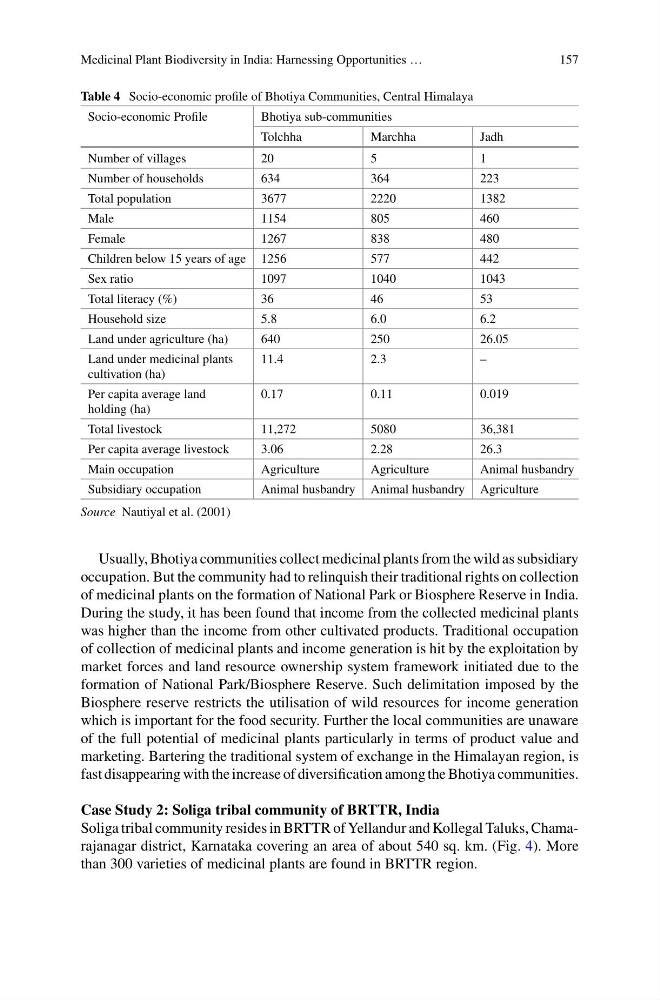
Table 4 Socio-economic profile of Bhotiya Communities, Central Himalaya
Socio-economic Profile
Bhotiya sub-communities
Tolchha
Marchha
Jadh
Number of villages
20
5
1
Number of households
634
364
223
Total population
3677
2220
1382
Male
1154
805
460
Female
1267
838
480
Children below 15 years of age 1256
577
442
Sex ratio
1097
1040
1043
Total literacy (%)
36
46
53
Household size
5.8
6.0
6.2
Land under agriculture (ha)
640
250
26.05
Land under medicinal plants
cultivation (ha)
11.4
2.3
–
Per capita average land
holding (ha)
0.17
0.11
0.019
Total livestock
11,272
5080
36,381
Per capita average livestock
3.06
2.28
26.3
Main occupation
Agriculture
Agriculture
Animal husbandry
Subsidiary occupation
Animal husbandry Animal husbandry Agriculture
Source Nautiyal et al. (2001)
Usually, Bhotiya communities collect medicinal plants from the wild as subsidiary
occupation. But the community had to relinquish their traditional rights on collection
of medicinal plants on the formation of National Park or Biosphere Reserve in India.
During the study, it has been found that income from the collected medicinal plants
was higher than the income from other cultivated products. Traditional occupation
of collection of medicinal plants and income generation is hit by the exploitation by
market forces and land resource ownership system framework initiated due to the
formation of National Park/Biosphere Reserve. Such delimitation imposed by the
Biosphere reserve restricts the utilisation of wild resources for income generation
which is important for the food security. Further the local communities are unaware
of the full potential of medicinal plants particularly in terms of product value and
marketing. Bartering the traditional system of exchange in the Himalayan region, is
fast disappearing with the increase of diversification among the Bhotiya communities.
Case Study 2: Soliga tribal community of BRTTR, India
Soliga tribal community resides in BRTTR of Yellandur and Kollegal Taluks, Chamarajanagar district, Karnataka covering an area of about 540 sq. km. (Fig. 4). More
than 300 varieties of medicinal plants are found in BRTTR region.
157
Table 4 Socio-economic profile of Bhotiya Communities, Central Himalaya
Socio-economic Profile
Bhotiya sub-communities
Tolchha
Marchha
Jadh
Number of villages
20
5
1
Number of households
634
364
223
Total population
3677
2220
1382
Male
1154
805
460
Female
1267
838
480
Children below 15 years of age 1256
577
442
Sex ratio
1097
1040
1043
Total literacy (%)
36
46
53
Household size
5.8
6.0
6.2
Land under agriculture (ha)
640
250
26.05
Land under medicinal plants
cultivation (ha)
11.4
2.3
–
Per capita average land
holding (ha)
0.17
0.11
0.019
Total livestock
11,272
5080
36,381
Per capita average livestock
3.06
2.28
26.3
Main occupation
Agriculture
Agriculture
Animal husbandry
Subsidiary occupation
Animal husbandry Animal husbandry Agriculture
Source Nautiyal et al. (2001)
Usually, Bhotiya communities collect medicinal plants from the wild as subsidiary
occupation. But the community had to relinquish their traditional rights on collection
of medicinal plants on the formation of National Park or Biosphere Reserve in India.
During the study, it has been found that income from the collected medicinal plants
was higher than the income from other cultivated products. Traditional occupation
of collection of medicinal plants and income generation is hit by the exploitation by
market forces and land resource ownership system framework initiated due to the
formation of National Park/Biosphere Reserve. Such delimitation imposed by the
Biosphere reserve restricts the utilisation of wild resources for income generation
which is important for the food security. Further the local communities are unaware
of the full potential of medicinal plants particularly in terms of product value and
marketing. Bartering the traditional system of exchange in the Himalayan region, is
fast disappearing with the increase of diversification among the Bhotiya communities.
Case Study 2: Soliga tribal community of BRTTR, India
Soliga tribal community resides in BRTTR of Yellandur and Kollegal Taluks, Chamarajanagar district, Karnataka covering an area of about 540 sq. km. (Fig. 4). More
than 300 varieties of medicinal plants are found in BRTTR region.